Scottish music a different way: The Unusual Suspects
The Old Fruitmarket in Glasgow offers both welcome and whimsy, and a sense of connection with history, as well. The arc of the Victorian ceiling and the ironmongery and grocer’s signs from the days when the building was the city’s produce market remain, in what is now a venue whose atmosphere is infused with music.
History, whimsy, and welcome were all fully present one January night during Celtic Connections as a packed out standing room only crowd joined the Unusual Suspects to mark the completion of their album Big Like This.
Pipes and more pipes, whistles, fiddles and more fiddles, accordion, trumpet, flugelhorn, drums, percussion, piano, bass, flute, trombone, guitar, saxophone, harp, and voice: these were the instruments the Suspects brought to make their sound that night, and what a sound it was indeed. Completely contemporary, completely traditional, altogether Scottish, and completely engaging, as many of the best musicians in Scotland joined up to show just why they are the best musicians in Scotland, each giving their unique gifts, and in complete service to the music.
That music included a high energy blast of a set which paired Gordon Duncan’s Pressed for Time with John Morris Rankin’s Hull’s Reel and from the tradition, Saint Kilda’s Wedding. Also from the tradition and fully respecting that, but very likely not sounding like any way you have heard it done before, was Fair Floo’ers, with Corrina Hewat taking lead vocal, backed with harmonies from Ewan Robertson and Calum MacCrimmon.
The heart of this band is collaboration among the gifted musicians, and the creative vision they all share with Corrina Hewat and Dave Milligan. Hewat and Milligan had the idea for a folk orchestra, folk big band, a dozen or so years ago. As the years unfolded they worked on the thought, and were offered a slot at the Celtic Connections Festival in 2003. A recording followed, but even with festival commissions and invitations from the likes of Celtic Colours on Cape Breton and L’Orient Celtique in France, it has proved challenging to work with a twenty two piece band, each of whose members has other commitments and careers and who live and travel to all sorts of different places.
They do it, though. “This is a passion David and I have, to work on this band,” Hewat says. The couple, who are married, each have their own full slate of musical commitments beyond the Suspects too, but it an idea and a passion they continue to build upon. That passion, from Milligan and Hewat and all the musicians on stage, was evident that evening at the Old Fruitmarket, and it radiated into joy shared with those who came to listen, who gave it back to the band in full measure. The music is rather complex stuff, actually, containing elements from jazz and folk, and varied Scottish traditions from alla cross the land. No worries, the audience was with the artists every step of the way, and wanting more, as they played a set of tunes comprising Grappa Groove from Eilidh Shaw, who was one of the fiddlers on the night, Not Only But Oslo by Milligan, and Elmo Lives Downstairs, which was written by Hewat.
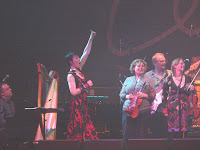 In addition to Fair Floo’ers there were other songs on the program, including May Thy Morn from the pen of Scottish national bard Robert Burns and Both Sides of the Tweed, written by Dick Gaughan. There were tunes from fiddler Anna Massie, who was also in the band on the night, and Calum MacCrimmon, who was playing pipes and whistles with the band. Catriona Macdonald, Patsy Reid, Mairearad Green, Ewan Robertson, and Colin Steele were among the other players on stage to contribute to the powerful closing, a five set work composed by Hewatt and Milligan called the L'Orient Suite, which allowed every part of the Suspects full measure of participation.
One of the things the Unusual Suspects were doing that evening was celebrating the completion of their album called Big Like This. That album is out now, and one of the best ways to describe the music on it is through a remark Corrina Hewat made when speaking of her own composing style and understanding of music: “You know, I think jazz is really folk music too. I don’t see it as merging folk and jazz, I actually think it’s just one big music. I don’t distinguish between them,” she said. The musicians’ joy in exploring that idea nd meeting the challenges that go along with that comes across as clearly on the recording as it did on that Glasgow night. Take a listen -- take several. You will be well rewarded.
photographs were taken with permission of the artists and are copyrighted. thank you for respecting this
.
Quite a few of the musicians you’ve met here along the music road, in addition to those mentioned above, have taken part in the band over time
visit the Unusual Suspects web site to see a list
you may also wish to see
Bahrain and Scotland: a musical connection
Music Road: Scotland on the harp: Corrina Hewat
Music Road: Music for St Andrew's Day: music of Scotland
History, whimsy, and welcome were all fully present one January night during Celtic Connections as a packed out standing room only crowd joined the Unusual Suspects to mark the completion of their album Big Like This.
Pipes and more pipes, whistles, fiddles and more fiddles, accordion, trumpet, flugelhorn, drums, percussion, piano, bass, flute, trombone, guitar, saxophone, harp, and voice: these were the instruments the Suspects brought to make their sound that night, and what a sound it was indeed. Completely contemporary, completely traditional, altogether Scottish, and completely engaging, as many of the best musicians in Scotland joined up to show just why they are the best musicians in Scotland, each giving their unique gifts, and in complete service to the music.

That music included a high energy blast of a set which paired Gordon Duncan’s Pressed for Time with John Morris Rankin’s Hull’s Reel and from the tradition, Saint Kilda’s Wedding. Also from the tradition and fully respecting that, but very likely not sounding like any way you have heard it done before, was Fair Floo’ers, with Corrina Hewat taking lead vocal, backed with harmonies from Ewan Robertson and Calum MacCrimmon.
The heart of this band is collaboration among the gifted musicians, and the creative vision they all share with Corrina Hewat and Dave Milligan. Hewat and Milligan had the idea for a folk orchestra, folk big band, a dozen or so years ago. As the years unfolded they worked on the thought, and were offered a slot at the Celtic Connections Festival in 2003. A recording followed, but even with festival commissions and invitations from the likes of Celtic Colours on Cape Breton and L’Orient Celtique in France, it has proved challenging to work with a twenty two piece band, each of whose members has other commitments and careers and who live and travel to all sorts of different places.
They do it, though. “This is a passion David and I have, to work on this band,” Hewat says. The couple, who are married, each have their own full slate of musical commitments beyond the Suspects too, but it an idea and a passion they continue to build upon. That passion, from Milligan and Hewat and all the musicians on stage, was evident that evening at the Old Fruitmarket, and it radiated into joy shared with those who came to listen, who gave it back to the band in full measure. The music is rather complex stuff, actually, containing elements from jazz and folk, and varied Scottish traditions from alla cross the land. No worries, the audience was with the artists every step of the way, and wanting more, as they played a set of tunes comprising Grappa Groove from Eilidh Shaw, who was one of the fiddlers on the night, Not Only But Oslo by Milligan, and Elmo Lives Downstairs, which was written by Hewat.
 In addition to Fair Floo’ers there were other songs on the program, including May Thy Morn from the pen of Scottish national bard Robert Burns and Both Sides of the Tweed, written by Dick Gaughan. There were tunes from fiddler Anna Massie, who was also in the band on the night, and Calum MacCrimmon, who was playing pipes and whistles with the band. Catriona Macdonald, Patsy Reid, Mairearad Green, Ewan Robertson, and Colin Steele were among the other players on stage to contribute to the powerful closing, a five set work composed by Hewatt and Milligan called the L'Orient Suite, which allowed every part of the Suspects full measure of participation.
One of the things the Unusual Suspects were doing that evening was celebrating the completion of their album called Big Like This. That album is out now, and one of the best ways to describe the music on it is through a remark Corrina Hewat made when speaking of her own composing style and understanding of music: “You know, I think jazz is really folk music too. I don’t see
 it as merging folk and jazz, I actually think it’s just one big music. I don’t distinguish between them,” she said. The musicians’ joy in exploring that idea nd meeting the challenges that go along with that comes across as clearly on the recording as it did on that Glasgow night. Take a listen -- take several. You will be well rewarded.
photographs were taken with permission of the artists and are copyrighted. thank you for respecting this
.
Quite a few of the musicians you’ve met here along the music road, in addition to those mentioned above, have taken part in the band over time
visit the Unusual Suspects web site to see a list
you may also wish to see
Bahrain and Scotland: a musical connection
Music Road: Scotland on the harp: Corrina Hewat
Music Road: Music for St Andrew's Day: music of Scotland
-->Your support for Music Road is welcome and needed. If you are able to chip in, here is a way to do that, through PayPal. Note that you do not have to have a PayPal account to do this. Thank you.
Labels: blogsherpa, celtic connections 2011, composer, corrina hewat, glasgow, scotland, Scottish music, unusual suspects band


 she offers tunes that are at once melodic and percussive, and, if you need categories, would fit into both jazz and folk. “You know, I think the jazz thing is really folk music too. I don’t see them as merging folk and jazz, I actually think it’s just one big music. I don’t distinguish between them,” she says.


