Tuesday, January 14, 2020

Celtic Connections 2020: 5 highlights for the first days of the festival

Winter is often a time for gathering in, for sharing stories. Winter in Scotland especially invites this, which is one of the reasons for the continuing success of Celtic Connections, which takes place for eighteen days beginning in mid January in Glasgow.

Collaboration, both planned and spontaneous, is also a hallmark of Celtic Connections. This year, the festival runs from 16 January through 2 February. There will be concerts, workshops, talks, walks, and even a mini festival within a festival in venues across Glasgow. Here is bit about what’s planned for the early days of the festival.

Grit Orchestra, an 80-piece ensemble of folk, jazz and classical musician originally founded to perform and celebrate the late Martyn Bennett’s musicUnder the baton of founding conductor Greg Lawson, the orchestra will première pieces by multi-instrumentalist Fraser Fifield, saxophonist Paul Towndrow, fiddlers Chris Stout and Patsy Reid, harpist Catriona McKay and cellist Rudi de Groot. The pieces will draw from each composer’s reflections on the Declaration of Arbroath. Scotland will mark the 700th anniversary of this document of freedom in April.

Another highlight will see the band Breabach marking its 15th anniversary, a journey which saw them winning an award for up and coming musicians at Celtic Connections in 2005 and this year finds the five musicians, known as one of Scotland’s most innovative groups, headlining the main stage at the Royal Concert Hall. Special guests including former band members will join Breabach and The Seamus Egan Project will debut their new album in support on the night, too.

The first Saturday of the Festival will see a mini festival celebrating Scotland’s Year of Coasts and Waters, with talks, plays, and music, all with connections to Scotland’s waters, coasts, and islands. Musicians will include Gillian Frame, Fara, Daimh, Julie Fowlis, Capercaillie, and others.

Julie Fowlis will appear later that evening too, when she joins Eamon Doorley, Zoe Conway, and John McIntyre for a rare performance of their stellar collaborative project, Allt, in which the four explore connection of Scottish Gaelic and Irish language music.

On another evening, Hamish Napier will introduce his nature focused project The Woods, and Sarah-Jane Summers will offer music from her album Owerset, which comprises music she’s composed inspired by connections between words in Scots and words in Old Norse.

That’s a taste of a few highlights of what’s on the schedule just in the first few days of this year’s Celtic Connections Festival. More to come...

You may also wish to see
Celtic Connections Festival website
What’s ahead in Scotland’s Year of Coasts and Waters, at Perceptive Travel
More about the album Allt
Hamish Napier’s project The Railway
Frenzy of the Meeting from Breabach

-->Your support for Music Road is welcome and needed. If you are able to chip in, here is a way to do that, through PayPal. Note that you do not have to have a PayPal account to do this. Thank you.

Another way to support: you could Buy Me a Coffee at ko-fi.com

Labels: , , , , , , , , , ,

Bookmark and Share
posted by Kerry Dexter at 0 Comments

Saturday, October 13, 2018

Scotland's Music: Sarah-Jane Summers: Solo

Image, emotion, connection, story: these elements are parts of what makes music, and what connects musician and listener. At times musicians use words. At other times sound of the instrument holds the stories and ideas.

So it is with the recording Solo, from Sara-Jane Summers. In it, Summers and her fiddles stand alone, and yet they are not alone, as they hold dear and convey a wealth of stories.

Often Summers shares her gifts of playing and composition in collaboration. The Nu Nordic band Fribo, the chamber folk ensemble RANT, the contemporary string quartet Quatuor Bozzini, the Celtic fusion Grit Orchestra, top Gaelic singer Julie Fowlis, are some of those with whom she has worked. There are also the albums Summers has made with her husband, Finnish guitarist Juhani Silvola, which have won wide acclaim.

For her album Solo, however, Summers wanted to create what the title suggests: just the woman and her fiddle. She recorded it in a church near her adopted home in Norway. Summers, who comes from the Highlands of Scotland, has long been drawn to and has studied music of the Nordic lands. Elements of that infuse her work. Her heart, though, is in the Highlands, and it is to that music she looked first when choosing what to include her solo project.

There are slow airs, and there's a snap of strathspey. There's a nod to the Nordic lands on one tune, and one original composition which stands well alongside material from the tradition. What comes clear is the sound of Scotland. Though it is not spoken, what comes clear is the cadence of Gaelic. In the faster paced tunes such as the set including three traditional strathspeys, one can hear the cadence of the dance, as well.

For the most part, the music Summers has chosen here tends toward the side of reflection. That's not to say it's quiet, always, though that's included. What stands out is, rather, the quiet intensity and the deep connection among musician, instrument, and the music she's chosen.

It is a recording well worth your time for repeated listening in order as Summers has set it out. If you've only time for a taster to begin, though, the opening track, Lath' a' suibhal Sleibhe Dhomh/ On a day as I traversed the mountain makes a fine place to start. Riddell's Lament for King George V, that set of strathspeys which begins with the tune Are You Always Pleased, and Morning Prayer, a tune written by Summers herself, combine to make a good introduction to the whole. You will want to listen to all of them, though, and to read the sleeve notes in which Summers gives a bit of history and context to each the tunes.

Some of the tunes Summers has chosen from her own research; some are ones she's known most of her life; in several she makes tribute to her teacher the late great Donald Riddell, and to his teacher, Alexander Grant of Battangorm/ Sandy Battan, who was a relative of Summers. "Donald was very excited to give the gift of the tradition back to my family and this circle has always meant the world to me," Summers says.

A gifted and creative tutor herself (she has. among other things made an instructional dvd focused on the strathspey), Summers keeps the giving of gifts going with that work, with her collaborative projects, and especially, with this recording, Solo.

You may also wish to see
Scotland's Music: Julie Fowlis: Alterum
website of Sarah-Jane Summers
Celtic Music and Nordic Music Meet: Fribo

Photograph of Sarah-Jane Summers by Johannes Selvaag.

If you'd like to support my creative work at Music Road,
here is a way to do that, through PayPal. Note that you do not have to have a PayPal account to do this. Thank you.

Labels: , , , ,

Bookmark and Share
posted by Kerry Dexter at 0 Comments

Wednesday, May 09, 2018

Folk with Edge: Sarah-Jane Summers Virr and Moira Smiley Unzip the Horizon

Music, through listening, through creating, through playing, encompasses the new as well as the familiar.

There’s always more to explore, whichever path in music you follow. Two artists who know this well are fiddle and viola player Sarah-Jane Summers and singer Moira Smiley. They are both grounded in folk tradition and both have classical music experience and have worked in other genres of music as well. For recent releases, each has chosen to bring innovation to the fore.

Sarah-Jane Summers has chosen to call her album Virr. That is a word in Scots which can mean energy, gusto, or force. It can mean the sound made by an object in swift motion, a whirr, and it may also described force itself. Any of those terms work as a description of the music Summers creates for the twelve tracks on the album, too.

If you know Summers’s other work, Virr is maybe not quite what you would expect -- and yet it is, too. She has always been fascinated by sound, language, and landscape, and looked for ways to express these on her instruments (she plays fiddle, viola, and Hardanger fiddle). A native of the Highlands of Scotland, she’s also long been interested in the connections between the musics of Scotland and those of the Nordic lands. As a Scot now living in Norway, “it makes sense that Scots words which are etymologically Norse should be of particular interest,” she says.

One day, her husband and fellow musician Juhani Silvola suggested “Shall we go into the studio and record something?” Summers took him up on the suggestion, found her viola sitting in the studio, picked it up and began to improvise.

That interest Scots and Norse words, the unexpected opportunity to sit in the studio and improvise now and then across several weeks’ time, and her own observations of weather, language, and sound and the possibilities of her instruments come together on the twelve tracks on Virr.

Each is named for a Scots weather-related word having its origins in old Norse. A few are gently melodic. Some are harsh, as weather sometimes is -- emotions too, Summers notes. Several take journeys among and through these variations and back again. Though it is only Summers and her fiddle in play, the sounds she evokes at times remind of the crash of an orchestra in full flight. At others they suggest the rough haunting presence evoked by singers of sean nos. Tirl, Aitran, Katrisper, Aftrak, Rissen, Unbrak -- you can begin to hear a suggestion of the music in the words Summers has chosen as titles.

Creative, intriguing, thought provoking -- an adventure in the listening, and it would seem, in the creating as well. Summers has a suggestion: “I would be delighted if you would sit with a coffee, a cup of tea, a glass of red or whatever your thing is and have a wee listen and also ponder the power of the weather,” she says.

Moira Smiley is one for taking her listeners on not-quite-what-is-expected adventures, too. Her most recent recording is called Unzip the Horizon. Smiley’s primary instrument is her voice. She’s helmed vocal ensembles, composed classical music, been featured with the top Irish American group Solas, and currently, among other projects, tours with Jayme Stone’s Folklife. An encounter in Ukraine and time spent in the refugee camps at Calais were two things that became catalysts for Unzip the Horizon. Those other musical experiences come along on this project, as well.

Smiley’s voice and her songwriting -- twelve of the fourteen tracks are originals, two are reinvented songs from American folk tradition-- provide a connection through songs that are always questioning, sometimes dissonant, sometimes tender. As is true with Sarah-Jane Summers’s album Virr, there’s a lot going on and a lot to think about in the range of ideas Smiley offers.

Among other things, in addition to singing she plays half a dozen or so instruments. Many fellow musicians come and go on the tracks, among them a number whose work you have met here along the music road before -- Krista Detor, David Weber, Seamus Egan, Chloe and Leah Smith of Rising Appalachia, Darrell Scott, and Jayme Stone.

In Ukraine, Smiley had the chance to speak with an elder musician. The woman spoke of the power of voices to connect past and present, and to change the future. Those ideas, and her experience volunteering in the camps at Calais where she found music touching lives of people who had exactly nothing else, helped set Smiley on a path to exploring her voice and her songwriting in new ways.

“The voice can be a scary, tender instrument, not just sweet and pretty,” Smiley reflects. “I’ve long embraced that when singing certain traditional folk songs, but I longed to pull it into my own songwriting.”

So she has. There’s the spooky and enigmatic Appalachian style song Dressed in Yellow, hints of jazz, classical, and rock influences in various songs, lyrics with questions more than answers, and sound which includes all sorts of harmonies along with sighs, crackles, claps, stamping feet... it is a journey in both sound and idea. Bellow includes African, African American, and gospel sounds while celebrating the voice -- the joining of voices -- and urging connection. Smiley includes part of the lyrics in her sleeve notes:

Please don’t give up. Please don’t lose that sound
So many people fought to gain that ground
Please don’t give up. Please don’t hide your voice
So many people did not have that choice
Sometime -- anytime -- you want to bellow, call on me
We’ll unzip the horizon with our voices

Though pain, confusion, anger, and searching are all present, so too are joy and hope, in Bellow and in other songs. Almost quietly Smiley sings the last words of Sing It Out: “Though we might fear and we might doubt/We must remember joy and sing it out.”

That, really, makes a throughline of what both Sarah-Jane Summers and Moira Smiley celebrate on these recordings: the joy of creativity, the joy of exploration, the joy of connection -- and in some cases, the joy of surprises. Not always what you’re used to hearing, maybe not always easy to hear at first, but well worth the patience and the effort to listen, to explore, and to come to share that exploration as you do.

Photograph of Sarah-Jane Summers by Kerry Dexter; photograph of Moira Smiley by Alexandra DeFurio

You may also wish to see
Sarah-Jane Summers has another recent recording, Solo, about which there will be more here on Music Road coming up shortly
Excellent duo album from Sarah-Jane Summers & Juhani Silvola Widdershins
Sarah-Jane Summers talks about the Highlands of Scotland, at Wandering Educators
Jayme Stone’s Folklife, on which Moira Smiley appears
Carrie Newcomer’s Live at the Buskirk-Chumley, on which Moira Smiley sings harmonies
Moira Smiley’s song Refugee is part of this story at Wandering Educators about music and the geography of hope
Another sort of experiment in music: Kathy Mattea: Calling Me Home

If you'd like to support my creative work at Music Road,
here is a way to do that, through PayPal. Note that you do not have to have a PayPal account to do this. Thank you.

Labels: , , , , , , , , , ,

Bookmark and Share
posted by Kerry Dexter at 0 Comments

Saturday, December 07, 2013

Advent reflections and music

The second week in Advent is a time for settling in, for reflection, for learning and remembering . Used to be, when I was growing up, the readings for the second Sunday in Advent had to do with reading the Scriptures, considering them, reflecting, taking in the meanings they may have.

Along the way, and especially through walking this music road, I have learned that God speaks through other things -- through anything we will allow. A fall of light, a line in a play -- or a poem, the work of an actor in a television show, the quiet voice of rain, a story from the past, the color of a turning leaf, the fall of snow, the words of a friend or a stranger -- the words of a song, the notes of a tune...

Music to go along with these ideas Al Petteway and Amy White share the reflective spirit of the mountain in winter with harp, guitar, bouzouki, dulcimer, and voice on original and traditional pieces including Gabriel’s Message, People Look East, Into the Light, and Breaking Up Christmas on their album Winter Tidings: An Appalachian Christmas

Karen Mal and Will Taylor join up on mandolin and guitar for classy and thoughtful interpretations of The Coventry Carol, The Frist Noel, and other seasonal classics A Mandolin Christmas

If music to do with Christmas is not your interest at present, I think you will still enjoy theses recordings. For another choice, though, you may want to listen to Mala Fama in which fiddle player Sarah-Jane Summers, guitarist Juhani Silvola, and bassist Morten Kvam offer music with flavors Summers’ native Highlands of Scotland landscapes, as well as ideas of travel, laughter, and reflection.

photographs are by Kerry Dexter and are copyrighted. thank you for respecting this

You may also wish to see
first week in Advent: candle in the window
Cherish the Ladies: storytellers in music
Perceptive Travel: wreaths, music, legend

-->Your support for Music Road is welcome and needed. If you are able to chip in, here is a way to do that, through PayPal. Note that you do not have to have a PayPal account to do this. Thank you.

Labels: , , , , , , , , ,

Bookmark and Share
posted by Kerry Dexter at 2 Comments

Saturday, September 08, 2012

September music


September: northern or southern hemisphere, it is a time of transition, from late in one season to the start of another. Here in the northern part of the globe, there’s a hint of autumn's crispness in the air now and then, but summer’s heat is still around now and again too. Light still lingers long most evenings and late summer rains splash the afternoons. The angle of light is changing, , though and its color is tending toward autumn’s clarity, tracing outlines on the leaves of trees and bushes as children make their way home from school in the late afternoon.

autumn leaves north florida copyright kerry dexter

It is a time for looking forward, looking back, gathering strands of thought together, planning -- and letting go. Music, as ever, is a good companion for such things.


Coty Hogue was born in Montana, earned a master’s degree in Appalachian studies in North Carolina, and calls the Pacific northwest home. All these things come through in her albumWhen We Get to Shore, which was recorded live at Empty Sea Studios in Seattle. Hogue offers a well thought out set with songs from Sarah Fulford (the opening tack, Jonah) and music from Hogue’s own pen (Fire and Ashes) as well as songs from Bruce Springsteen, Hazel Dickens, and Bill Monroe. There are songs from the American folk tradition in the mix as well. Hogue has a clear voice and a respect for the story and character of each song which well serves the musical tales she tells.
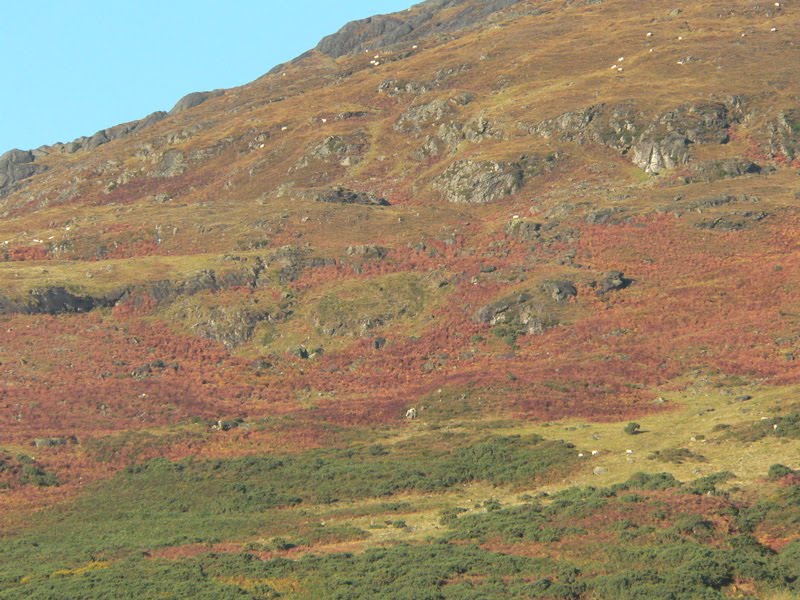
hillside ireland copyright kerry dexter
On the other side of the Atlantic, Sarah- Jane Summers draws inspiration for her tunes -- she’s a fiddle player -- from generations of her family background in the Highlands of Scotland, and from Scotland’s connections with Nordic music across other seas as well. There are tunes from tradition as well as music from contemporary composers including Charlie McKerron and Jenna Reid. There are fine tunes from Summers herself as well on the album Nesta.


Change is very present in Carrie Newcomer’s album Everything Is Everywhere. Newcomer is from Indiana and often draws on her native midwest for musical inspiration. That is true on Everything Is Everywhere as well, and in this case it is mixed with ideas and impressions Newcomer gained while doing a musical residency in India.

As the season changes, each of these three quite different albums will make good companions for your thoughts.

you may also wish to see
Music, harvest, and time
season of change: music for autumn 2008
Some Bright Morning from Rani Arbo & daisy mayhem

photographs. of autumn leaves in the US south and a hillside in Ireland, are by Kerry Dexter, and are copyrighted. thank you for respecting this.

-->Your support for Music Road is welcome and needed. If you are able to chip in, here is a way to do that, through PayPal. Note that you do not have to have a PayPal account to do this. Thank you.

Labels: , , , , , , , , ,

Bookmark and Share
posted by Kerry Dexter at 0 Comments