Wednesday, May 09, 2018

Folk with Edge: Sarah-Jane Summers Virr and Moira Smiley Unzip the Horizon

Music, through listening, through creating, through playing, encompasses the new as well as the familiar.

There’s always more to explore, whichever path in music you follow. Two artists who know this well are fiddle and viola player Sarah-Jane Summers and singer Moira Smiley. They are both grounded in folk tradition and both have classical music experience and have worked in other genres of music as well. For recent releases, each has chosen to bring innovation to the fore.

Sarah-Jane Summers has chosen to call her album Virr. That is a word in Scots which can mean energy, gusto, or force. It can mean the sound made by an object in swift motion, a whirr, and it may also described force itself. Any of those terms work as a description of the music Summers creates for the twelve tracks on the album, too.

If you know Summers’s other work, Virr is maybe not quite what you would expect -- and yet it is, too. She has always been fascinated by sound, language, and landscape, and looked for ways to express these on her instruments (she plays fiddle, viola, and Hardanger fiddle). A native of the Highlands of Scotland, she’s also long been interested in the connections between the musics of Scotland and those of the Nordic lands. As a Scot now living in Norway, “it makes sense that Scots words which are etymologically Norse should be of particular interest,” she says.

One day, her husband and fellow musician Juhani Silvola suggested “Shall we go into the studio and record something?” Summers took him up on the suggestion, found her viola sitting in the studio, picked it up and began to improvise.

That interest Scots and Norse words, the unexpected opportunity to sit in the studio and improvise now and then across several weeks’ time, and her own observations of weather, language, and sound and the possibilities of her instruments come together on the twelve tracks on Virr.

Each is named for a Scots weather-related word having its origins in old Norse. A few are gently melodic. Some are harsh, as weather sometimes is -- emotions too, Summers notes. Several take journeys among and through these variations and back again. Though it is only Summers and her fiddle in play, the sounds she evokes at times remind of the crash of an orchestra in full flight. At others they suggest the rough haunting presence evoked by singers of sean nos. Tirl, Aitran, Katrisper, Aftrak, Rissen, Unbrak -- you can begin to hear a suggestion of the music in the words Summers has chosen as titles.

Creative, intriguing, thought provoking -- an adventure in the listening, and it would seem, in the creating as well. Summers has a suggestion: “I would be delighted if you would sit with a coffee, a cup of tea, a glass of red or whatever your thing is and have a wee listen and also ponder the power of the weather,” she says.

Moira Smiley is one for taking her listeners on not-quite-what-is-expected adventures, too. Her most recent recording is called Unzip the Horizon. Smiley’s primary instrument is her voice. She’s helmed vocal ensembles, composed classical music, been featured with the top Irish American group Solas, and currently, among other projects, tours with Jayme Stone’s Folklife. An encounter in Ukraine and time spent in the refugee camps at Calais were two things that became catalysts for Unzip the Horizon. Those other musical experiences come along on this project, as well.

Smiley’s voice and her songwriting -- twelve of the fourteen tracks are originals, two are reinvented songs from American folk tradition-- provide a connection through songs that are always questioning, sometimes dissonant, sometimes tender. As is true with Sarah-Jane Summers’s album Virr, there’s a lot going on and a lot to think about in the range of ideas Smiley offers.

Among other things, in addition to singing she plays half a dozen or so instruments. Many fellow musicians come and go on the tracks, among them a number whose work you have met here along the music road before -- Krista Detor, David Weber, Seamus Egan, Chloe and Leah Smith of Rising Appalachia, Darrell Scott, and Jayme Stone.

In Ukraine, Smiley had the chance to speak with an elder musician. The woman spoke of the power of voices to connect past and present, and to change the future. Those ideas, and her experience volunteering in the camps at Calais where she found music touching lives of people who had exactly nothing else, helped set Smiley on a path to exploring her voice and her songwriting in new ways.

“The voice can be a scary, tender instrument, not just sweet and pretty,” Smiley reflects. “I’ve long embraced that when singing certain traditional folk songs, but I longed to pull it into my own songwriting.”

So she has. There’s the spooky and enigmatic Appalachian style song Dressed in Yellow, hints of jazz, classical, and rock influences in various songs, lyrics with questions more than answers, and sound which includes all sorts of harmonies along with sighs, crackles, claps, stamping feet... it is a journey in both sound and idea. Bellow includes African, African American, and gospel sounds while celebrating the voice -- the joining of voices -- and urging connection. Smiley includes part of the lyrics in her sleeve notes:

Please don’t give up. Please don’t lose that sound
So many people fought to gain that ground
Please don’t give up. Please don’t hide your voice
So many people did not have that choice
Sometime -- anytime -- you want to bellow, call on me
We’ll unzip the horizon with our voices

Though pain, confusion, anger, and searching are all present, so too are joy and hope, in Bellow and in other songs. Almost quietly Smiley sings the last words of Sing It Out: “Though we might fear and we might doubt/We must remember joy and sing it out.”

That, really, makes a throughline of what both Sarah-Jane Summers and Moira Smiley celebrate on these recordings: the joy of creativity, the joy of exploration, the joy of connection -- and in some cases, the joy of surprises. Not always what you’re used to hearing, maybe not always easy to hear at first, but well worth the patience and the effort to listen, to explore, and to come to share that exploration as you do.

Photograph of Sarah-Jane Summers by Kerry Dexter; photograph of Moira Smiley by Alexandra DeFurio

You may also wish to see
Sarah-Jane Summers has another recent recording, Solo, about which there will be more here on Music Road coming up shortly
Excellent duo album from Sarah-Jane Summers & Juhani Silvola Widdershins
Sarah-Jane Summers talks about the Highlands of Scotland, at Wandering Educators
Jayme Stone’s Folklife, on which Moira Smiley appears
Carrie Newcomer’s Live at the Buskirk-Chumley, on which Moira Smiley sings harmonies
Moira Smiley’s song Refugee is part of this story at Wandering Educators about music and the geography of hope
Another sort of experiment in music: Kathy Mattea: Calling Me Home

If you'd like to support my creative work at Music Road,
here is a way to do that, through PayPal. Note that you do not have to have a PayPal account to do this. Thank you.

Labels: , , , , , , , , , ,

Bookmark and Share
posted by Kerry Dexter at 0 Comments

Monday, November 06, 2017

Circle of Song: Jayme Stone's Folklife and Macmath: The Silent Page

How does get passed along? Consider what two groups of musicians have done with very different songs of heritage: they have taken the music into their own lives as artists. By doing that they make the music, the stories it tells, and the lives of those who created it, real and inviting to listeners in the present. Music as time travel and as stories for the future, if you will.

Jayme Stone is an award winning banjo player, producer, and composer. In the project Jayme Stone’s Folklife, he joins up with singer and accordion player Moira Smiley, fiddler Sumala Jackson, and bassist Joe Phillips to explore, imagine, and at times reinvent music from across the landscape of American song. Rather than consider early field recordings and other sources on which they drew only as snapshots from generations past, Stone chose to look at them, he says, as heirloom seeds.

“I’m not collector,” Stone says, “Nor am I particularly nostalgic. I revel in the act of discovery.” With that in mind he brought Phillips, Smiley, and Jackson, three equally adventurous musical friends, together “to help blow the dust off these carefully chosen songs, uncover their hidden histories, and till fresh soil to see what might spring forth from these sturdy seeds.”

Quite a lot does. There are ten tracks on Jayme Stone’s Folklife,, drawn from seedbeds in Caribbean islands and in Mississippi, from the rural church tradition of sacred harp singing to the low down rhythms of a backwoods dance hall. Story, harmony, powerful musicianship with both instruments and voices, and the sheer energy, creativity, and joy of collaboration are what connect this diverse group of songs.

Every cut is worth exploring more than once. Listen out especially for Buttermilk, with guests Dom Flemons and Ron Miles, and Stone’s work on a prepared banjo (that’s one with objects added to the strings, making for a unique sound -- it’s still a banjo, but listen...). You will also want to hear what Moira Smiley does with the lead voice part on There’s More Love Somewhere. All four join on the singing for Hallelujah, along with guests Felicity Williams and Denzel Sinclaire. You may find yourself singing along -- and dancing along -- to these songs, which may feel familiar even if you’ve not heard them -- or not heard them like this -- before. Jayme Stone wishes that for you. “These songs are yours too,” he says. “Sing them, plant them in your yard, graft themto your own musical tree. Keep them watered and even if they lie fallow for a spell, they’ll revive. Folk songs are perennials.”

That is an idea the musicians who joined up as The Macmath Collective understand. It is what they’ve done with their recording Macmath: The Silent Page.

It began with two handwritten books. Perhaps you’ve heard songs referred to as Child ballads? Even if you’ve not you’ve no doubt heard some of the songs themselves, or sung them: Barbara Allen, Matty Groves, The Cherry Tree Carol, and dozens of others have entered the folk and popular song landscape, been adapted, and revised and handed on because Francis James Child, a professor at Harvard, published the books called The English and Scottish Popular Ballads in several volumes between 1882 and 1898. William Macmath, from Galloway in southwestern Scotland, loved music and the stories told through it. He was one of the people Child relied on to gather songs for him. Artist Edward Hornel (one oof the group of painters known as the Glasgow Boys ) bought a collection of papers which included those two handwritten books, and they ended up the collection at his home in southwestern Scotland. More than a century later, songwriter and community choir leader Alison Burns came across them, and in her words “began to think about ways to sing this paper collection back to life.”

Most of the songs and stories in the books were told directly to William Macmath by people who knew them and lived them in southwestern Scotland. It seemed natural then to turn to musicians in living and working in that region today with the idea. Wendy Stewart, one of Scotland’s top harp players, joined on, as did flute and fiddle player Claire Mann, who has won many All Ireland titles and been a principal flute tutor on the Scottish Music course at the Royal Conservatoire of Scotland. Guitarist and bouzouki player Aaron Jones, who has toured the world with artists including Old Blind Dogs and Kate Rusby, and singer Robyn Stapleton, who was named Scotland’s Young Traditional Musician of the Year by BBC Radio Scotland in 2014, were in. So were Jamie McClennan, who brought his fiddle and guitar talents to Scotland from New Zealand more than ten years ago, and Emily Smith, who is five albums into a solo career which includes awards for her songwriting and singing, among them twice being named as Scots Singer of the year by BBC Radio Scotland.

That’s an impressive group, yes. But what does the recording sound like? “We decided early on that our goal was to make a collection of singable songs with great arrangements,” Burns says. To that end, they sometimes tweaked some of the lines to help them fit with the music, and on occasion found local tunes or wrote new melodies where no music for a song existed.

There are thirteen songs on the recording. You may find song lyrics, story lines, perhaps melodies or phrases of music that will seem familiar, but you’ve not heard them quite like this before. There are love songs with happy endings and with not, fantastical tales, song which evoke the natural landscape and the world of fairies, a nonsense rhyme or two, stories of unusual people, advice on marriage, all framed in tales that people enjoyed singing and handing on through hundreds of years.

“We’ve chosen songs that were unusual, rare, or unique to the collection,” Burns points out, adding that while some of the stories may be familiar or you may have heard other versions of the songs, “the reason that you do may well be down to the work of William Macmath in recording and sending them on to Child for publication.”

In the hands and voices of these musicians the songs are no museum pieces, though. Source material, rather, and stories which on their own reflect and share the lively tale telling and singing that has taken place in southwestern Scotland through the centuries. Listen out especially for the lively tale of the cabin by in The Golden Vanitee and the story of love challenged by obstacles real and fantastical in The Queen of the Fairies. The joy of collaboration in music comes through in the singing and playing of the Macmath Collective on every track.

Singing songs back to life, reaching across time to share thoughts, ideas, celebrations, and stories: these are at the heart of the work on Macmath: The Silent Page and on Jayme Stone’s Folklife.

You may also wish to see
Emily Smith: Echoes
Music for Reflection with a song from Robyn Stapleton
Geography of Hope with a song by Moira Smiley
Carrie Newcomer’s album The Beautiful Not Yet which Jayme Stone produced and on which Moira Smiley sings harmony

-->Your support for Music Road is welcome and needed. If you are able to chip in, here is a way to do that, through PayPal. Note that you do not have to have a PayPal account to do this. Thank you.

Labels: , , , , , , , , , , ,

Bookmark and Share
posted by Kerry Dexter at 0 Comments

Wednesday, March 16, 2016

Ireland and Irish America: twenty years of Solas and music

Twenty years ago. Think back a moment to where you were and what you were doing -- and how the past two decades have unfolded. Changes will be a constant, no doubt, whatever area of life draws your attention with these thoughts.

That has been true for the band Solas, too. When flute and banjo player Seamus Egan, guitarist John Doyle, fiddle player Winifred Horan and singer Karan Casey brought their varied backgrounds of in Irish music together in New York City in the mid 1990s, they were each working on other projects. They knew they liked the sound they were creating together, though, a sound which, both lyrically and melodically, drew on their experiences in both Ireland and North America. They knew they wanted to share what they were creating with wider audiences, too -- what they did not know is that they were at the start of becoming one of the most celebrated and influential groups in working in the music of Ireland and Irish America.

They decided to call themselves Solas, which means light in Irish. That’s been a true name, one that ties into the energy with which they present their music and the discoveries they make in it and share with their listeners. Miles and miles and decades of world tours, band members coming and going, gigs in world class venues, awards, recognitions, road songs and road stories by the thousands learned and told, and it turns out they have been at sharing this music for twenty years. How to mark that milestone with a recording?

Founding members Horan and Egan, longtime cohorts Eamon McElholm on guitar and piano and Mick McAuley on accordion, and most recent member singer Moira Smiley didn’t want to do a retrospective, exactly. They did want to honor and include past band members as well as give the nod to the continuing and evolving nature of the sound they create now.

All These Years is the result. It is a sixteen track journey that moves from high energy jigs and reels to graceful slower pieces, from songs that come from the tradition to newer songs from writers including Martha Scanlon and Patty Griffin, and music written by members of the band as well.

Song and tune alike, there’s connection and creation evident between the players and the singers, and stories told as thoughtfully through tune as through song. Past members of the band were able to join in, too, adding and recalling their own distinct contributions to sound and story. Doyle and Casey are part of the project, as are former band members Donal Clancy, Johnny B. Connolly, John Williams, Mairead Phelan, Deirdre Scanlon, Noriana Kennedy, and Niamh Varian-Berry. Long time collaborators Chico Huff, Trevor Hutchinson, and John Anthony sit in too.

If you have been walking the music road with me for a time, many of those names and the music they make will be well known to you. Whether or not that is the case, what they have gathered to create with All These Years is indeed music which looks both back and forward, honoring the band’s past while standing brightly in the present and looking toward the future.

Each of the tracks is well worth your time, and well worth more than one listening. It is also a project that will benefit from being heard in the order in which the artists have designed it for you. Especially take note of Wandering Aengus, with Noriana Kennedy as the singer and a really interesting musical framework for her singing, Winifred Horan’s quiet composition, a waltz called Lost in Quimper, Moira Smiley’s take on the traditional song As I Went out Walking, Niamh Varian-Berry and Karan casey leading things on two rather different songs from the tradition, Willie Moore and Sixteen Come Next Sunday respectively, and Horan on fiddle and Egan on piano on the closer, Egan’s title track All These Years. In fact, if you’ve only time for one track, listen to that last one -- and then you will want to hear all the others, too.

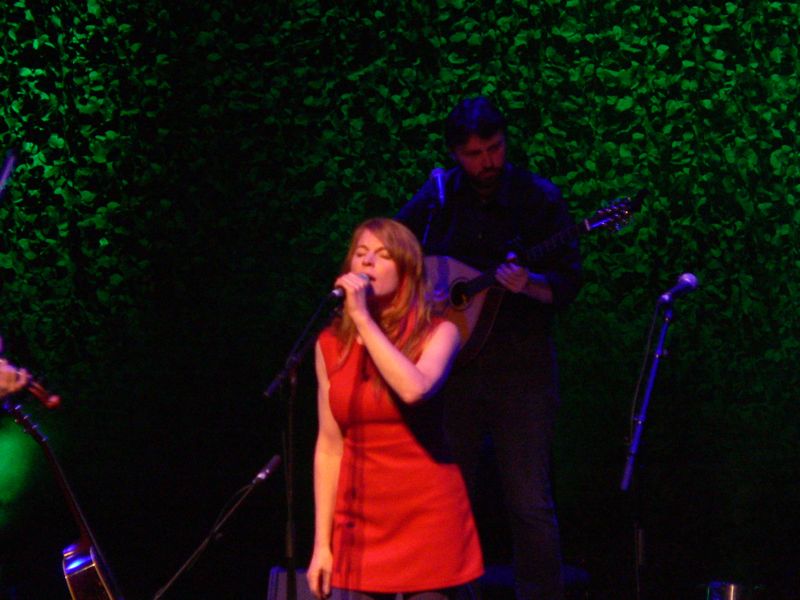
At Celtic Connections in Glasgow this winter, there was a CD release concert at the Glasgow Royal Concert Hall. All the musicians on the recording got to be there, as well as several other unexpected guests. I was fortunate to be there, and that is where most of these photographs were made.

Band photograph courtesy of the artists. Performance photographs of Seamus Egan, Moira Smiley, Winifred Horan (with Moira Smiley in the background), and Karan Casey with Donal Clancy by Kerry Dexter, made at Celtic Connections with permission of the festival, the artists, and the venue involved. Thank you for respecting copyright.

You may also wish to see
Solas:Shamrock City
Exiles Return: Karan Casey and John Doyle
Ireland's music: Danu: Buan

-->Your support for Music Road is welcome and needed. If you are able to chip in, here is a way to do that, through PayPal. Note that you do not have to have a PayPal account to do this. Thank you.

Labels: , , , , , , , , ,

Bookmark and Share
posted by Kerry Dexter at 0 Comments