Music of Healing: Arising from the Troubles from Tommy Sands
Musician Tommy Sands is a gentle man with a powerful message, a songwriter who talks of hurt and healing, division and reconnection in his songs. He has taken his songs of peace and justice from prisons in Nevada to community groups in the Middle East. The heart of his music, though, comes from his home country County Down in Northern Ireland
Down lies right along the border with the Republic, a borderland that has seen more than its share of bloodshed and division among folk who would otherwise be a community of neighbors. It is a beautiful place, a land of mountain and water, legend and story. From these wellsprings, Tommy Sands draws his music.
In Irish history and legend, there comes a time when leader Fionn MacCumhaill is talking with his people of music. “What is the most beautiful music in the world,?” he asks them, and they speak up for the songs of birds, the laughter of a girl, the baying of hounds. Fionn agrees that they are all good, but he says. “The most beautiful music of all is the music of what happens.”
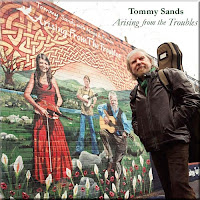 “Growing up, I heard songs all around me, songs of emigration and things that were very meaningful to those who wrote them, traditional songs. Then there were things happening around me, and I felt, as a songwriter, that I wanted to write about what was going on around me. I don’t know how historical Fionn MacCumhaill was exactly, “ says Tommy Sands, “but sometimes mythology is truer than factual stuff.”
For his album Arising from the Troubles, Sands has gathered together eighteen songs, some of which he’s been singing live for years but has not before put on record. They come from and speak of the political and personal aspects of the troubled times of Northern Ireland, the history and the present day. As well as the hard times, anger, and pain, they speak too of the possibilities of hope and peace,
Sands is joined on the album by his son Fionan and his daughter Moya. Moya takes the lead in singing on A Stone’s Throw. In four verses, Sands and his daughter illuminate the idea of communities of people who grow up separately together, and the changes that have taken place from the time Sands went to school with that situation to the time his daughter did. If you are familiar with American songwriter Kate Campbell’s work, you may see parallels with her song about growing up separately together black and white in the American south, a song called A Cotton Field Away.
We’ll Sing It All Over and You Sold Us Down the River are both anthems of a sort, from differing perspectives. Sing It All Over is a forceful statement of principles of the civil right movement in Northern Ireland (part of the words you hear in the background are ‘one man one vote one one vote’), while Sold Us Down the River is a song Sands wrote after speaking with a Protestant neighbor and thinking about the man’s feelings of being expected to be loyal to the crown and then let down by the actions of the British government.
Sailing Through the Sky explores a poetic, thoughtful, and bittersweet idea about being in prison. Troubles recalls the uncertainty of years when a strange car coming down the road or a word spoken at the wrong time might lead to fear and even death.
The sadness, pain, anger, and fear is context, though, for hope and even humor. The Mixed Marriage, a duet with Dolores Keane, finds the two singers poking fun at differences. Pete Seeger joins in for The Music of Healing, a song which became the genesis of an annual event exploring and celebrating ways music can reach across troubled times. In the opening verse, Sands writes
Don’t beat the drum, that frightens the children
Don’t sing songs about winning and losing
Sit down beside me, the green fields are bleeding
Sing me the music of healing.
and in the chorus repeats
Ah, the heart’s a wonder
Stronger than the guns of thunder
Even when we’re torn asunder
Love will come again.
It is a song Sands has sung across the world, and in his hometown of Rostrevor in County Down. As Sands was growing up there, the violence and division of the Troubles was coming on, but he saw another side, too. “When my parents played music -- my father played the fiddle and my mother played accordion -- people would come into the house, and it didn't matter what religion you were, what politics, soon I’d see their feet tapping in time, all to the same tune,” he says.
With songs that put poetry in politics and politics into poetry, and music into both, Tommy Sands keeps carrying that idea on.
you may also wish to see
Music Road: Tommy Sands: Let the Circle Be Wide
Music Road: now playing: Radio Ballads: Northern Ireland
thoughts about the summer riots in Belfast, at Perceptive Travel
Down lies right along the border with the Republic, a borderland that has seen more than its share of bloodshed and division among folk who would otherwise be a community of neighbors. It is a beautiful place, a land of mountain and water, legend and story. From these wellsprings, Tommy Sands draws his music.
In Irish history and legend, there comes a time when leader Fionn MacCumhaill is talking with his people of music. “What is the most beautiful music in the world,?” he asks them, and they speak up for the songs of birds, the laughter of a girl, the baying of hounds. Fionn agrees that they are all good, but he says. “The most beautiful music of all is the music of what happens.”
 “Growing up, I heard songs all around me, songs of emigration and things that were very meaningful to those who wrote them, traditional songs. Then there were things happening around me, and I felt, as a songwriter, that I wanted to write about what was going on around me. I don’t know how historical Fionn MacCumhaill was exactly, “ says Tommy Sands, “but sometimes mythology is truer than factual stuff.”
For his album Arising from the Troubles, Sands has gathered together eighteen songs, some of which he’s been singing live for years but has not before put on record. They come from and speak of the political and personal aspects of the troubled times of Northern Ireland, the history and the present day. As well as the hard times, anger, and pain, they speak too of the possibilities of hope and peace,
Sands is joined on the album by his son Fionan and his daughter Moya. Moya takes the lead in singing on A Stone’s Throw. In four verses, Sands and his daughter illuminate the idea of communities of people who grow up separately together, and the changes that have taken place from the time Sands went to school with that situation to the time his daughter did. If you are familiar with American songwriter Kate Campbell’s work, you may see parallels with her song about growing up separately together black and white in the American south, a song called A Cotton Field Away.
We’ll Sing It All Over and You Sold Us Down the River are both anthems of a sort, from differing perspectives. Sing It All Over is a forceful statement of principles of the civil right movement in Northern Ireland (part of the words you hear in the background are ‘one man one vote one one vote’), while Sold Us Down the River is a song Sands wrote after speaking with a Protestant neighbor and thinking about the man’s feelings of being expected to be loyal to the crown and then let down by the actions of the British government.

Sailing Through the Sky explores a poetic, thoughtful, and bittersweet idea about being in prison. Troubles recalls the uncertainty of years when a strange car coming down the road or a word spoken at the wrong time might lead to fear and even death.
The sadness, pain, anger, and fear is context, though, for hope and even humor. The Mixed Marriage, a duet with Dolores Keane, finds the two singers poking fun at differences. Pete Seeger joins in for The Music of Healing, a song which became the genesis of an annual event exploring and celebrating ways music can reach across troubled times. In the opening verse, Sands writes
Don’t beat the drum, that frightens the children
Don’t sing songs about winning and losing
Sit down beside me, the green fields are bleeding
Sing me the music of healing.
and in the chorus repeats
Ah, the heart’s a wonder
Stronger than the guns of thunder
Even when we’re torn asunder
Love will come again.
It is a song Sands has sung across the world, and in his hometown of Rostrevor in County Down. As Sands was growing up there, the violence and division of the Troubles was coming on, but he saw another side, too. “When my parents played music -- my father played the fiddle and my mother played accordion -- people would come into the house, and it didn't matter what religion you were, what politics, soon I’d see their feet tapping in time, all to the same tune,” he says.
With songs that put poetry in politics and politics into poetry, and music into both, Tommy Sands keeps carrying that idea on.
you may also wish to see
Music Road: Tommy Sands: Let the Circle Be Wide
Music Road: now playing: Radio Ballads: Northern Ireland
thoughts about the summer riots in Belfast, at Perceptive Travel
-->If you'd like to support my creative work,
here is a way to do that, through PayPal. Note that you do not have to have a PayPal account to do this.Thank you.
Another way to support: you could 
If you enjoy what you are reading here, you may also like to check out my newsletter at Substack for more stories about music, the people who make it, and the places which inspire it.
Labels: blogsherpa, county down, fionan sands, ireland, irish music, moya sands, northern ireland, rostrevor, songwriter, tommy sands


