Tuesday, March 14, 2023

Ireland's music: 6 ways to discover ideas and stories you may not have heard

Ireland is a rather small country, as countries go.

As the time in spring around Saint Patrick’s day on 17 March reminds, though, through the creativity and courage of its sons and daughters Ireland has had and continues to have impact across the world.

At Music Road, we’ve been mainly concerned with how that happens through music.

Whatever aspect of Ireland you celebrate, and however you may be doing that, music goes along.

I encourage you to take this Patrick season to explore the music of Ireland beyond what’s often shared this time of year.

Slam-your-mug-on-the-table droning songs have their place, as do cry in your cup of tea sentimental pieces, fast flying jigs to which to dance, and light as air new age tinged music.

They all, in deed have their places in Irish music.

There is more to the music of Ireland, and the creativity of Irish musicians, though. There wisdom of an Ireland that is both ancient and new.

Here are several ways to help you explore these ideas.

From Altan The Gap of Dreams will take you Donegal and beyond

Connections between Ireland and Scotland in music, language, and story : Allt from Julie Fowlis, Eamon Doorley, Zoe Conway, and John McIntyre.

Fiddle, Flute, Guitar: 3 Ways to Explore Ireland

Northern Ireland: 4 Songs to Help You Understand

Discover ways Karan Casey, Cathie Ryan, Muireann Nic Amhlaoibh, and Cara Dillon tell Ireland’s stories, and their own

Music and Community:Stories of Ireland

...and coming up later this year, I’ve another project to tell you about that will expand on these ideas. Stay tuned!

-->Your support for Music Road is welcome and needed. If you are able to chip in, here is a way to do that, through PayPal. Note that you do not have to have a PayPal account to do this. Thank you.

You can also Buy Me a Coffee at ko-fi.com

Labels: , , , , , , , ,

Bookmark and Share
posted by Kerry Dexter at 0 Comments

Friday, December 17, 2021

Gifts of Winter: 5 recordings to explore

Reflection and creativity are both part of winter, and of the Advent season.

With those two things in mind, here is a bit about several long time favorite recordings which go along with winter time.

Seasonal music not your thing? No worries, there will be more to come of non seasonal new releases and old favorites, good for holiday gift lists as well. Also check out the links toward the end of this piece...

The title track of Cara Dillon’s album Upon a Winter’s Night was written by Cara’s musical partner and husband, Sam Lakeman, and their son Noah. It’s a piece which evokes, among other things, the ideas of changes and celebration which go along with the Christmas story. It has a lively chorus to which you may find yourself singing along, as well. There is also outstanding uillean pipe contribution from Jarlath Henderson.

There are two more original tracks along with a selection of well known and perhaps lesser known songs on the recording. There is one piece in Irish, Rug Muire Mhac Do Dhia, and a fine take on O Holy Night for which Cara is joined by her sister Mary Dillon. Sam plays guitar or piano or bodhran on most tracks and several other musical friends sit in, including Niall Murphy on fiddle and James Fagan on bouzouki. Cara Dillon brings to this music a bit of the stillness and the joy of winter in her native Northern Ireland.

Matt and Shannon Heaton make their music at places where the music of Ireland and the folk traditions of North American music intersect.

On their album Fine Winter’s Night this is well in evidence with song and tune both reflective and upbeat. Both Heatons song and both write songs; hearing them trade lead and harmony on songs both traditional and original is one of the things to enjoy about this recording. Each is a fine player and a composer of tunes as well, which you will hear, for example, on Dust of Snow, and in their version of the Shetland tune Da Day Dawn. Shannon’s principal instrument is the flute, Matt’s are guitar and bouzouki.

You hear those on the tunes of course, and they well know how to weave their gifts on their instruments into songs as well. Shannon’s title track Fine Winter’s Night is a fine recognition of the brilliance of cold winter nights and the welcome of warmth within. In First Snowfall of December Matt draws listeners in to a tale of Victorian era New England Christmas time. The duo offer well known songs too. While keeping to the spirit of the season, they give carols including O Little Town of Bethlehem and It Came Upon the Midnight Clear a fresh dusting of creative ideas.

Kathy Mattea has two wintery albums out. Good News and Joy for Christmas Day.

On Good News, there are two songs form the tradition, Christ Child Lullabye from Scotland (with Scottish troubadour Dougie Maclean joining in) and and Brightest and Best. The eight contemporary cuts include Mattea’s own memorable Somebody Talkin’ About Jesus, along with the haunting title track written by Ron Mahes. and perhaps the best known songs from the album: Mary Did You Know? and New Kid in Town.

On Joy for Christmas Day, Mattea puts her own thoughtful stamp on O Come O Come Emmanuel, and offers a Christmas Collage of carols, featuring the guitar and arranging skill of her longtime guitarist, Bill Cooley. The eleven tracks are a mix of traditional and contemporary music for Advent and Christmas time. Among them are When the Baby Grew Up, O Come, All Ye Faithful, and the reflective Straw Against the Chill

Emily Smith chose a mix of traditional and contemporary music for her album Songs for Christmas, too. Smith comes from Scotland and is a fine songwriter as well as a singer and player of accordion, piano, and guitar. She’s joined by her musical partner and husband Jamie McClennan who plays guitar, fiddle, and is a singer and songwriter as well. Their musical journey winds from historic carols to contemporary Americana to Scotland based stories. All are well worth repeated listening. That said, listen out especially for Little Road to Bethlehem, Christ Has My Hairt, Ay, and Smith’s originals Find Hope and Winter Song.

Each of these albums is a winter season classic, well worth your listening for musicianship, creativity and, indeed, grace of the season.

Image by Jerzy Górecki from Pixabay

You may also enjoy
Three more albums of winter, from Jay Ungar and Molly Mason, Hanneke Cassel, and April Verch and Joe Newberry.
First story of this season’s holiday gift ideas: Albums from Sarah McQuaid, the Spell Songs Singers, and the band Staran
A story about A candle in the window, at Perceptive Travel
Music for Starry Winter Nights, at Wandering Educators
Second in this season’s holiday gift ideas: music from Graham Rorie, David Milligan, Karine Polwart
Advent: music, silence, and winter

In times when you are able to listen to much music at no cost, take this as a gentle reminder that if you enjoy this music, help support the work of these artists and the cause of good, thoughtful music everywhere by purchasing their music and merch. Direct purchase from an artist’s site is one way. Bandcamp is also a platform which supports artists’ work.

Speaking of support, if you’re in a position to do so this holiday season (and beyond), your support for Music Road is most welcome. Here’s one way:

-->Your support for Music Road is welcome and needed. If you are able to chip in, here is a way to do that, through PayPal. Note that you do not have to have a PayPal account to do this. Thank you.

and another choice:

You can also Buy Me a Coffee at ko-fi.com

Labels: , , , , , , , , , ,

Bookmark and Share
posted by Kerry Dexter at 0 Comments

Sunday, February 25, 2018

Ireland's Music: Cara Dillon: Wanderer

Cara Dillon comes from Dungiven, a small town in Country Derry in Northern Ireland. Growing up, there was music in her family, and in the town, That turned out to be Dillon’s calling. It has, over the years, taken her into a range of music experiences and also taken her across the world in the sharing of her music. It seems natural that her most recent album would be called Wanderer.

It is not the album Dillon and her musical partner and husband, Sam Lakeman, set out to make at this point in time. They were working on a different project, when, Dillon explains, songs from Derry, many she’s known since her early years, kept coming to her mind. She’d sing them while working about the house or preparing meals for the family at their home in the west country of England. “Sam would come through the door and say ‘What song is that? That’s a good song --let’s record it!’ ” Dillon says.

The couple decided to keep the production of the ten tracks stripped back and spare. There are a few guests -- Kris Drever, John Smith, Justin Adams, Niall Murphy, and Ben Nicholls-- tastefully deployed to enhance the feeling of space, landscape, and journey in the songs. Dillon sings with a storyteller’s grace; Lakeman’s piano and acoustic guitar work quietly to enhance the dialogue among melody, idea, and voice.

There are seven traditional songs, two Dillon/Lakeman originals, and a cover of Shaun Davey’s Dubdhara. In sharing the songs, Dillon and Lakeman create a fine balance between sadness in leaving and warmth of connection with well loved people and places. Derry, which is the big town for the region of Dillon’s homeplace, is very present both directly and indirectly in the songs.

“Derry has seen so much, it’s like the walls can speak,” Dillon says. “It’s one of those places that’s quite magical, when you start to read and hear about all that’s happened there, but the most wonderful thing is that people are so proud of their culture, because it’s been threatened for such a long time, so now there’s this lovely tradition where people have passed songs along with great passion.”

Some of those threats she alludes to were political; Derry is very near the border between the Republic of Ireland and the North, which long before official partition of the two countries was a flashpoint for strife. Derry was also a major emigration port for centuries. That’s not only in the distant past, either; Dillon’s mother told her a story from her own childhood about a relative who was emigrating and slipped quietly out the door unseen during his farewell party, and the sadness that came over the whole house when people understood that he had taken his leave. That story stayed with Dillon and is the basis for The Leaving Song.

The dew’s on the grass
We’ve finished the glass
The dawn’s on it’s way, now
But my son leaves today
God help me I pray
God help me i pray

Slip out the door, love
But don’t say goodbye
Just take one last look at this
Northwestern sky

“I’m a mother myself now,” Dillon says, “ and so I can imagine the pain they must have felt.”

That points to one of the gifts Dillon and Lakeman share through the songs on Wanderer, though: that sadness can be shared and hope can heal. You could hear The Tern and the Swallow as a lament, which in some ways it is. If you’re far from from your native land, especially if that land is Ireland, it may have you wanting to return right away. It is also, however, a song filled with acceptance and hope. So is the rather more upbeat song The Banks of the Foyle, which forsees a happy ending of a life in Derry for lovers separated for a time. Both Sides the Tweed is a classic song of wishing for freedom and reconciliation, which has often been recorded. Dillon and Lakeman put their own own stamp on it in the spare version they create, while remaining very true to the song.

“We always try to keep the song at the forefront of what we do, myself and Sam,” Dillon says, “because we both have such a great respect for the tradition. The way we describe it to each other at times is that it’s like finding a really beautiful gemstone and trying to find the right setting for it.”

They have done that for the songs that they have chosen for Wanderer. From the returning home of The Tern and the Swallow through to the setting out on a journey of Dubdhara, it is a journey well worth the taking with them. Explore The Wanderer more than once: each listen will reveal new facets of those gems and their settings.

Concert photographs made at the Celtic Connections Festival in Glasgow, with permission of the artists, the festival, and the venue.

-->Your support for Music Road is welcome and needed. If you are able to chip in, here is a way to do that, through PayPal. Note that you do not have to have a PayPal account to do this. Thank you.

Another way to support: you could Buy Me a Coffee at ko-fi.com

If you enjoy what you are reading here, check out my newsletter at Substack for more stories about music, the people who make it and the places which inspire it.

Labels: , , , , , ,

Bookmark and Share
posted by Kerry Dexter at 0 Comments

Monday, April 17, 2017

Music in times of change

In the midst of change and uncertainty, it’s often a good idea to take time for contemplation and reflection, time to find interior silence -- even when there may not be much in exterior circumstances to encourage that.

Music is a good gateway to silence. That can seem a paradox, but recall that creating music is as much about the notes as the space between them. It has been said that a painter paints on canvas, and a musician paints on silence.

With those ideas in mind, take a listen to these four pieces of music.

At times music without words -- tunes, in the Celtic music world -- invite this sort of reflection. Fiddle player and composer Hanneke Cassel draws on the traditions of Scotland and Cape Breton with hints of bluegrass, Americana, and occasional inflections to other places her travels have taken her. Take a listen to the Gretl in the Garden set, which you may find recorded on her album Trip to Walden Pond.

Songwriter Carrie Newcomer often looks to intersections of faith and the everyday to frame her stories. Hers is a clear eyed faith and a clear hearted look at living both in the moment and seeing threads of connection, grace, and spirit that pull through, now and then laced with humor too. In this song, Newcomer reminds that in times of uncertainty it is often wise to, as she says in the title of her song, Lean In Toward the Light. The song is recorded on her album The Beautiful Not Yet.

Music can be a gift of hope, whatever the circumstance. Cara Dillon knows this. Dillon comes from Northern Ireland and loves to perform and record music from the folk traditions of Ireland and Scotland. She recognizes ideas that connect across time and oceans, too. This song, Bright Morning Stars Arising, has engaged Dillon’s audiences from Ireland to Scotland to China. You may find it on her album A Thousand Hearts.

The members of the band Capercaillie have taken their music to Africa, the middle east, North America, and other points across the globe. Their base, and the heart of their music, is in their home in Scotland, however. You will hear references to Scotland in this song -- the poetry of Sorely Maclean, for instance. It is a piece that invites more than one listen for both melody and words, though, and connects with ideas of contemplation, reflection, and trust whatever place you may call home. Karen Matheson sings lead. The song and the album where you will find it are both called At the Heart of It All.

-->Your support for Music Road is welcome and needed. If you are able to chip in, here is a way to do that, through PayPal. Note that you do not have to have a PayPal account to do this. Thank you.

Labels: , , , , , , , ,

Bookmark and Share
posted by Kerry Dexter at 0 Comments

Tuesday, March 17, 2015

Ireland's Music: Cara Dillon: A Thousand Hearts

Finding songs to record is, for Irish singer Cara Dillon, rather like a journey -- a journey through time and ideas, words and melody, through songs from the traditions of Ireland, contemporary song, and at times music she and her husband and musical partner Sam Lakeman write themselves. They have learned to take their time with things, with letting the music and the ideas take them on journeys, and find the best ways to put their own stamp on them as they share the music with their audiences.

As they were considering the songs that make up the collection they have gathered for A Thousand Hearts they were struck by by a thread of hearts and passion which run through the stories told. Not that the pieces are all romantic love songs -- there are those, but alongside them songs of longing, regret, choices, change, faith, mystery, love for land, emigration, and humor -- all things which encompass and are encompassed by love. So they came to the title A Thousand Hearts.

Dillon often crosses the borders of musical styles in her work, but it is to Irish tradition that she returns as the base for her understanding of and respect for music.

“I’m from a very small town in County Derry, in the northwest of Ireland,” Dillon says, “ and basically where I’m from music, traditional music, is a way of life. Everyone is encouraged from when they’re knee high to play an instrument and to sing. to learn the local songs of the town there, Dungiven, and the local history and the legends of the town.”

It was to memories of music she learned while growing up that Dillon and Lakeman returned for several pieces on the album. My Donald is one such: it is the story of a woman thinking of her man, who works on the sea following the whale. In Dillon’s introspective treatment, it seems as though the listener is hearing the woman’s tale directly -- set off by an instrumental bit at the end which both allows Dillon’s gifted backing musicians to show their chops and suggests thoughts of those stormy and distant seas the sailor might traversing.

The Shores of Lough Bran finds Dillon giving a thoughtful take on an emigration song, which in a way resonates with her choice of Shawn Colvin’s modern day song of another sort of leaving, a love affair which is, as you might gather from its title, going to end: Shotgun Down the Avalanche. Lough Bran is, in fact, a much more hopeful and upbeat song, which makes sense, but both speak of longing and change -- as does River Run, another contemporary piece written in memory of one who died at a young age. River Run, Dillon’s voice is backed by Lakeman alone on piano, offers a quiet meditation on grief and change done with just the right degree of understatement.

All of which may make the album sound a bit grim; it’s not, not at all. There are upbeat songs, for one thing: the cheery story and melody of Jacket So Blue, the wry humor of Eighteen Years Old are two.

Speaking of love, and hope, and hearts: two of the strongest songs on the album -- though all of them are keepers -- treat of these things in differing musical and lyrical ways, but yet the threads of love, hope, choice and change resonate through them as well. Bright Morning Star Arising, from Canadian musician Ruth Moody, suggests that idea of hope and change -- for the better, this time -- through both title and lyric, and Dillon has found that when she does it in concert, people in her audiences are singing along with the choruses. Taímse Im’ Choladh. which Dillon sings in Irish, is an aisling, a dream song, in which Ireland (or Scotland, the song is known there are well) appears in a dream in the person of a beautiful woman urging the dreamer to rise and help her.

Whatever the source of the song they are working on at the time, “we always try to keep the song at the forefront of what we do, myself and Sam,” Dillon says, “because we both have such a great respect for the tradition. The way we describe it to each other at times is like finding a really beautiful gemstone and trying to find the right setting for it, so that it’s the focus of everyone's attention. The setting is just as important for it to be seen. We work on the songs a lot, and sometimes people come up after the show and say, is that a traditional song, or a song that you’ve written? And to me, that’s quite a big compliment.”

Gorgeous voice, thoughtful phrasing, backing players who add their own gifts to the telling of the stories: with A Thousand Hearts Cara Dillon and Sam Lakeman have indeed met the challenges they set themselves. Take a listen; take more than one. Each song is a gem which reveals another facet as listenings unfold.

Photograph of Cara Dillon by Kerry Dexter, made at the Celtic Connections Festival with permission of the artist, the festival and the venue. Thank you for respecting copyright.

Note: When first written this album was available to order only from European sources, but it is now available trough Amazon in the US (Music Road is an Amazon affiliate -- this does not influence coverage) in both physical and digital formats. Most links in this story now take you to Amazon US; I've left one to Amazon UK in the next to last paragraph for the convenience of Europe based readers.

You may also wish to see
Ireland's music: Cara Dillon: Lass of Glenshee
Julie Fowlis: Every Story
Cathie Ryan: Through Wind and Rain

If you'd like to support my creative work at Music Road,
here is a way to do that, through PayPal. Note that you do not have to have a PayPal account to do this. Thank you.

Labels: , , , , ,

Bookmark and Share
posted by Kerry Dexter at 1 Comments

Saturday, May 31, 2014

Ireland's music: Cara Dillon: Lass of Glenshee

Cara Dillon is from Dungiven in Northern Ireland, a town just near the Sperrins and just west of Derry. She has a fine new album out, A Thousand Hearts, about which there will be more here along the music road presently. Meanwhile, though, take a listen and a look at Dillon and friends perfoming a haunting take on The Lass of Glenshee at Fleadh Cheoil 2013 in Derry.

Dillon has recorded the song on her album Hill of Thieves.

You may also wish to see
Ireland's music: two voices in which you'll learn about a fine album from Cara's sister Mary
Celtic Connections 2013: Images
Radio Ballads: Northern Ireland

-->If you'd like to support my creative work,
here is a way to do that, through PayPal. Note that you do not have to have a PayPal account to do this.Thank you.

Labels: , , , ,

Bookmark and Share
posted by Kerry Dexter at 0 Comments

Sunday, March 16, 2014

Listening to Ireland: Patrick season

Ireland: it is a twenty first century country, to be sure, and yet... the music and the stories, the legends and the landscapes, reach back across time to connect, to share to create, to reassure, to inspire. The music and the stories reach across the world, too, to new landscapes where Ireland’s far flung sons and daughters have made their homes, and to places where the sound of the music is the only connection.

During the spring of the year, Patrick season, folk often turn thoughts and hearts especially to those connections and to the music of Ireland. Here along the Music Road Irish music and the people who make it are a subject of conversation and reflection often, as are those Irish landscapes; you’ll find upwards of three hundred stories on these ideas in our archives.

For your Patrick season enjoyment, here are several to explore

Tommy Sands is from Rostrevor in County Down, just along the border with the Republic. He knows both dark and light sides, both the political side of recent Irish history and how it plays out in day to day life. To hear ways these make part of his music, take a listen to his albums Let the Circle Be Wide and Arising from the Troubles.

Cathie Ryan is first generation Irish American, and has lived long in both countries. Landscape, legend, and story all play their parts in the music she writes herself and what she sources from traditional and contemporary song. Hear this in her recordings Through Wind and Rain and The Farthest Wave.

The four members of T With the Maggies each have careers as members of other ensembles and collaborations. When the four women, who knew each other growing up in Donegal before their music took them along differing paths, got together to create an album, they made a project through which you may hear the wind and water, rugged mountains and hidden glens and crashing waves and tales and history that form Ireland’s far northwest. Learn more about this recording from T With the Maggies.

One of the Maggies on that album is Mairéad Ni Mhaonaigh, singer, fiddle player, and songwriter who is also founding member of the band Altan. They have traveled the world with their music and collaborated with symphony orchestras and American country superstars. Home in Donegal is where they made their album Poison Glen, which they chose to name after an especially lovely spot in their native county. Take a listen to fiery fiddling, graceful singing, and class act ensemble work on Poison Glen.

Mary Black does not always -- or even often -- choose music from Irish tradition. The native Dubliner is brilliant and hearing the stories and poetry, the threads that connect and pull through, in the work of contemporary songwriters, though. Many of her choices are songwriters from Ireland, but whatever she chooses, Black puts her own graceful and very Irish stamp upon it, and adds to the ongoing tradition of class act songs and singers in Ireland. Hear this in Twenty Five Years Twenty Five Songs.

There is more, of course, much more, to the music of Ireland, and I’ve more recordings and conversations with artists waiting in the wings to share with you -- and a book or two in the works as well. Keep in touch here along the Music Road to know more about all that.

Photograph of hillside in Louth, Republic of Ireland, is by Kerry Dexter and is copyrighted. Thank you for respecting this.

You may also wish to see
Women of Ireland: Music
Learning about Irish Music: a bouquet of albums
Julie Fowlis and Muireann Nic Amhlaoibh: Dual

-->Your support for Music Road is welcome and needed. If you are able to chip in, here is a way to do that, through PayPal. Note that you do not have to have a PayPal account to do this. Thank you.

Another way to support: you could Buy Me a Coffee at ko-fi.com

Labels: , , , , , , , , , ,

Bookmark and Share
posted by Kerry Dexter at 3 Comments

Tuesday, May 28, 2013

Ireland's music: two voices

Frances Black and Mary Dillon are both from Ireland. Black grew up in Dublin, while Dillon is from Dungiven in Northern Ireland. Each is a gifted singer, and each has taken a bit of time between albums. As much as the new music each has chosen differs one from the other. each recording offers music which Illuminates aspects of the spirit of Ireland, and reaches beyond the island as well.

Mary Dillon’s album is called North, appropriate enough as the music is in the main sourced from the North of Ireland and the recording was created there as well. Dillon has a gentle and natural phrasing, a voice and style well suited to the songs she has chosen and the stories she tells with her own songwriting.

Most of the songs she’s chosen for North comes from the tradition and tell of love gone wrong -- but have no worries there are cheerful ones as well, and reflective pieces too. A particular standout is The Boatman, filled with vivid and compelling imagery which frames ideas of love, loss, hope and history. It stands well in company with songs from the tradition and from other writers. Among these are the lost lover returns in disguise tale told in The Banks of the Claudy, the anti war meditation in John Condon, and the woman missing her man tale in Bleacher Boy, a song with lines which may sound familiar, even if the song itself does not, as they are turns of phrase which have traveled into the songs in Scotland, Canada, and the American west. Another standout is Ard Ti Chuain, a song of love of a place, which Dillon sings in Irish.

Mary Dillon comes from a musical family -- her sister is the singer and songwriter Cara Dillon. Frances Black is from a family in which music, both traditional and popular, was part of her everyday life growing up too. For her album Stronger Black has chosen ten songs by contemporary writers, thoughtful and poetic in their lyrics and lasting in their melodies, songs which, you could say, are parts of the next steps in storytelling tradition.

These include songs which allow the singer to muse on the many facets of love and resilience, which Black does in a distinctive voice and style that well invite the listener in to consider the stories she tells and the ideas she suggests. Anna McGarrigle, James Taylor, Carole King, Gary Burr, and Paul Brady are several of the writers she’s favored. Rise invites thoughts of that resilience, while I Would Be Stronger Than That asks questions about the not always straightforward paths of love. Long Ago and Far Away, Black notes, was the first song she ever sang in public, when she was around fourteen years of age and was asked to sing at a friend's birthday party, while Heart Like a Wheel was a song she first heard her sister sing when they were kids, and later learned to sing it when a friend asked her to do so. You’ve no need to know a thing about the connections that weave in and out of these songs, or Black's family connections (her sister Mary is one of Ireland’s best loved singers, her brothers Martin, Michael, and Shay have all worked as professional musicians, and all five have at times worked together, as well) to appreciate the beauty of what she offers here. Whehter you know any of thsoe things or not, though, you may hear a bit of resonance with tradition and family, a resonance which only adds to the grace of the music, and to Frances Black’s standing as a gifted interpreter of song.

you may also wish to see
from Northern Ireland: Cara Dillon: After the Morning
Reflections with Mary Black
learning about Irish music: a bouquet of albums

-->Your support for Music Road is welcome and needed. If you are able to chip in, here is a way to do that, through PayPal. Note that you do not have to have a PayPal account to do this. Thank you.

Labels: , , , , , ,

Bookmark and Share
posted by Kerry Dexter at 6 Comments

Saturday, October 06, 2012

Music and forgiveness


Forgiveness: it is a circumstance that holds both past and present -- and at times, future -- and ways of finding balance among all those things. At times it’s necessary to forgive others, once and many times, and at times it is just as necessary to learn how to forgive one’s self. A place of peace, an open vista, room to grow, and a hard road, sometimes, to get there. It is a subject musicians deal with directly and indirectly, and music is often a good companion on the journey.

Music to go along with these ideas

Carrie Newcomer  Hush
Cathie Ryan Be Like the Sea
Carrie Newcomer  Before And After
Cathie Ryan In the Wishing Well
Bill Cooley Requiem for a Mountain


you may also wish to see
rest in music
cathie ryan: the farthest wave

photograph was made in Derry, Northern Ireland, and is copyrighted. thank you for respecting this

-->If you'd like to support my creative work at Music Road,
here is a way to do that, through PayPal. Note that you do not have to have a PayPal account to do this.Thank you.

Labels: , , , , , ,

Bookmark and Share
posted by Kerry Dexter at 0 Comments

Saturday, September 22, 2012

Music and Mystery


How are songs and tunes constructed?

The are built with notes and scales, tone and rhythm and words, if you choose to use words. They come too from the breath and heart of those who play them, from ideas, from the connections which happen between singer and song, composer and sound, player and instrument. They come from what happens between musician and listener, and with how music is worn and burnished as it is passed from one person to another, from one generation to another. It cones from mystery.

fort william scotland copyright kerry dexter
mournes in mist, northern ireland copyright kerry dexterThese two photographs are what got me thinking about these ideas. The intricacy of the tree and the window and their contrasts, and the long view of mystery with mountains in mist. The tree and and window are in Fort William in the Western Highlands of Scotland, and the mountains are the Mournes in Northern Ireland.

Music to go along with these ideas
Cathie Ryan: Through Wind and Rain
history into song: capercaillie: glenfinnan
music, silence, and spiritual journey
Lovers' Well: Matt & Shannon Heaton

-->If you'd like to support my creative work at Music Road,
here is a way to do that, through PayPal. Note that you do not have to have a PayPal account to do this.Thank you.

Labels: , , , ,

Bookmark and Share
posted by Kerry Dexter at 0 Comments

Wednesday, July 18, 2012

Reading Ireland: Companion to Irish Traditional Music

Reading the Companion to Irish Traditional Music is a bit like exploring an ever changing and intriguing landscape, one which includes detailed intricacies of ancient stone walls, buildings which span centuries of styles, and uplifting long range views of mountains and valleys in the distance.

companion irish traditional music cork university pressThis is the second edition of the Companion, and as was the case with the first edition it is edited by Fintan Vallely. Vallely is both a musician and a scholar, a man whose life and experiences span both the Republic of Ireland and Northern Ireland. For this volume Vallely has recruited two hundred others, musicians, writers, scholars, and researchers from varied aspects of Irish tradition to write on subjects both well known and less widely known, the wide ranging to the narrowly focused. The articles are arranged in alphabetical fashion.

The level of information and the quality of writing are quite high. If you come at this from immersion in scholarship of Irish music’s diaspora, as I do, you will find yourself wondering at times “where is the entry on...” or “why didn’t they cover...” That does not diminish the usefulness of the book, really, but it is something to be aware of, and reason to make this volume one of your sources on Irish traditional music rather than the only one. It’s not that the ways the music of Ireland as it appears in places beyond the island aren’t covered, either. They are, but that is not what the book is about (time for me to be working on that sort of book I think). Also, as someone who has worked on academic reference works (to be clear, I did not contribute to this one) I know that there are many issues which go into the depth, breadth, and focus of a work of this sort, with several hundred contributors writing nearly 1800 articles. That said, editor Vallely has done a fine job.

In addition to articles on specific people, places, and events, there are considerations of concepts --dissonance, to take one example, and artistic consciousness for another -- which are spoken of and illustrated with examples from Irish traditional music. This sort of article should prove fascinating not only to those steeped in the tradition but intriguing to people coming from other areas of music, the arts, and history, as well.

A Timeline of Irish Music in History and a compilation of suggestions on published material on Irish music, both appearing at the end of the book, enhance the value of the project as well. Even should you choose not to read many of the articles, these additions could be worth the price of the volume on their own.

session louth copyright kerry dexter

The Companion to Irish Traditional Music belongs on your reference shelf to fuel and expand your interest in Irish music, Ireland, history and all the many vistas that will open to you as you leaf through its more than 800 pages. It is not inexpensive (perhaps you will want to split the cost with friends, or to suggest it to your library, and you may at times find a discounted price available from Amazon should you choose to follow the links in this article) but it is well worth the effort to get your hands on a copy and begin exploring.

photograph is of a session in County Louth in the Republic of Ireland and is copyrighted. thank you for respecting this.

you may also wish to see
another book by Fintan Vallely
Blooming Meadows: The World of Irish Traditional Musicians


learning about Irish music: a bouquet of albums
Concerts, Conversations, and Travel: Ireland

-->If you'd like to support my creative work,
here is a way to do that, through PayPal. Note that you do not have to have a PayPal account to do this.Thank you.

Labels: , , , , , ,

Bookmark and Share
posted by Kerry Dexter at 0 Comments

Friday, July 06, 2012

Music and time

Listening to and playing music, practicing and learning it, are ways to find quiet, as quiet often makes a space to find music. Both arise, I think, from the quality of focus, on the one hand, and being relaxed, on the other.

Some while back, I read that a person in medieval times received as much information in a year as a person now does in the course of one day’s time. As information, connectivity, and electronic devices -- and people’s expectations concerning all that -- continue to grow, we might be up to receiving several years’ worth of information in a day by now.

As this season unfolds, take time to step away from that flow of information and into the stream of listening to playing, and sharing music, relaxing into a landscape or a candle flame, and hearing the quiet.
sunset mournes northern ireland copyright kerry dexter

music to go along with these ideas

Scotland's Highlands in music: Duncan Chisholm

Hanneke Cassel: For Reasons Unseen


the photograph is of sunset over the Mourne Mountains in County Down, Northern Ireland. it is copyrighted. thank you for respecting that
.

you may also wish to see

music, silence, and spiritual journey


and
Delicious Baby's Photo Friday, where travelers offer new insights to the world each Friday.

-->If you'd like to support my creative work,
here is a way to do that, through PayPal. Note that you do not have to have a PayPal account to do this.Thank you.

Labels: , , , , , ,

Bookmark and Share
posted by Kerry Dexter at 0 Comments

Friday, May 25, 2012

Music, inspiration, and landscape

Landscape and music often intertwine: the one inspires the other. That may come through sound, or horizon, or angle of light, it may be natural landscape or buildings or bridges. Other sorts of creativity -- poetry, prose, paining, photography, storytelling -- also come from our connection with the landscapes in which we live.


mournes ireland copyright kerry dexter


Have you a favorite piece of music which has to do with landscape?


music to go along with these ideas
India to Indiana in song and image
Appalachian and Celtic: Kyle Carey: Monongah
Cathie Ryan: the farthest wave

The photograph is of the Mourne Mountains in County Down, Northern Ireland, and is copyrighted. Thank you for respecting that.

you may also wish to see
Delicious Baby's Photo Friday, where travelers offer new insights to the world each Friday.

-->Your support for Music Road is welcome and needed. If you are able to chip in, here is a way to do that, through PayPal. Note that you do not have to have a PayPal account to do this. Thank you.

Labels: , , , ,

Bookmark and Share
posted by Kerry Dexter at 0 Comments

Monday, March 19, 2012

Learning about Irish music: a bouquet of albums for spring

With Saint Patrick’s Day and the feast of Saint Bridgid, spring is a time when Irish music is heard all around, in forms from high sweet harmonies to gritty street stories to hearty drinking songs. There's more to Irish music than this, though. Irish music is as varied as its makers and its listeners.

Music, landscape, and history intertwine in in ways direct and subtle, in lives and emotions past and present. In honor of Irish saints and coming spring time here is a look some of the best recordings to take you deeper in to the many ways Irish artists make their music and hand it on.
cathie ryan farthest wave
If you follow the links in this story, you’ll find to longer articles about these recordings and artists, and places where you may hear their music. While you are at it, explore other work by these artists. All of it is well worth your time. Yes, they are all that good.

The title of Mary Black’s album 25 years 25 songs will suggest to you that this singer has been at the making of her music for a while. Thoughtful song selection along with voice and phrasing which illuminate both the narrative and the emotion of the songs she chooses are hallmarks of Black’s work. You’ll also want to take a listen to By the Time It Gets Dark and Stories from the Steeples

Tommy Sands knows quite a bit about narrative too. Almost all the songs on Arising from the Troubles are ones he has written himself, and he’s joined by his son and daughter, both fine musicians in their own rights. The Sands Family is from Rostrevor in Down, not far from the border of the Republic and the North. The songs in this collection raise good questions and put a human perspective into events sometimes made distant by new reports.

Cathie Ryan knows about asking good questions, both in the songs she writes herself, and in the ones she chooses from the tradition and from contemporary writers. Her album The Farthest Wave proves a fine balance of these three aspects of her work, with humour and passion, grief, love, and resilience, myth and present day all given their places through connection of people and land.

Heidi Talbot and John Doyle both have ways of weaving old and new songs and melodies john doyle karan caseyaround and through each other with a result that old songs sound fresh and newly composed pieces stand as counterparts to ones burnished by tradition. Take a listen to Heidi work on her album The Last Star and check out John’s collaboration with Karan Casey, Exiles Return.

Niamh Ni Charra speaks of story and legend through her fiddle and her concertina rather, but her stories are as vividly told as those with words, which you may hear on Súgach Sámh / Happy Out The same is true of Donal Clancy, on his reflective guitar focused meditation called Close to Home, while Davy Spillane gets to the heart of Ireland's landscape with the voice of his pipes on A Place Among the Stones.

Matt and Shannon Heaton explore many aspects of connection between Ireland and America, and the season of winter, with their recording Fine Winter's Night. Altan take you straight to the heart of Donegal, and to a few songs which have made their way across the ocean to that far northwestern part of altan poison glenIreland, on Poison Glen -Gleann Nimhe while Dervish and Grada offer sets of song and tune that invite you in to the feeling of good friends sharing tunes around the kitchen table.

That is a characteristic Irish music holds, whatever season you listen or play it , that of sharing good friendship through music.

you may also like to see
Concerts, Conversations, and Travel: Ireland

-->Your support for the work,here at Music Road is welcome and needed.
Here is one way to offer that, through PayPal. Note that you do not have to have a PayPal account to do this. Thank you.

Another way to support: you could Buy Me a Coffee at ko-fi.com

Labels: , , , ,

Bookmark and Share
posted by Kerry Dexter at 6 Comments

Monday, March 12, 2012

Concerts, Conversations, and Travel: Ireland

As Saint Patrick’s Day approaches, here is a look back at several favourite conversations with Irish musicians, stories about travel in Ireland, and reports of concerts of Irish music. Most are from here along the Music Road, along with several from other places. Follow the links to enjoy good reading and great music -- with, of course, more of both to come.


conversations with Irish artists
Cathie Ryan talks about teaching tradition
Mary Black shares her reflections on her career and song choices
Michael Black talks about music, family, and friends
Heidi Talbot talks about learning music growing up in Kildare, and about creating her latest album, sharing songs and stories [at Wandering Educators]

session at pjs ireland louth copyright kerry dexter


travel in Ireland, north and south. photo essays too
Ceol Chairlinn: sharing music in winter a quieter side of the Irish year
Irish music, Irish landscape and why not all Irish songs are drinking songs

an encounter with the not so distant past in Newry: Meeting the Past in Northern Ireland [at Perceptive Travel]
history, memory, museums, and the Reminiscence Project in Northern Ireland:
Holding Memory in Your Hands [at Perceptive Travel]
reflections on Belfast Unrest and Travel in Northern Ireland [at Perceptive Travel]
Traditional Irish musicians honored at Gradam Ceoil [at Irish Fireside]

two favourite stories about concerts

at Club Passim in Cambridge, Massachusetts, USA Another Fine Winter's Night with Matt and Shannon Heaton
from City Halls in Glasgow, Scotland T with the Maggies and the music of Donegal

photograph of a Sunday afternoon session in Louth, Ireland, is by Kerry Dexter and is copyrighted. thank you for respecting that.

Ahead, in honor of Saint Patrick I’ll gather up for you stories of my favorite recordings of Irish music -- this is now available at Music Road: learning about Irish music: a bouquet of albums for spring. Who are your favourite Irish musicians, and what are your favourite places in Ireland? If you like, let us know in the comments.

If you enjoy what you’ve been reading here, a way to support more of it: Buy Me a Coffee at ko-fi.comb>

Labels: , , , , , , ,

Bookmark and Share
posted by Kerry Dexter at 9 Comments

Tuesday, October 18, 2011

Music of Healing: Arising from the Troubles from Tommy Sands

Musician Tommy Sands is a gentle man with a powerful message, a songwriter who talks of hurt and healing, division and reconnection in his songs. He has taken his songs of peace and justice from prisons in Nevada to community groups in the Middle East. The heart of his music, though, comes from his home country County Down in Northern Ireland

Down lies right along the border with the Republic, a borderland that has seen more than its share of bloodshed and division among folk who would otherwise be a community of neighbors. It is a beautiful place, a land of mountain and water, legend and story. From these wellsprings, Tommy Sands draws his music.

In Irish history and legend, there comes a time when leader Fionn MacCumhaill is talking with his people of music. “What is the most beautiful music in the world,?” he asks them, and they speak up for the songs of birds, the laughter of a girl, the baying of hounds. Fionn agrees that they are all good, but he says. “The most beautiful music of all is the music of what happens.”
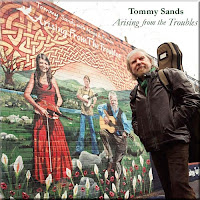
tomy sands arising from the troubles“Growing up, I heard songs all around me, songs of emigration and things that were very meaningful to those who wrote them, traditional songs. Then there were things happening around me, and I felt, as a songwriter, that I wanted to write about what was going on around me. I don’t know how historical Fionn MacCumhaill was exactly, “ says Tommy Sands, “but sometimes mythology is truer than factual stuff.”

For his album Arising from the Troubles, Sands has gathered together eighteen songs, some of which he’s been singing live for years but has not before put on record. They come from and speak of the political and personal aspects of the troubled times of Northern Ireland, the history and the present day. As well as the hard times, anger, and pain, they speak too of the possibilities of hope and peace,

Sands is joined on the album by his son Fionan and his daughter Moya. Moya takes the lead in singing on A Stone’s Throw. In four verses, Sands and his daughter illuminate the idea of communities of people who grow up separately together, and the changes that have taken place from the time Sands went to school with that situation to the time his daughter did. If you are familiar with American songwriter Kate Campbell’s work, you may see parallels with her song about growing up separately together black and white in the American south, a song called A Cotton Field Away.

We’ll Sing It All Over and You Sold Us Down the River are both anthems of a sort, from differing perspectives. Sing It All Over is a forceful statement of principles of the civil right movement in Northern Ireland (part of the words you hear in the background are ‘one man one vote one one vote’), while Sold Us Down the River is a song Sands wrote after speaking with a Protestant neighbor and thinking about the man’s feelings of being expected to be loyal to the crown and then let down by the actions of the British government.tommy sands fionan sands moya sands

Sailing Through the Sky explores a poetic, thoughtful, and bittersweet idea about being in prison. Troubles recalls the uncertainty of years when a strange car coming down the road or a word spoken at the wrong time might lead to fear and even death.

The sadness, pain, anger, and fear is context, though, for hope and even humor. The Mixed Marriage, a duet with Dolores Keane, finds the two singers poking fun at differences. Pete Seeger joins in for The Music of Healing, a song which became the genesis of an annual event exploring and celebrating ways music can reach across troubled times. In the opening verse, Sands writes

Don’t beat the drum, that frightens the children
Don’t sing songs about winning and losing
Sit down beside me, the green fields are bleeding
Sing me the music of healing.

and in the chorus repeats

Ah, the heart’s a wonder
Stronger than the guns of thunder
Even when we’re torn asunder
Love will come again.

It is a song Sands has sung across the world, and in his hometown of Rostrevor in County Down. As Sands was growing up there, the violence and division of the Troubles was coming on, but he saw another side, too. “When my parents played music -- my father played the fiddle and my mother played accordion -- people would come into the house, and it didn't matter what religion you were, what politics, soon I’d see their feet tapping in time, all to the same tune,” he says.

With songs that put poetry in politics and politics into poetry, and music into both, Tommy Sands keeps carrying that idea on.

you may also wish to see
Music Road: Tommy Sands: Let the Circle Be Wide
Music Road: now playing: Radio Ballads: Northern Ireland
thoughts about the summer riots in Belfast, at Perceptive Travel

-->If you'd like to support my creative work,
here is a way to do that, through PayPal. Note that you do not have to have a PayPal account to do this.Thank you.

Another way to support: you could Buy Me a Coffee at ko-fi.com

If you enjoy what you are reading here, you may also like to check out my newsletter at Substack for more stories about music, the people who make it, and the places which inspire it.

Labels: , , , , , , , , ,

Bookmark and Share
posted by Kerry Dexter at 11 Comments

Monday, September 12, 2011

Masters of the Irish Harp

If you have an Irish passport, there’s a harp on it. If you’ve coins from Ireland in your pocket, there are harps on those too. Then there are the pubs, the beer, and the tea towels: the harp is a powerful symbol of Ireland.

The power of the sound of the harp is a focus on Lyric RTE fm’ s collection Masters of the Irish Harp. There are sixteen cuts on the album, with music which ranges from Bach to O’Carolan, from newly composed works to those which come from ancient sources.

It is a varied and wonderful range of players represented on Masters of the Irish Harp as well.
You’ve met a number of them here along the music road, while others may be new to you. masters of the Irish harpIt goes from Grainne to Grainne in terms of players, opening with Grainne Hambly’s sparkling take on The Geese in the Bog and closing with Grainne Yeats’ reflective Carolan’s Farewell to Music. Both harps and harpers range across background, from concert harp to clarsach, from classically trained players to those from traditional background, and many who cross borders among those fields. Some of the pieces are newly recorded for this project, while others are selected from the artists’ previously released recordings. It is a well chosen and well sequenced collection, with appeal for those who know the Irish harp and its players well and for for those who are new to the sound of the Irish harp.

It’s certainly worth listening all the way through and as sequenced. That said, notable tracks include Maire ni Chathasaigh’s Reel for a Water Diviner, Cormac de Barra’s Monaghan Jig, Michelle Mulcahy’s Green Mountain set, and Siobhan Armstrong's Da Mihi Manum.

follow this link to listen to excerpts from the tracks Masters of the Irish Harp and follow the link below which is called Elsafty Armstrong Browne to see a video of Siobhan Armstrong playing the wire strung Irish harp

you may also wish to see

Music Road: Scotland on the harp: Corrina Hewat
Music Road: harps and Celtic Connections
Music Road: Elsafty Armstrong Browne

Labels: , , , , , ,

Bookmark and Share
posted by Kerry Dexter at 2 Comments

Saturday, August 20, 2011

From Northern Ireland: Cara Dillon: After the Morning

On her album
After the Morning Cara Dillon includes original material, covers of songs by Scotsman Dougie MacLean and American writers Pam Rose and Mary Ann Kennedy, and traditional songs. It was a bit of a change up for the singer, who had been associated most strongly with traditional folk material, and it is one she handled well, at times choosing sparse instrumental backing for her graceful light soprano voice, and at others bringing in fuller sounds of strings, and percussion and yet at other times backing from keyboards from her husband Sam Lakeman, who produced the album, and traditional musicians Cathal Hayden on fiddle and Mairtin O’Connor on accordion.

“We always try to keep the song at the forefront of what we do, myself and Sam,” Dillon says, “because we both have such a great respect for the tradition. The way we kind of describe it to each other at times is like finding a really beautiful gemstone and trying to find the right setting for it, so that it’s the focus of everyone's attention. The setting is just as important for it to be seen. We work on the songs a lot, and sometimes people come up after the show and say, is that a traditional song, or a song that you’ve written? And to me, that’s quite a big compliment.”.

cara dillon after the morningDillon grew up in Dungiven, in County Derry, Northern Ireland, where she knew traditional music as part of her daily life. “You know I think kids growing up now think folk music is a bit uncool, but for us then, it was just the done thing, and I loved it,” Dillon says. She’s not speaking of some far bygone days, either: she’s is in her mid thirties now. Dillon was good at the music, too, winning the All Ireland prize for singing in English when she was fourteen.

It is to Derry and Donegal that Dillon often returns for song ideas, both seeking songs from the the tradition and seeking inspiration for the songs she and Lakeman write and arrange. On After the Morning, Brockagh Braes and Bold Jamie are two from the area’s well of tradition. The Streets of Derry, on which folk rock star Paul Brady, a native of Derry, joins in, is another. The Snows They Melt the Soonest is another from the tradition as well, with just Lakeman’s piano thoughtfully backing Dillon’s voice. The original songs include the bittersweet love song Never in in a Million Years and a quiet, reflective tribute to Dillon’s father, October Winds.

Though Dillon tours internationally, she’s not quite as well known outside Europe as she is within it. After the Morning is a fine place to make her acquaintance.

-->Your support for Music Road is welcome and needed. If you are able to chip in, here is a way to do that, through PayPal. Note that you do not have to have a PayPal account to do this. Thank you.

Labels: , , , , ,

Bookmark and Share
posted by Kerry Dexter at 2 Comments

Thursday, July 14, 2011

Beoga: How to Tune a Fish

How do you tune a fish? The wry and coming coming at things from and angle perspective that question implies infuses the music offered by the five members of the band Beoga on their album How to Tune a Fish. A like titled set opens the music, and it draws you right in, just as though you were hearing them at a session in their based in County Antrim, Northern Ireland. Interesting choice of instruments they bring to the music, too: two accordions, piano, fiddle, and bodhran.

irish band beogaThe second set, Sticky Bun Slides (the title comes from a conversation bodhran player Eamon Murray had with an Italian friend) keeps things dancing right along , and moves into the song Home cookin’ from American songwriter Rick Danko, with fiddler Niamh Dunne stepping up to sing, adding a bit of an Irish edge to the country blues in the piece. Ballymacaldrick is a lovely slow tune from accordion player Damian McKee, inspired by his home place in Antrim.

Seán Óg Graham handles the other accordion, and on occasion guitar as well. He also composed a number of the tunes, including that one about fish tuning. Liam Bradley , whose background includes world wide composing and arranging for Irish dance, is on keyboards for the group.

It’s a lively mix of tradition and innovation they bring here -- in fact How to Tune a Fish seems to lean a bit more toward a trad focus than several of the band’s earlier albums. Not to say they don’t bring in other things as well, including the country take on Home cookin’ and a vaudeville song called Come Out of the Rain, which they clearly have a fine time doing. Songs and tunes both, it is apparent that these five really enjoy each other’s music, and really are listening to each other, as well. through all the twelve tracks.

That’s an aspect interwoven into the music which makes things all the better for those who listen. The word beoga means lively in irish, and Bradley, Dunne, McKee, Murray and Graham deliver on that. Not lively for the sake of fast played tunes though, but rather because that’s at the heart and energy of the music they offer, Irish music moving forward with a crisp northern edge.


About that fish -- care to offer an answer to the question?

you may also wish to see
Music Road: Grada: Natural Angle
Music Road: malinky: flower & iron
Music Road: music of Donegal: Altan

Labels: , , , , ,

Bookmark and Share
posted by Kerry Dexter at 0 Comments

Monday, July 11, 2011

Twelfth of July: Ireland north and south

"Come pledge again your heart and your hand
One grasp that never will sever
Our password be our native land
Our motto, love forever
Let the orange lily be
Your badge, my patriot brother
It's the everlasting green for me
And we for one another..."

from Sean Tyrrell's song The Twelfth of July (Lament of the Children)


Cathie Ryan also has a very fine version of this song on her album Cathie Ryan

you may also wish to see

Music Road:Radio Ballads: Northern Ireland
Music Road: Ireland, north and south

-->If you'd like to support my creative work,
here is a way to do that, through PayPal. Note that you do not have to have a PayPal account to do this.Thank you.

Labels: , , , , ,

Bookmark and Share
posted by Kerry Dexter at 0 Comments