Reading Ireland: Companion to Irish Traditional Music
Reading the Companion to Irish Traditional Music is a bit like exploring an ever changing and intriguing landscape, one which includes detailed intricacies of ancient stone walls, buildings which span centuries of styles, and uplifting long range views of mountains and valleys in the distance.
 This is the second edition of the Companion, and as was the case with the first edition it is edited by Fintan Vallely. Vallely is both a musician and a scholar, a man whose life and experiences span both the Republic of Ireland and Northern Ireland. For this volume Vallely has recruited two hundred others, musicians, writers, scholars, and researchers from varied aspects of Irish tradition to write on subjects both well known and less widely known, the wide ranging to the narrowly focused. The articles are arranged in alphabetical fashion.
The level of information and the quality of writing are quite high. If you come at this from immersion in scholarship of Irish music’s diaspora, as I do, you will find yourself wondering at times “where is the entry on...” or “why didn’t they cover...” That does not diminish the usefulness of the book, really, but it is something to be aware of, and reason to make this volume one of your sources on Irish traditional music rather than the only one. It’s not that the ways the music of Ireland as it appears in places beyond the island aren’t covered, either. They are, but that is not what the book is about (time for me to be working on that sort of book I think). Also, as someone who has worked on academic reference works (to be clear, I did not contribute to this one) I know that there are many issues which go into the depth, breadth, and focus of a work of this sort, with several hundred contributors writing nearly 1800 articles. That said, editor Vallely has done a fine job.
In addition to articles on specific people, places, and events, there are considerations of concepts --dissonance, to take one example, and artistic consciousness for another -- which are spoken of and illustrated with examples from Irish traditional music. This sort of article should prove fascinating not only to those steeped in the tradition but intriguing to people coming from other areas of music, the arts, and history, as well.
A Timeline of Irish Music in History and a compilation of suggestions on published material on Irish music, both appearing at the end of the book, enhance the value of the project as well. Even should you choose not to read many of the articles, these additions could be worth the price of the volume on their own.
The Companion to Irish Traditional Music belongs on your reference shelf to fuel and expand your interest in Irish music, Ireland, history and all the many vistas that will open to you as you leaf through its more than 800 pages. It is not inexpensive (perhaps you will want to split the cost with friends, or to suggest it to your library, and you may at times find a discounted price available from Amazon should you choose to follow the links in this article) but it is well worth the effort to get your hands on a copy and begin exploring.
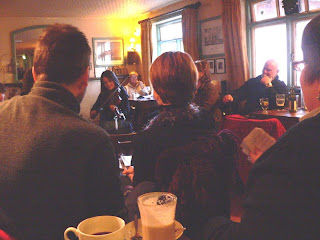
photograph is of a session in County Louth in the Republic of Ireland and is copyrighted. thank you for respecting this.
you may also wish to see
another book by Fintan Vallely
Blooming Meadows: The World of Irish Traditional Musicians
learning about Irish music: a bouquet of albums
Concerts, Conversations, and Travel: Ireland
 This is the second edition of the Companion, and as was the case with the first edition it is edited by Fintan Vallely. Vallely is both a musician and a scholar, a man whose life and experiences span both the Republic of Ireland and Northern Ireland. For this volume Vallely has recruited two hundred others, musicians, writers, scholars, and researchers from varied aspects of Irish tradition to write on subjects both well known and less widely known, the wide ranging to the narrowly focused. The articles are arranged in alphabetical fashion.
The level of information and the quality of writing are quite high. If you come at this from immersion in scholarship of Irish music’s diaspora, as I do, you will find yourself wondering at times “where is the entry on...” or “why didn’t they cover...” That does not diminish the usefulness of the book, really, but it is something to be aware of, and reason to make this volume one of your sources on Irish traditional music rather than the only one. It’s not that the ways the music of Ireland as it appears in places beyond the island aren’t covered, either. They are, but that is not what the book is about (time for me to be working on that sort of book I think). Also, as someone who has worked on academic reference works (to be clear, I did not contribute to this one) I know that there are many issues which go into the depth, breadth, and focus of a work of this sort, with several hundred contributors writing nearly 1800 articles. That said, editor Vallely has done a fine job.
In addition to articles on specific people, places, and events, there are considerations of concepts --dissonance, to take one example, and artistic consciousness for another -- which are spoken of and illustrated with examples from Irish traditional music. This sort of article should prove fascinating not only to those steeped in the tradition but intriguing to people coming from other areas of music, the arts, and history, as well.
A Timeline of Irish Music in History and a compilation of suggestions on published material on Irish music, both appearing at the end of the book, enhance the value of the project as well. Even should you choose not to read many of the articles, these additions could be worth the price of the volume on their own.

The Companion to Irish Traditional Music belongs on your reference shelf to fuel and expand your interest in Irish music, Ireland, history and all the many vistas that will open to you as you leaf through its more than 800 pages. It is not inexpensive (perhaps you will want to split the cost with friends, or to suggest it to your library, and you may at times find a discounted price available from Amazon should you choose to follow the links in this article) but it is well worth the effort to get your hands on a copy and begin exploring.
photograph is of a session in County Louth in the Republic of Ireland and is copyrighted. thank you for respecting this.
you may also wish to see
another book by Fintan Vallely
Blooming Meadows: The World of Irish Traditional Musicians
learning about Irish music: a bouquet of albums
Concerts, Conversations, and Travel: Ireland
-->If you'd like to support my creative work,
here is a way to do that, through PayPal. Note that you do not have to have a PayPal account to do this.Thank you.
Labels: blogsherpa, cork university press, fintan vallely, ireland, irish history, irish music, northern ireland


