Monday, May 25, 2020

Seeing Ireland: 3 music videos

Landscape and the love of it run deep in the heart of the music of Ireland. Whether you are dreaming of, remembering, or imaging a visit to the island of Ireland, here are three music videos that will help you see aspects of the place.

“This is what I believe that we bring to our audiences” says Mairead Ni Mhaonaigh. to her long time friend Moya Brennan, “that they can sense the beauty of this place.” The two are walking in Donegal where they both spent time growing up and where Mairead lives.

They go on share a memory and a song about the lights in the windows you see a at Christmas. Perhaps you are reading this at another time. It is a fine song nonetheless, good to enjoy at any season. As Ni Mhaonaigh and Brennan remark during their conversation, you are going to want to bring a heavy coat with you when you come to Donegal anyway...

You may find the song Soilse na Nollag/The Lights of Christmas, recorded on the Windham Hill collection called The Very Best of Celtic Christmas. You may find more of NI Mhaonaigh’s work on recordings by Altan, and of Brennan’s with Clannad.They each have solo albums out as well.

The Wild Atlantic Way has become the descriptive name for the many landscapes and places you will meet along the west coast of Ireland, all the way from KInsale in Cork to Malin Head in Donegal. There are six regions and, indeed all sorts of things to aexplore and all sorts of great music to hear as well.

Aoife Scott and Enda Reilly wrote the song All Along the Wild Atlantic Way, and with her partner and fellow musician Andy Meaney along for the journey Scott brings quite a bit of the place to life through this video as well as in the lyrics and melody.

You will find the song recorded on Scott’s debut album Carry the Day, and she has a second one out now as well, called Homebird.

There is much of the landscape of Ireland which lends itself to myth and legend, and many stories to go along. The stories may be true or may not, likely some of both in most cases. The song Port na bPúcaí/The Fairy Tune is one such. It comes from the Blasket Islands, which lie off the coast of west Kerry. Muireann Nic Amhlaoibh lives in the Dingle peninsula and across from the Blasket Islands.

The song, she says, was given her by her father, who told her the story that a Blasket Islands fisherman heard the music on the wind one night and played it on his fiddle. Some say it was a whale song, others that its origin was from the otherworld. The words are a story of a woman captured by the fairies. There is an otherworldly aspect to the landscape of the west Kerry shore where this video was filmed, and to the sound of the music, as well. Billy Mag Fhloinn constructed (after a concept of Gorkhem Sen) and plays the acoustic instrument called the yaybahar to compliment Nic Amhlaoibh’s singing. You will find the song on Muireann Nic Amhlaoibh’s recording Thar Toinn/Seaborne.

You may also wish to learn more about
Altan’s album The Gap of Dreams
Muireann Nic Amhlaoibh’s Foxglove & Fuschia
Another Irish musician who draws on landscape in her work to learn about
One of the most loved stories at Music Road: Irish music, Irish landscape

From the Music from Shifting Times series at Wandering Educators
Music for Connection and Contemplation, with music from Aoife Scott, Matt and Shannon Heaton, Cathie Ryan, and others

Photographs by Kerry Dexter, Thank you for respecting copyright.

-->Your support for Music Road is welcome and needed. If you are able to chip in
here is a way to do that, through PayPal. Note that you do not have to have a PayPal account to do this. Thank you for considering.

You can also Buy Me a Coffee at ko-fi.com

Labels: , , , , , , , , , ,

Bookmark and Share
posted by Kerry Dexter at 0 Comments

Saturday, March 14, 2020

Ireland's music: Aoife Scott: Homebird

Aoife Scott opens her album Homebird with a song called Another Reason. It’s a song of hope and welcome and celebration, written by Scott and Andy Meaney for the birth of their niece Kitty.

It’s a song both gentle and lively at once. It begins a path into fine and varied storytelling through the tracks which follow.

Scott has a a warm and lovely voice, and well knows how to use the colours of it in the stories she chooses. Whatever sort of story she offers in a song, her love and respect for being a singer and sharing music come through clearly.

There is Ireland’s Hour of Need, in which the singer connects heroes from Ireland’s history to the present. It was written by Barry Kerr. On a somewhat related theme, Scott and Meaney wrote Fuel I Need. The idea there, Scott writes in the sleeve notes “is to know that your own strength and power will prevail,” as you turn anger in a better direction.

Irish Born, which Andy Meaney wrote, has a lively tune with a memorable sing along chorus. The words talk of experiences of the many Irish people who travel and live far from home.

There a gentle contemporary love song in Irish, Do Mhuirin O, and The Night Visiting Song from the tradition.

There a song from another tradition, too: a family tradition. Aoife is the daughter of Frances Black; her aunt is Mary Black; and many other Black family members are musicians too. It was her Granny Black who taught all of them how to sing, Scott says, but it was from her Nana Scott that she learned the sprightly song The Dublin Saunter. In Nana Scott’s honour and memory, she sings it here. Through her rendition you can see a lively atmosphere of a walk in Dublin on a spring day, and perhaps hear a bit of the love and joy Nana Scott shared in teaching the song to her granddaughter.

There are more tracks on the album; all of them are keepers and well worth your listening more than once. Scott brings things to a reflective close with a quiet take on a song by Briege Murphy called The Sea.

Ron Block (yes, that Ron Block, of Alison Krauss + Union Station) produced Homebird. He plays banjo on the album as well, along with Nashville compatriots Stuart Duncan on fiddle and Sierra Hull on mandolin. The contingent of Irish musicians in addition to Scott and Meaney includes Cathal O’Curran on bodhran, Floriane Blanke on harp, and Mary, Frances, Martin, and Michael Black along with next generation Black family members Roisin O, Danny O’Reilly, and Eoghan Scott on backing vocals.

You may also wish to see
Aoife Scott’s web site
Listening to Ireland:Patrick Season
About Aoife Scott’s album Carry the Day
Ireland’s music: Foxglove & Fuschia from Muireann Nic Amhlaoibh

-->Your support for Music Road is welcome and needed. If you are able to chip in, here is a way to do that, through PayPal. Note that you do not have to have a PayPal account to do this. Thank you.

Labels: , , , , , , , ,

Bookmark and Share
posted by Kerry Dexter at 0 Comments

Sunday, March 31, 2019

Ireland's Music: Cherish the Ladies Heart of the Home

Joy and sorrow, light and shadow, tears and laughter: al these find their places in the music of Ireland. Indeed, you might say that songs and tunes and stories which bring all these in are the substance of Ireland’s music.

A fine place to hear this on the recording Heart of the Home, from Cherish the Ladies.

Heart of the Home opens with a set of tunes composed by flute player Joanie Madden to honor her father’s home town in East Galway. The Portumna Workhouse tells a tale without words of reflection on the darker side of things during the famine years, while the The Hurling Boys of Portumna takes a lively an lighter tack, It is for, Madden said “All those might men who brought tremendous glory to the town through sport.”

Singer and guitarist Kate Purcell, from Clare, steps in to join the band for the song Glenties. An image filled reflection on a small town in Donegal, it was written by musician Maurice McGroth while he was staying in the town. Purcell and the band combine for a graceful, atmospheric performance which is one of the standouts on the recording. Listen out especially for Nollaig Casey’s fiddle as the band backs Purcell on this track.

Cherish is a class act: Heart of the Home is their seventeenth album. More than than thirty years ago, Joanie Madden, who plays flutes and whistles, and Mary Coogan, whose instruments are guitar, bouzouki, and banjo, were founding members of the band. Joining them these days are Mirella Murray on accordion, Kathleen Boyle on piano, and Nollaig Casey on fiddle. In performance and on record they often invite guests to join in.

As you might suppose from the title, the idea of home and well loved places runs through the music chosen for this recording. Another highlight of Heart of the Home is Ambletown, the song of a seafaring man longing for home. That home, in the song, is in the north country, so it is fitting that the Ennis Sisters, who come from Newfoundland in Atlantic Canada, join in as the voices.

Ways of thinking about home take twists and turns. Kathleen Boyle joins a Turlough O’Carolan piece with a tune she wrote for some of her former students in The Murphy Boys set. The Letty from Cavan set includes a tune Madden wrote for her neighbors along with tune fro Ed Reavy and Martin Mulhaire, both Irish musicians who emigrated to the United States. There are several sets with tunes the women found in Irish tune books from the nineteenth century which allow them to have great times telling stories as their instruments converse with each other. Farewell to the Catskills is a lyrical tune Madden wrote about a place in New York state which has often welcomed people with ties to Ireland. Galway balladeer Don Stiffe steps in to sing Shadow of a Singer and his Song, in which songwriter Dermot Henry looks back at the changes and challenges of his early days in music, finding among hardships a sense of home in the connection between performer and audience.

There is the title track, Heart of the Home, written by Andy M. Stewart. Not long before he passed away, songwriter Stewart suggested that this would be a good piece of Cherish the Ladies to take on, and indeed they did, inviting Irish country singer Nathan Carter to sing the lyrics for the recording and the video. On tour, Purcell often sings the lead; they each add distinctive presence to the song, with the instruments from the band weaving in and out an through their singing.

When Cherish began, there were very few well known Irish women musicians. A whole band of top class women musicians? That was unheard of. Cherish the Ladies did, however, make themselves heard. Through the years they have played with top class musicians from symphony orchestras to country musicians to the best in Irish music. Time in Cherish has been part of the careers of many top class musicians as well, among them, fiddler Eileen Ivers, dancer Jean Butler, singers and songwriters Cathie Ryan and Heidi Talbot, and singer Aoife Clancy.

Heart of the Home is a fine next step of Cherish the Ladies. If you know their work you will certainly want it; if you’ve not yet met them, this is a fine place to make their acquaintance. They tour extensively, too . As the music on Heart of the Home suggests, you will certainly enjoy seeking out the chance to see Cherish the Ladies in performance.

Photographs oby Kerry Dexter, made at the Celtic Connections Festival In Glasgow, with the permission of the artists, the festival, and the venue.

You may also wish to see
Eileen Ivers Beyond the Bog Road.
Cathie Ryan Through Wind & Rain
Cherish the Ladies storytellers in music, which talks about their winter holiday albums

Your support for Music Road is welcome and needed. If you are able to chip in,
here is a way to do that, through PayPal. Note that you do not have to have a PayPal account to do this. Thank you.

Another way to offer support, you could Buy Me a Coffee at ko-fi.com

Labels: , , , , , , , , , , ,

Bookmark and Share
posted by Kerry Dexter at 0 Comments

Wednesday, March 16, 2016

Ireland and Irish America: twenty years of Solas and music

Twenty years ago. Think back a moment to where you were and what you were doing -- and how the past two decades have unfolded. Changes will be a constant, no doubt, whatever area of life draws your attention with these thoughts.

That has been true for the band Solas, too. When flute and banjo player Seamus Egan, guitarist John Doyle, fiddle player Winifred Horan and singer Karan Casey brought their varied backgrounds of in Irish music together in New York City in the mid 1990s, they were each working on other projects. They knew they liked the sound they were creating together, though, a sound which, both lyrically and melodically, drew on their experiences in both Ireland and North America. They knew they wanted to share what they were creating with wider audiences, too -- what they did not know is that they were at the start of becoming one of the most celebrated and influential groups in working in the music of Ireland and Irish America.

They decided to call themselves Solas, which means light in Irish. That’s been a true name, one that ties into the energy with which they present their music and the discoveries they make in it and share with their listeners. Miles and miles and decades of world tours, band members coming and going, gigs in world class venues, awards, recognitions, road songs and road stories by the thousands learned and told, and it turns out they have been at sharing this music for twenty years. How to mark that milestone with a recording?

Founding members Horan and Egan, longtime cohorts Eamon McElholm on guitar and piano and Mick McAuley on accordion, and most recent member singer Moira Smiley didn’t want to do a retrospective, exactly. They did want to honor and include past band members as well as give the nod to the continuing and evolving nature of the sound they create now.

All These Years is the result. It is a sixteen track journey that moves from high energy jigs and reels to graceful slower pieces, from songs that come from the tradition to newer songs from writers including Martha Scanlon and Patty Griffin, and music written by members of the band as well.

Song and tune alike, there’s connection and creation evident between the players and the singers, and stories told as thoughtfully through tune as through song. Past members of the band were able to join in, too, adding and recalling their own distinct contributions to sound and story. Doyle and Casey are part of the project, as are former band members Donal Clancy, Johnny B. Connolly, John Williams, Mairead Phelan, Deirdre Scanlon, Noriana Kennedy, and Niamh Varian-Berry. Long time collaborators Chico Huff, Trevor Hutchinson, and John Anthony sit in too.

If you have been walking the music road with me for a time, many of those names and the music they make will be well known to you. Whether or not that is the case, what they have gathered to create with All These Years is indeed music which looks both back and forward, honoring the band’s past while standing brightly in the present and looking toward the future.

Each of the tracks is well worth your time, and well worth more than one listening. It is also a project that will benefit from being heard in the order in which the artists have designed it for you. Especially take note of Wandering Aengus, with Noriana Kennedy as the singer and a really interesting musical framework for her singing, Winifred Horan’s quiet composition, a waltz called Lost in Quimper, Moira Smiley’s take on the traditional song As I Went out Walking, Niamh Varian-Berry and Karan casey leading things on two rather different songs from the tradition, Willie Moore and Sixteen Come Next Sunday respectively, and Horan on fiddle and Egan on piano on the closer, Egan’s title track All These Years. In fact, if you’ve only time for one track, listen to that last one -- and then you will want to hear all the others, too.

At Celtic Connections in Glasgow this winter, there was a CD release concert at the Glasgow Royal Concert Hall. All the musicians on the recording got to be there, as well as several other unexpected guests. I was fortunate to be there, and that is where most of these photographs were made.

Band photograph courtesy of the artists. Performance photographs of Seamus Egan, Moira Smiley, Winifred Horan (with Moira Smiley in the background), and Karan Casey with Donal Clancy by Kerry Dexter, made at Celtic Connections with permission of the festival, the artists, and the venue involved. Thank you for respecting copyright.

You may also wish to see
Solas:Shamrock City
Exiles Return: Karan Casey and John Doyle
Ireland's music: Danu: Buan

-->Your support for Music Road is welcome and needed. If you are able to chip in, here is a way to do that, through PayPal. Note that you do not have to have a PayPal account to do this. Thank you.

Labels: , , , , , , , , ,

Bookmark and Share
posted by Kerry Dexter at 0 Comments

Wednesday, May 20, 2015

Ireland's music: Danu: Buan

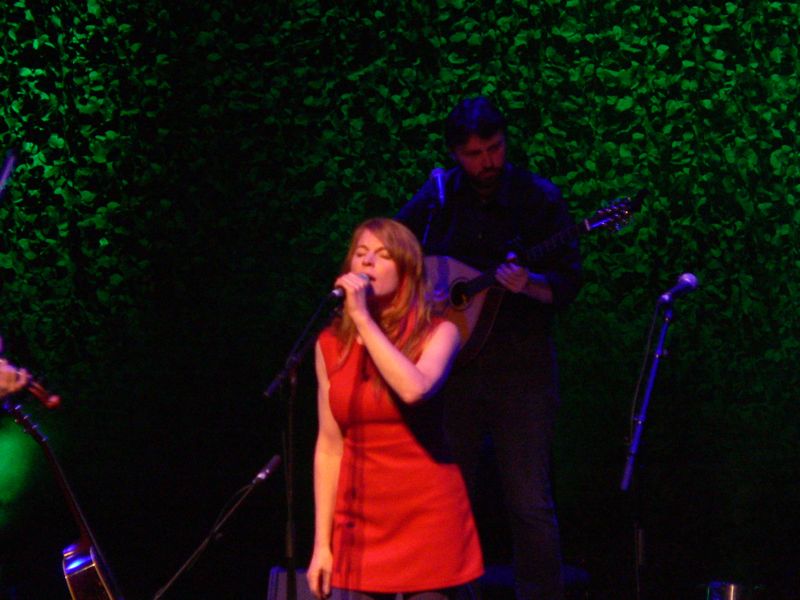
One of the hallmarks of the music of Ireland is connection, and another is conversation. Between musicians, with listeners, with the strands of irish tradition, with contemporary music which draws on tradition -- connection and conversation happen in al these ways. For twenty years, the musicians who join together as the band Danu have been working on this. Their album Buan clearly shows that they just keep getting better at these connections and conversations.

Across the years and through a few changes in membership, the band has retained the bright fire with which it began in Waterford those years ago and added the seasoning and maturity that twenty more years of living and playing music will bring. With musicians coming from Waterford, Dublin, Donegal, and Kerry they choose music which draws the range of Irish landscape into the conversation.

They invite listeners into the musical conversation of Buan with an opening set of slides and reels in which the traditions of Donegal meet those of Kerry. Bouzouki joins with flute, accordion takes its place as the tunes unfold and fiddle leads a lyrical dance on the closing tune as all the while bodhran speaks of the beat. Musical conversation continues with Nic Amhloaibh singing a song from Dingle in Irish. A lively set of jigs including two from McAuley’s pen flows into Nic Amlaoibh’s thoughtful rendition of Lord Gregory, a story of star crossed lovers which shows well not only Nic Amhloaibh’s fine voice but also the players’ ability and skill in supporting and illuminating a story told in song.

That skill is also evident in another and very different song. Donal Clancy’s choices in singing and phrasing work brilliantly to tell the story of Willie Crotty, an eighteenth century outlaw from the Waterford area whose colorful life is told in a song written by Clancy’s cousin Robbie O’Connell. The fast paced melody and upbeat playing only enhance Clancy’s storytelling flair.

The musical conversation in Buan continues in equally interesting fashion through a set of reels and a set of two lighthearted songs in Irish that the band dedicates to their children. The men of Ireland’s east and north were inspired by the west as well as a lovely set of a waltz composed by McAuley leads into a march composed by Clancy, both written after the band spent a week of rehearsal in West Kerry last spring.

The enigmatic, poetic, and image filled song Passage West by John Spillane of Cork provides a gorgeous showcase not only for Nic Amhlaioibh’s voice but for all the band members working together to create a vibrant story told as much through melody as through word -- and the words and singing themselves are powerful enough that they could stand alone.

Reels and hornpipes taken over from pipes music make up a set following Passage West, which makes a graceful bridge to The Willow Tree, a quiet song which weaves modern day love song with myth, legend, and landscape and which Nic Amhlaoibh learned from the singing of its composer, Padragian Ni Uallachain. That makes a fitting close to this conversation in music -- rather than a close an invitation to a quiet pause to reflect on the journey the conversation has taken, really -- a pause which will very likely lead to repeated listening.

Danu are: Éamon Doorley, guitar and bouzouki, Oisín McAuley, fiddle, Benny McCarthy, Accordion, Dónal Clancy, guitar, voice, Muireann Nic Amhlaoibh, voice, flute, and whistles.

Joining them on Buan are producer Donal Lunny on buzouki, zook, harmonium and bass bodhran as well as former band members Tom Doorley on flute and whistle and Donnachadh Gough on pipes and bodhran. For the concert at which the photographs were made, Oisin McAuley was delayed by weather from arriving in Glasgow, so former member Darragh Doyle stepped in. Phil Cunningham on accordion and Julie Fowlis on voice and whistles were also guests at the concert in Glasgow.

Photographs were made by Kerry Dexter at the Celtic Connections Festival in Glasgow, with permission of the artists, venue, and festival. Thank you for respecting copyright.

You may also wish to see
Ireland's Music: The Small Hours: Muireann Nic Amhlaoibh
Robbie, Aoife, and Donal: The Clancy Legacy
Julie Fowlis: Every Story

-->Your support for Music Road is welcome and needed. If you are able to chip in, here is a way to do that, through PayPal. Note that you do not have to have a PayPal account to do this. Thank you.

Another way to support: you could Buy Me a Coffee at ko-fi.com

Labels: , , , , , , , , , , ,

Bookmark and Share
posted by Kerry Dexter at 0 Comments

Wednesday, January 08, 2014

Best music 2013, part 2

Music at its best is a conversation, a connection between musicians and listeners and in some cases a wider world. Take a listen to conversations these musician offer.

This is part two of a three part series on best music of 2013 here at Music Road. Here is part one. Music Road: best music 2013, part 1

note: clicking on the text links and album cover images will take you to longer reviews of the recordings/and or places where you may hear bits of the music.

Ruth Moody, Canadian songwriter whose name you may know from her work with the award winning group The Wailin’ Jennys, is also a fine solo artist. She has the gift for weaving the spiritual into love songs and other experiences of day to day life in her lyrics, and the musicianship to invite you in. You may find all this, along with musical guests including Mike McGoldrick, Mark Knopfler , and Jerry Douglas on her album These Wilder Things.

Ron Block often puts questions of life illuminated by questions of faith front and center in his solo work too. In his case the ideas and the music are infused with bluegrass, which makes sense when you know that Block is a long time member of Alison Krauss + Union Station. Both as aspects of his interest come into his album Walking Song which includes a number of collaborations with new found songwriting partner Rebecca Reynolds.

You might know Heidi Talbot from her work with other musicians, as well: she was lead singer with Cherish the Ladies, and has been know to sing backup to Eddi Reader. Talbot is a fine solo artist as well. Her earlier albums have leant toward music draw for the deep reservoir of Celtic tradition (Talbot is Irish and lives in Scotland). On Angels Without Wings she walks farther into adding her own songwriting voice to the mix, and it proves as powerful and as gracious a one as is her singing voice. Notable cuts include When the Roses Come Again, I’m Not Sorry, and My Sister the Moon.

Childsplay is a gathering of musicians who come together in the Boston area, centered around musicians who play violins made by Bob Childs. The music they make on As the Crow Flies is by turns Celtic, Americana, and contemporary, some original compositions, some from those traditions. It’s not just violin and fiddle, either -- they bring along musical friends including flute player Shannon Heaton and guitarist Keith Murphy as well as Lissa Schneckenburger -- she is one of the fiddle players to be sure, and also lends her fine voice to tracks including Dear Companion and As the Crow Flies. Fiddle players you’ve met here along the music road include Hanneke Cassel and Katie McNally, and Nic Gareiss brings the percussion of his dancing feet as well.

The Paul McKenna Band are rising stars of Scotland’s music. Their album Elements, recently released in the United States, makes clear why this is so: creative tunes, thoughtful songs, a good blend of fast paced and slower tempo, and through it all the taste of Scotland lingers. Standout tracks include the instrumental set Flying Through Flanders , the fast paced song Mickey Dam, and the quiet reflection of the song Indiana.

Dervish know well how to balance music between high flying tunes and time for that quiet side side of things too. They are from the west of Ireland, and a number of the songs they have on The Thrush in the Storm are ones they draw from time as band in residence in Leitrim. The stories they tell in the liner notes are almost as interesting as the ones they tell in the songs and tunes. Listen out for The Rolling Wave set and Shanagolden, which has particularly fine singing from Cathy Jordan.

Therese Honey does not sing a line on her album Summer's End: her instrument is the harp. It’s a fine collection of original and traditional tunes in Celtic tradition, some lively, many inviting reflection. It is a recording you’d do well to let play through as the musician has sequenced the tunes for you.

John Reischman’s instrument is the mandolin, and while on Walk Along John he shows just about every color of it in folk, bluegrass, and Americana music, it’s the power of story, and of the journey he creates for the listener, that shines even more brightly than his skill on his instrument. It’s mainly original music with a few well chosen traditional tunes mixed in. From the Itzbin Reel to A Prairie Jewel though to Anisa’s Lullabye, Reischman will keep you engaged in his musical journey.

Joy Dunlop has a journey to bring you along on, as well -- in her case it is through her native Argyll in the west of Scotland. Whether Scottish Gaelic is your language or not, you’ll follow along with the humor, sorrow, joy, celebration, and other emotions Dunlop shares on Faileasan/Reflections, No worries if your Gaelic is not fluent -- or if you have any at all -- Dunlop tells the stories of the songs and a bit about how they came to her in the liner notes, in English. You’ll recognize the names of several of her musical friends -- all with connections to Argyll -- among them Donald Shaw, Karen Matheson, and Mary Ann Kennedy.

photographs are by Kerry Dexter, and are copyrighted. thank you for respecting this.

you may also wish to see
Ireland's music: two voices
Winter's grace

-->Your support for Music Road is welcome and needed. If you are able to chip in, here is a way to do that, through PayPal. Note that you do not have to have a PayPal account to do this. Thank you.

Labels: , , , , , , , , ,

Bookmark and Share
posted by Kerry Dexter at 0 Comments