Wednesday, March 28, 2018

Ireland's Music: Murieann Nic Amhlaoibh: Foxglove & Fuschia

As she was planning the project which would become her album Foxglove & Fuschia, Muireann Nic Amhlaoibh decided she wanted the music to be a bit like what she might do if she were planning for a gig in a pub near her home in Corca Duibhne, the Dingle peninsula, in the west of Ireland. It’s a situation she knows well, as she grew up in Dingle, surrounded by music and going to sessions from a young age.

As ancient stones and worn paths through mountain and along coast attest, people have been calling the Dingle peninsula in the west of Ireland home for thousands upon thousands of years. Rain and mist and wind, mountain and sea meet in a landscapes that suggests and evokes history and story.

Those stories are often told, shared, and forged through music.

Muireann Nic Amhlaoibh has studied in Dublin, taught in LImerick, and traveled the world with her music. For thirteen years she was lead singer and flute player with the top Irish band Danu. I came time, though, to return to to her native west Kerry, to live again in the Irish speaking region of the far west of Dingle where she herself had grown up and begun her life in music,

She also thought at the time that stepping away from Danu might be the end of her public career as a musician. It wasn’t.

/>

A sure and steady vision of where she is and what she wishes to create as an artist is at the heart of Foxglove & Fuschia, which is Nic Amhlaoibh’s third solo album. There are songs in English and in Irish, and a few well chosen tune sets too.

Some of the music has its origin in west Kerry. Other songs and stories make their way in from father afield. They all, though, relate in some way to that life of water and mist, music and mountain and story found in Dingle.

There is the gentle joy of word and lyric in Muirisin Deas is Nora, a song from The Great Blasket Island, which lies just to the west of the tip of Dingle. It is about a couple who have been married a long time and are still very much in love. The words in Irish are from a traditional poem, set to a new melody by guitarist Gerry O’ Beirne. O’Beirne, who often plays with Nic Amhloaibh when she goes on the road with her music, supports her on the song for the recording.He also wrote the image filled song Where Foxglove, from which Nic Amhlaoibh drew the title for the recording.

For most pieces on Foxglove & Fuschia, there are just one two musicians joining Nic Amhlaoibh. That still leaves good scope for family and friends to sit in, though: there’s a set of reels with Nic Amhlaoibh’s husband Billy Mag Fhlionn on bouzouki and a friend from her days with Danu, Donnchadh Gough, on bodhran, and on a set of polkas with her father, Feargal MacAmhlaoibh, as the fiddler, and with longtime friends, Padraig O se on accordion and Donough Hennessey on guitars. Donal O’Connor, Seamus Begley, Pauline Sclanlon. Eilis Kennedy and John McSherry are among those who sit in on various tracks, too.
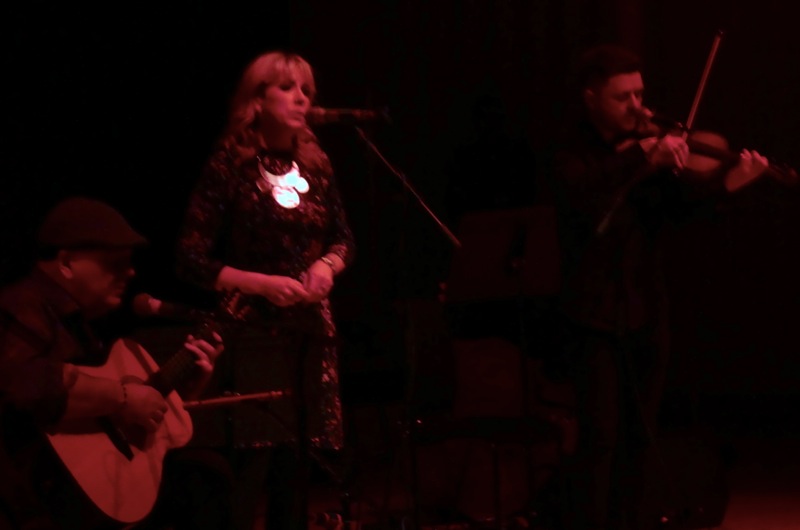
It is Nic Amhlaoibh’s voice and vision which define what’s happening on the album, though. Nowhere is that more evident than on The Final Trawl, a song of the sea by Scotland’s Archie Fisher. As part of her working co presenting the television programme Port for BBC Alba with Scottish singer Julie Fowlis, Nic Amhlaoibh had the chance to meet and sing with Fisher, who wrote the song with ideas and images drawn from his experience of seafaring.

Another song that weaves together the album’s ideas is Bean Dubh an Ghleanna. It is Nic Amhlaoibh says, one of the big songs which to her mind make up the classical tradition of Ireland’s folk music. Nic Amhlaoibh grew up in Dingle, in the Gaeltacht, where, she points out, you don’t actually study the traditional style of sean nos, you’re given the words and the melody and expected to find your own way into them.

Indeed, so she has, through each of the tracks on the recording. There are eleven of them, and each invites repeated listening. Tune, song, and story shared in ways which honor tradition and create it anew in one of Ireland’s most interesting and creative voices: this is what you will find on Foxglove & Fuschia.

Photographs of Muireann Nic Amhlaoibh and friends in concert at Celtic Connections in Glasgow, Scotland, by Kerry Dexter, made by permission of the artists, the festival, and the venue. Thank you for respecting copyright

You may also wish to see
Muireann Nic Amhlaoibh & Julie Fowlis: Dual
Musireann Nic Amhlaoibh: The Small Hours
Muireann Nic Amhlaoibh’s web site
Cathie Ryan: Through Wind & Rain

-->Your support for the work,here at Music Road is welcome and needed.
Here is one way to offer that, through PayPal. Note that you do not have to have a PayPal account to do this. Thank you.

Another way to support: you could Buy Me a Coffee at ko-fi.com

Labels: , , , , , , , , , , , , , ,

Bookmark and Share
posted by Kerry Dexter at 0 Comments

Tuesday, March 17, 2015

Ireland's Music: Cara Dillon: A Thousand Hearts

Finding songs to record is, for Irish singer Cara Dillon, rather like a journey -- a journey through time and ideas, words and melody, through songs from the traditions of Ireland, contemporary song, and at times music she and her husband and musical partner Sam Lakeman write themselves. They have learned to take their time with things, with letting the music and the ideas take them on journeys, and find the best ways to put their own stamp on them as they share the music with their audiences.

As they were considering the songs that make up the collection they have gathered for A Thousand Hearts they were struck by by a thread of hearts and passion which run through the stories told. Not that the pieces are all romantic love songs -- there are those, but alongside them songs of longing, regret, choices, change, faith, mystery, love for land, emigration, and humor -- all things which encompass and are encompassed by love. So they came to the title A Thousand Hearts.

Dillon often crosses the borders of musical styles in her work, but it is to Irish tradition that she returns as the base for her understanding of and respect for music.

“I’m from a very small town in County Derry, in the northwest of Ireland,” Dillon says, “ and basically where I’m from music, traditional music, is a way of life. Everyone is encouraged from when they’re knee high to play an instrument and to sing. to learn the local songs of the town there, Dungiven, and the local history and the legends of the town.”

It was to memories of music she learned while growing up that Dillon and Lakeman returned for several pieces on the album. My Donald is one such: it is the story of a woman thinking of her man, who works on the sea following the whale. In Dillon’s introspective treatment, it seems as though the listener is hearing the woman’s tale directly -- set off by an instrumental bit at the end which both allows Dillon’s gifted backing musicians to show their chops and suggests thoughts of those stormy and distant seas the sailor might traversing.

The Shores of Lough Bran finds Dillon giving a thoughtful take on an emigration song, which in a way resonates with her choice of Shawn Colvin’s modern day song of another sort of leaving, a love affair which is, as you might gather from its title, going to end: Shotgun Down the Avalanche. Lough Bran is, in fact, a much more hopeful and upbeat song, which makes sense, but both speak of longing and change -- as does River Run, another contemporary piece written in memory of one who died at a young age. River Run, Dillon’s voice is backed by Lakeman alone on piano, offers a quiet meditation on grief and change done with just the right degree of understatement.

All of which may make the album sound a bit grim; it’s not, not at all. There are upbeat songs, for one thing: the cheery story and melody of Jacket So Blue, the wry humor of Eighteen Years Old are two.

Speaking of love, and hope, and hearts: two of the strongest songs on the album -- though all of them are keepers -- treat of these things in differing musical and lyrical ways, but yet the threads of love, hope, choice and change resonate through them as well. Bright Morning Star Arising, from Canadian musician Ruth Moody, suggests that idea of hope and change -- for the better, this time -- through both title and lyric, and Dillon has found that when she does it in concert, people in her audiences are singing along with the choruses. Taímse Im’ Choladh. which Dillon sings in Irish, is an aisling, a dream song, in which Ireland (or Scotland, the song is known there are well) appears in a dream in the person of a beautiful woman urging the dreamer to rise and help her.

Whatever the source of the song they are working on at the time, “we always try to keep the song at the forefront of what we do, myself and Sam,” Dillon says, “because we both have such a great respect for the tradition. The way we describe it to each other at times is like finding a really beautiful gemstone and trying to find the right setting for it, so that it’s the focus of everyone's attention. The setting is just as important for it to be seen. We work on the songs a lot, and sometimes people come up after the show and say, is that a traditional song, or a song that you’ve written? And to me, that’s quite a big compliment.”

Gorgeous voice, thoughtful phrasing, backing players who add their own gifts to the telling of the stories: with A Thousand Hearts Cara Dillon and Sam Lakeman have indeed met the challenges they set themselves. Take a listen; take more than one. Each song is a gem which reveals another facet as listenings unfold.

Photograph of Cara Dillon by Kerry Dexter, made at the Celtic Connections Festival with permission of the artist, the festival and the venue. Thank you for respecting copyright.

Note: When first written this album was available to order only from European sources, but it is now available trough Amazon in the US (Music Road is an Amazon affiliate -- this does not influence coverage) in both physical and digital formats. Most links in this story now take you to Amazon US; I've left one to Amazon UK in the next to last paragraph for the convenience of Europe based readers.

You may also wish to see
Ireland's music: Cara Dillon: Lass of Glenshee
Julie Fowlis: Every Story
Cathie Ryan: Through Wind and Rain

If you'd like to support my creative work at Music Road,
here is a way to do that, through PayPal. Note that you do not have to have a PayPal account to do this. Thank you.

Labels: , , , , ,

Bookmark and Share
posted by Kerry Dexter at 1 Comments

Friday, February 22, 2013

Ireland's Music: The Small Hours: Muireann Nic Amhlaoibh

Dun Chaoin, in the Dingle peninsula in West Kerry, is a place where sea meets land and light and mountainside. It is a place where legend meets story meets present day. It is an area known for its rugged beauty, deep connection with history, a place where Irish is spoken as much, if not more, than English, and music in both languages is part of the conversation. Muireann Nic Amhlaoibh grew up there. Whether she is offering music from close to home or far way, West Kerry is a landscape you hear in her music.

Most often you hear her music in collaboration with other artists, particularly with her band mates in the top traditional band Danu, where Nic Amhlaoibh is the singer and has played flutes and whistles as well for going on a decade now. The members of Danu come from different parts of Ireland. One of the things that strengthens their sound as a band is that they take time to work in individual projects. Nic Amhlaoibh’s second solo recording, Ar Uair Bhig An Lae - The Small Hours, finds her exploring songs from nearby along with several which have caught her ear during her travels.

“Upon my return home to west Kerry at the stat of summer 2012, it was clear that I was returning to the wellspring, as songs started to come at me from all sides!” she writes in the album’s notes. One such is An Chiurach Bhleinfhionn, a song which may, it turns out, have been written about the location where she now lives. There are songs in Irish from West Kerry, from Cork, from the words of one of Ireland’s most famous female poets, songs which Nic Amhlaoibh learned from friends and neighbors along the way. There are songs in English as well. On tour in New Zealand Nic Amhlaoibh met Australian songwriter Kate Burke and has included her song Gold Hills, which fits in well in both word and idea with the songs in Irish. “I’m not really thinking about switching between languages, I’m thinking about the song when I’m working out what to sing,” she says. “But now that I’ve been at this for a while, and have had a few years to think about it, I see I’m almost a representative of the language, and in that sense I’m very proud to be able to sing in Irish, and if it gets people more interested in it, I’m very happy about that. There’s a great musicality to it, and I think people respond to that, whether they’re understanding the words or not.”

Nic Amhlaoibh herself has long been drawn to American bluegrass, so she has included a song from folk and bluegrass musician Tim O’Brien, which is called Another Day. It speaks of life and generations going on and the song living on after the singer, an idea which resonates through traditional music and fits well with the stories told in the other songs on the recording.

Nic Amhlaoibh’s own music began as a young child. She was drawn to music, but her father, a fiddler, could not get her interested in his instrument. She liked flutes and whistles, though, and followed her interest in singing, learning from tradition bearers around her in West Kerry. “You don’t really study sean nos singing,” she says of the bedrock style of Irish traditional singing. “You’re given the song, the words and the melody, and you’re expected to listen really well.”

From that beginning, too, you are expected to find your own way and your own place with a song. That is an approach which allows Nic Amhlaoibh to serve the spirit of these songs as she brings her own ideas to them. This is nowhere more clear -- or more beautifully done -- than in Cois na Abhann na Sead, which is known as River of Gems in English, and with The Bold Fenian Men, a story drawn from the history of Ireland which many have recorded, but none better than that which you’ll find on Ar Uair Bhig An Lae - The Small Hours.

The album was recorded in West Kerry with engineering by Ivan O'Shea and Donogh Hennessy. Among those backing Nic Amhlaoibh on the recording are Oisin McAuley on fiddle and Billy Mag Fhloinn on bodhran.

you may also wish to see
music, history, and Heisgeir
Dual: Julie Fowlis & Muireann Nic Amhlaoibh
learning about Irish music: a bouquet of albums for spring

my apologies to the Irish speakers here: I am writing on a computer which doesn’t allow for fadas -- and if you are wondering what those may be, they are diacritical marks, accent marks, used in Irish

-->If you'd like to support my creative work,
here is a way to do that, through PayPal. Note that you do not have to have a PayPal account to do this.Thank you.

Labels: , , , , , , , ,

Bookmark and Share
posted by Kerry Dexter at 7 Comments

Tuesday, March 06, 2012

Music of Ireland: Songs of the Scribe

The flight of a blackbird across the lough, a flight up to the stars, longing for solitude, longing for a lover, thanks for the wild winds, contemplation of the winds of God that put fire in the head, the gentle companionship of a quiet cat: all these make their way into Songs of the Scribe..

songs of the scrinbe music of irelandThe writers were the people who created the illuminated manuscripts of medieval Europe, the Book of Kells and its companions. These poems and and fragments and reflections come from Ireland, where most of this work was done in medieval times -- that idea of Ireland as a land of saints and scholars goes back a long way -- and they are some of the first bits of personal poetry in Ireland.

Pádraigín Ní Uallacháin, musician and scholar, has taken these texts as inspiration and substance for a series of contemplative songs, ones that evoke the stillness and focus, the history and the lives of this ancient time. They invite you in to “a world of woods, water, and birdsong, lamentation and the divine, mystical incantation and love songs,” she says.

So they do. There are ten pieces in all, all sung in Irish. The Hermit’s Wish is, as one might suspect from the title, one for solitude, to be alone with God. Liadan’s Lament longs for a lost lover, while Land of the Stars tells of a legend of love fulfilled and a flight to the stars in celebration. The quieter world of ancient times comes through as The Blackbird of Belfast Lough takes flight, while The Incantation of Amergin holds echoes of older times in its prayers of Christian faith. There’s the fire and wind of God spoken of in that one. In The Wind is Wild Tonight, the writer gives thanks for winds for a reason perhaps less mystical -- the wild winds of an Irish winter are about, and that means Viking raiders will not be sailing.

Ní Uallacháin’s voice is backed by her own touch on drones and bells with harps, monochords, and Tibetan bowl from Helen Davies. These spare arrangements well suit the songs. Contemplative they are, indeed, but distant, not at all. In Ní Uallacháin’s hands, it’s a world both present and ancient. That’s a dichotomy which will resonate with anyone who has ever spent a night of wild winds or crisp clear morning in Ireland.

The liner notes add to the music, with Irish lyrics and English translations, some of Ní Uallacháin’s thoughts on each song and bits about the history of the text, and photographs and images which enhance these ideas in

Songs of the Scribe

You may also wish to see
Ní Uallacháin’s book on the music of south east Ulster A Hidden Ulster: People, Songs and Traditions of Oriel
Music Road: Cathie Ryan: teaching tradition
Music Road: Music Road trip West Virginia Update: You may also want to learn about

Ní Uallacháin’s 2024 album Seven Daughters of the Sea

-->Your support for Music Road is welcome and needed. If you are able to chip in, here is a way to do that, through PayPal. Note that you do not have to have a PayPal account to do this. Thank you.

Another way to support: you could Buy Me a Coffee at ko-fi.com

Labels: , , , , , , , , ,

Bookmark and Share
posted by Kerry Dexter at 8 Comments

Monday, February 27, 2012

Music of Donegal: Altan: The Poison Glen -Gleann Nimhe

Land, sea, mountain, legend, history, solitude and community: Donegal, in Ireland's far northwest, is filled with these things. Altan, whose latest album is named after an area in Donegal called The Poison Glen, distill the essence of this land, both spirit and landscape, into their music.
altan poison glen donegal ireland music

As they have taken the music of Donegal across the globe for three decades now, Altan have collaborated with the artists ranging from Nashville’s country stars to Dublin’s classically trained musicians. Thinking about their latest project, they decided to focus on the energy and clarity that they bring to their live shows, just the six band members themselves, sparkling collaborations among fiddles, accordion, guitar, and bouzouki, deep energy of shared musical creativity, and Mairéad Ni Mhaonaigh’s thoughtful and thought provoking singing of songs in both English and Irish. These are what the band chose as the focus of how to present their music on The Poison Glen. “This is the core of our sound, what we do in our live shows, “ Ni Mhaonaigh says.

As they often do in performance, they open with a lively instrumental set, in this case pairing the traditional slip jig A Fig for a Kiss with the recently composed tune The Turf Cutter. This leads into the gentle song Seolta Geala,which invites you to seek the freedom of the ocean and forget the cares of with world,. Ni Mhaonaigh sings this in Irish. A set of reels which begins with The New Rigged Ship, a tune which traveled to Donegal from Shetland, well calls to mind that tunes in Irish music are most often made for dancers. “There’s a lot of emotion, a lot of life experience in these tunes. They're tunes for dances, but people pick up on the emotion in them,” Ni Mhaonaigh points out.

There is life experience in the songs, too, in both words and melody. Lily of the West is a tale involving love, jealousy, confrontation, murder, exile, and all sorts of other things, which has traveled back and forth across the ocean between the Americas and Ireland more than once. Ni Mhaonaigh and the band put their own stamp on the song, which Ni Mhaonaigh learned from a singer from Aranmore, who had a large store of songs in Irish -- this was one of the few songs in in English that she sang. There are thirteen tracks in all on the album, well balances between song and tune, between music from traditional sources and newly composed material.

A deep gift for finding and creating songs and tunes which honor and share the rugged landscape,strong community, and long legends of Donegal is what has marked Altan, since the early days in the 1980s when Ni Mhaonaigh and her late husband Frankie Kennedy began playing as the duo which evolved into the current band of six musicians. As they worked together on The Poison Glen, not only did they enjoy putting this project together, but “we saw there is a lot of creativity in the band, a lot of places for us to go. We all write, we all compose...an album of all original music might be something we’d look to do in future. We saw, too, how we could use the studio almost as another instrument in the band,” Ni Mhaonaigh says. “We’re very proud of this album, and we see there are more possibilities ahead for us to explore.”

Altan is:
altan ireland music celtic connections copyright kerry dexter Daithi Sproule, whose own compositions have been recorded by Liz Carroll, Aoife Clancy and others, on guitar, Ciaran Curran, whose subtle and original touch on bouzouki have brought him many chances to work with great traditional players, and Mark Kelly, who adds a rock and jazz as well as classical music knowledge to his work with the band on on guitar and backing vocals, Ciaran Tourish has added his talent on fiddle and whistles to the music of Paul Brady, Mary Black, Maura O'Connell, Dé Danann and Tim O'Brien among others, while Dermot Byrne, who plays accordion, has worked with Manus McGuire, Sharon Shannon, Frankie Gavin, and the late jazz violinist Stephane Grappelli. Mairéad Ni Mhaonaigh, on fiddle and vocals, has recorded with Enya, the Chieftains, Dolly Parton, T With the Maggies and others, and she is also in demand as a teacher and as a presenter of programs for broadcast . On Poison Glen, they are joined by Jim Higgins on percussion and Harry Bradley on flute.

About the title:
“The Poison Glen is a very beautiful part of Donegal,” Ni Mhaonaigh says. There are many stories about how it got its name, from it being a map maker’s mistaken writing of the name to an event in a battle fought there to a legend involving a one eyed giant called Balor, his daughter who he locked in a tower, a man who came to free the daughter, and what happened next. “I like the story about Balor the best!” says Ni Mhaonaigh. “We had Poison Glen it as a working title for the album, and we thought it had bit of an edge to it, so we decided to keep it.”

photograph of members of Altan at the Celtic Connections Festival in Glasgow, made with permission of the artists and the festival, and is copyrighted. thank you for respecting this.

you may also wish to see

Music Road: Altan: 25th Anniversary Collection
Music Road: from Donegal: T with the Maggies
for another equally interesting version of Lily of the West, check out Lovers' Well: Matt & Shannon Heaton

-->Your support for Music Road is welcome and needed. If you are able to chip in, here is a way to do that, through PayPal. Note that you do not have to have a PayPal account to do this. Thank you.

Labels: , , , , , , , ,

Bookmark and Share
posted by Kerry Dexter at 1 Comments

Thursday, December 01, 2011

Music for the first week in Advent: candle in the window

There is a tradition in Irish households, in Ireland and through the Irish diaspora across the world, to leave a light in the window on Christmas eve, and at times during other nights in December as well. This is meant to show that the holy family, on their journey seeking shelter that Christmas eve in Bethlehem, would be welcome. It’s also meant to show that Christ is welcome here, and that strangers weary on the road this Christmas season find welcome at this home. The Christ candle, we always called it when I was growing up.

Moya Brennan and Mairéad Ni Mhaonaigh grew up in Donegal, in the north west of Ireland. They went their separate ways into top level careers in music, Brennan playing the harp and singing with the group Clannad and Ni Mhaonaigh singing and playing the fiddle with the band Altan. Each has had success as a solo artist, as well. In this video, they are taking a walk on a winter day in Donegal, and they sing a song Mairéad wrote, called Soilse na Nollaig, which you might translate to English as Christmas lights or December lights. It’s a fine song to hear during this first week in Advent.


Moya and Mairéad recently joined forces with two other childhood friends to form the group T with the Maggies, and they’ve so far released one album. They have done several Christmas concerts in Ireland, so perhaps a holiday album may in future. Music Road: from Donegal: T with the Maggies

you may also wish to see
Music Road: Dual: Julie Fowlis & Muireann Nic Amhlaoibh
Music Road: Cathie Ryan: teaching tradition

-->Your support for Music Road is welcome and needed. If you are able to chip in, here is a way to do that, through PayPal. Note that you do not have to have a PayPal account to do this. Thank you.

Labels: , , , , , , , , , ,

Bookmark and Share
posted by Kerry Dexter at 4 Comments

Saturday, June 18, 2011

Old stories, old songs: Róisín Dubh by Elsafty, Armstrong, Browne

this really doesn't need anything from me except to advise you to watch and listen, and to let you know the musicians are Ronan Browne on pipes, Róisín Elsafty the singer, and Siobhán Armstrong playing the harp, at the Galway Early Music Festival


more about sean nos and about the EAB trio members to come...

you may also wish to see

Cathie Ryan also does a mesmerizing version of Roisin Dubh, which she recorded when she was with Cherish the Ladies
Music Road: harps and Celtic Connections
Ma Bhionn Tu Liom Bi Liom

-->Your support for Music Road is welcome and needed. If you are able to chip in, here is a way to do that, through PayPal. Note that you do not have to have a PayPal account to do this. Thank you.

Labels: , , , , , , , , , ,

Bookmark and Share
posted by Kerry Dexter at 1 Comments

Monday, December 14, 2009

Third week in advent


The sort of happy anticipation you have when you're getting ready to be with someone you love is the idea behind the readings and celebrations of the third week in Advent. Gaudete Sunday, the third Sunday is often called, from the introit in the Mass of the day - gaudete -- rejoice.

Music that especially goes along with this idea is a recording by the Ireland based group Dordan called The Night Before. Dordan is Mary Bergin on whistles and flute, Dearbhaill Standun on fiddle, Kathleen Loughnane on harp, and singer and guitarist Martina Goggin. With seasonal tunes and songs they create an atmosphere by turns hushed and joyous, and in many ways very Irish too, all leading to Christmas eve, and then the celebration of Christmas. Music includes Draiocht na bOiche, Oiche Nollag, Don Oiche Ud i mBeithil, and March of the Dreoilin.

You may find The Night Before as a stand alone recording, but a better way to look for it is as part of the two disc set
Narada Presents: The Best of Celtic Christmas. More about the other disc to come -- it includes music from Bonnie Rideout, Kathy Mattea, Cathie Ryan, and Natalie MacMaster among others.


you may also want to see
Music Road: first week in advent

Music Road: Eileen Ivers: An Nollaig

Music Road: Alasdair Fraser & Natalie Haas: In the Moment

-->Your support for Music Road is welcome and needed. If you are able to chip in, here is a way to do that, with any amount of your choosing, through PayPal. Note that you do not have to have a PayPal account to do this. Thank you.

Another way you could chip in is

You can also Buy Me a Coffee at ko-fi.com

Labels: , , , , , , ,

Bookmark and Share
posted by Kerry Dexter at 4 Comments

Sunday, May 17, 2009

Dual: Julie Fowlis & Muireann Nic Amhlaoibh: video

The recording Dual, in which Julie Fowlis, Muireann Nic Amhlaoibh, Ross Martin, and Eamon Doorley join up to explore connections and differences in Irish and Scots Gaelic music, made our best of the year list here at Music Road.

They have just announced a run of new tour dates beginning later this month in Ireland.
Whether you can make one of the dates noted below or not, look in on them performinga song from the record at the launch of the Scottish language television network, MG Alba. Doesn't that look like an amazing space in which to play?


more about the recording
Dual: Julie Fowlis & Muireann Nic Amhlaoibh

new tour dates:

28th May. 8pm. Regional Cultural Centre, Port Road, Letterkenny, Co. Donegal

29th May 8pm. The Glens Centre, Manorhamilton, Co. Leitrim

30th May, 8pm. An Droichead, Cook St, Belfast.

1st June, 8pm. The Crane, 2 Sea Road, Galway.

3rd June, 8pm. Linnenhall Arts Centre, Castlebar, Co. Mayo

4th June, 8pm. Celbridge Library, Celbridge, Co. Kildare.

5th June, 8pm. Racket Hall Country House Hotel, Roscrea, Co. Tipperary

6th June, 8pm. Ionad an Bhlacaoid Mhóir, Dún Chaoin, Co. Chiarraí


you may also want to see

Music Road: best music, 2008

Muireann Nic Amhlaoibh: Daybreak/Fainne an Lae

a short film about julie fowlis

-->Your support for Music Road is welcome and needed. If you are able to chip in, here is a way to do that, through PayPal. Note that you do not have to have a PayPal account to do this. Thank you.

Labels: , , , , , ,

Bookmark and Share
posted by Kerry Dexter at 1 Comments

Monday, March 16, 2009

Music of Donegal: Altan


Local Ground


Donegal is in the far northwest of Ireland, a land of mountain and water, and one which shares more of its borders with Northern Ireland than with the Republic. Going back in history, it has been a place with many close connections with Scotland, and an area where Irish is often the first language. All those influences have come into play with through the music of the area, producing varied and distinctive styles of melody and song, and musicians who are not afraid to mix up genres and styles to get their points across.

The band Altan is one of the best known and most highly regarded groups of musicians from Ireland’s northwest, attacking tunes with fire and vigor at one moment and turning in haunting ballads the next. That is, in fact, reflective of of both the landscape on the history of their native place. Local Ground is a recent recording, which includes songs in both English and Irish, a crossing the waters American folk song Adieu My Lovely Nancy, a jig from early 20th century Donegal fiddle master John Doherty, one learned from modern Donegal born fiddle giant Tommy Peoples, several original tunes, and a close with a lullabye gently sung in Irish, Dun Do Shuil, Close Your Eyes.


As you are thinking about St. Patrick and lreland, here ia video to go along. celeberating Ireland's far northwest, a place where Irish and Scottish music, landscape, and isolation have united over the years to form a music with its own voice.

-->If you'd like to support my creative work,
here is a way to do that, through PayPal. Note that you do not have to have a PayPal account to do this.Thank you.

Labels: , , , , ,

Bookmark and Share
posted by Kerry Dexter at 0 Comments

Friday, November 14, 2008

Dual: Julie Fowlis & Muireann Nic Amhlaoibh

Julie Fowlis, Muireann Nic Amhlaoibh, Eamon Doorley, and Ross Martin

Dual

In English, the word dual means two sides of the same thing, be they alike or different. In Irish and in Scots Gaelic, dual means to twine, braid, interlace, or coil. It also means one’s own inheritance. So it is the right title for this collaboration among four musicians who explore the connections and divergences of Scots Gaelic and Irish music.

If you’re thinking but wait, I don’t know either of these languages, have no worries. You can hear the stories, the rhythms, the sea, the laughter, the history, and the conversation quite clearly through the music as the four play and sing. And if you’d like to, you may check out their comments and English translations of the lyrics in the liner notes. But listen a few times through first.

Fowlis is from North Uist in the Outer Hebrides off the northwest coast of Scotland. Nic Amhlaoibh is from Dun Chaoin, in Kerry about as far west as you can go on coast of Ireland. The two singers met several years ago, and as a one off thing a at festival decided to try doing a couple of songs together. “Only we found we had no songs in common -- or so we thought then,” Fowlis recalled. Each taught the other a song, “and we just had a blast. It was so much fun,” Nic Amhlaoibh says.

As it turned out, they did have a good bit of music in common, or at least in similarity. They found they had quite a few personal parallels as well. Each was in a band and doing solo work too, each had grown up in the far western parts of their homelands, learning songs in the old languages from tradition bearers themselves, and speaking Irish and Scotttish Gaelic as naturally as English. “When I’m doing a song, I don’t think of what language the song is in, I just think of the story,” Nic Amhlaoibh says. “Scots Gaelic is a very ancient language,” Fowlis points out. “Some of these songs go back centuries. But they are about real places and real emotions, and it’s what I know and love.”

Fowlis is in the band Dochas, has two solo albums out, often guests on other musicians’ projects, and was recently named Scotland’s first ambassador for Scottish Gaelic in recognition of her work as a musician. Nic Amhlaoibh is the lead singer with the top Irish band Danu, hosts specials on TG4, the Irish language television network, and teaches in the traditional music course at the University of Limerick. Still, “One of us came up with the hare brained idea to do a tour, just in Gaelic speaking areas. So I booked a few gigs in Scotland she organized a few dates in Ireland, and off we went -- and the concerts were wonderful, really intimate concerts at small halls, but they went over well and we loved doing it,” Fowlis said. Each year Nic Amhlaoibh, who also plays flutes and tin whistles, Fowlis, who plays whistles and pipes in addition to her singing, Fowlis’ husband Eamon Doorley, who plays bouzouki in the band Danu with Nic Amhlaoibh, and Scottish guitarist Ross Martin made time for a short run of gigs. Their audiences kept asking for an album, even when they ventured into booking gigs outside the Gaeltacht. “After we’d booked those we wondered, is this going to work at all?” Fowlis recalled, laughing. It did, and provided the push to get them gathering up grant support, booking studio time, and creating what stands to be one of the best records of the year, in any language.

As the concerts were, it’s an intimate collection. Fowlis’ sister Michelle adds vocals on one cut, and Nic Amhlaoibh’s husband, Billy Mag Fhloinn, joins in on bodhran, but aside from their contributions it’s just the original four. They offer songs about work, about a boat race, about the sea, about singing and dancing, love songs and pipe tunes and songs about battles. The languages and musics of Ireland and Scotland diverged about four centuries ago, and the music the artists have chosen here highlights both divergence and connection in story and in melody. You might hear a melody line that reminds you of the song My Own Dear Galway Bay in the song An Eala Bhan, which is from North Uist, or one that calls to mind the Irish love song Mo Ghille Mear in A Riogain Uasall, which is thought to be a metaphor for the battle of Culloden.

What you will mainly hear, whether you understand the languages or not, is conversation on the love of the land, the people and their stories, their work their lives, and their histories. It is a conversation in words you may or may not know, played and sung with grace and emotion which make language not a barrier, but a connection.

Julie Fowlis

Muireann Nic Amhlaoibh

You may also wisht to see
Muireann Nic Amhlaoibh: Daybreak/Fainne an Lae
a short film about julie fowlis
Danu: One Night Stand
Dochas: An Darna Umhail/ A Second Glance

Labels: , , , , , , ,

Bookmark and Share
posted by Kerry Dexter at 0 Comments

Wednesday, September 24, 2008

Gaelic and Irish on television


There’s now a television channel in Scotland which broadcasts in Scots Gaelic. It has studios on Lewis and on Skye. It’s called BBC Alba, and is available on Sky Channel and freesat, and is expected to become available on cable as arrangements are worked out.

BBC Alba is still ramping up its program schedule; however it is expected to provide an additional outlet for Gaelic speaking musicians, as well well as broadcasting sports, drama, and programs for those learning Gaelic. Speaking of musicians, the debut programming on BBC Alba included a movie about Elvis, whose family actually has Scottish roots. And next time you’re in the Prestwick airport, near Glasgow, look for a marker commemorating his visit there.

In Ireland, the Irish language channel TG4 has been around for some years and has a full range of programming, from music to chat shows to soap operas to documentaries. The English language television broadcaster in Ireland, RTE, is running a series on its web site called easy Irish, to assist with learning or remembering conversational Irish.

What does all this have to to with music? There’s a thought that the rhythms of language are related to the rhythms of music. There are also songs with lyrics in both languages. And there’s a thought that language and poetry and music are related to landscape. There’s fine song writing, past and present, in Irish, English, Gaelic, and Scots, languages which are each, in their ways, related. Learning more of each adds to the appreciation of the music.

A number of the artists you’ll find here along the Music Road sing in these languages, including Julie Fowlis, Muireann nic Amhlaoibh, Emily Smith, Cathie Ryan, Mary Black, Mary Ann Kennedy, and John Spillane. There are, of course many more who do also. BBC Alba, BBC Scotland, BBC Northern Ireland, RTE, and TG4 all have web sites, each with some programming available online. Even if you do not plan to study the languages, it will add dimesnsion to your music listening to hear them spoken.


link to a video of Cathie Ryan singing in Irish
Music Road: now playing: a short film about julie fowlis

Labels: , , , ,

Bookmark and Share
posted by Kerry Dexter at 0 Comments