Sunday, September 27, 2020

Ireland's Music: Thar Toinn/ Seaborne from Muireann Nic Amhlaoibh

The sea, especially the sea in the west of Ireland, has always been part of Muireann Nic Amhlaoibh’s life. So has Gaelic. Music has, as well. It is natural, then then that she should bring these things together in her six song project Thar Toinn/Seaborne.

Nic Amhlaoibh plays flutes and whistles, and sings. Those are talents she often put to use in her thirteen years as lead singer with the top traditional band Danu, and in collaboration with other artists as well. She has traveled the world with her music. but it is to west Kerry, to the Dingle peninsula, that she returned to build her own career as a solo artist, and to raise her family.

For all that it is somewhat shorter than a full album, Nic Amhlaoibh makes the most of that concentrated form. There are stories told in Irish and in English, as well as one in Scottish Gaelic, with narratives drawn from truth, legend, and maybe a bit of both. The arrangements serve to enhance Nic Amhlaoibh’s choices in how she presents the lyrics. She has one of the best voices around, and that’s illuminated with a musical and poetic intelligence which makes her performances last well beyond first hearing. All that is present as part of what’s going on here.

One of Nic Amhloaibh’s gifts is saying much by saying little, in both story and style. That holds true whether she is telling a story of a faithless lover in Blackwaterside, venturing into Scottish Gaelic to sing a Cape Breton song of a woman whose sweetheart is lost on the sea, offering a west Kerry song wishing good luck and safe home to fisher folk, or telling a story of looking back at a well loved place in Ireland which may have been written by a man who survived the sinking of the Titanic.

Nic Amhlaoibh bookends these pieces with a song written by a friend who was both poet and boatman, and a song which may have come across the water from the singing of fairies.

The opener to Thar Toinn is Faoiseamh Faoistine, with words written by Danny Sheehy and music from Gerry O’Beirne. The song urges and encourages the listener to connect with land and sea. As Nic Amhlaoibh writes in her sleeve notes, Sheehy’s words also encourage listener to seek solace there.

Many years ago, a fisherman from the Blasket Islands heard the music of Port Na Bpucai one night while out on the sea. Perhaps it was wind, perhaps whale song, but then again, those fairies... it is after all a story fo a woman taken across the sea by fairies. It is also the song from which the title of the album comes.

For this arrangement of Port Na Bpucai Nic Amhlaoibh is joined by Billy Mag Fhlionn, who plays the Yaybahar, an acoustic instrument with which adds an otherworldly sound fitting for the song’s story. Mag Fhlionn built the Yaybahar himself after a concept by Gorkem Sen.

Others join in to support Nic Amhlaoibh through the album, too. Scottish singer Julie Fowlis adds her voice to the Cape Breton song,. Among others who sit in are Donal O’Connor, Gerry O’Beirne, Niamh Varian-Berry, and Donogh Hennessy.

It is, however, Muireann Nic Amhlaoibh’s voice, vision, and connection with the waters which center Thar Toinn/Seaborne. It is a gathering of songs which invite repeated listening to explore the many facets of that vision and connection.

You may also wish to see
Seeing Ireland: 3 Music videos
Foxglove and Fuschia, another album from Muireann Nic Amhlaoibh
About the album Buan from Danu
About the album Alterum from Julie Fowlis.

A way to support Music Road: you could Buy Me a Coffee at ko-fi.com

If you enjoy what you are reading here, check out my newsletter at Substack for more stories about music, the people who make it and the places which inspire it.

Labels: , , , , , , , , , , ,

Bookmark and Share
posted by Kerry Dexter at 0 Comments

Wednesday, March 28, 2018

Ireland's Music: Murieann Nic Amhlaoibh: Foxglove & Fuschia

As she was planning the project which would become her album Foxglove & Fuschia, Muireann Nic Amhlaoibh decided she wanted the music to be a bit like what she might do if she were planning for a gig in a pub near her home in Corca Duibhne, the Dingle peninsula, in the west of Ireland. It’s a situation she knows well, as she grew up in Dingle, surrounded by music and going to sessions from a young age.

As ancient stones and worn paths through mountain and along coast attest, people have been calling the Dingle peninsula in the west of Ireland home for thousands upon thousands of years. Rain and mist and wind, mountain and sea meet in a landscapes that suggests and evokes history and story.

Those stories are often told, shared, and forged through music.

Muireann Nic Amhlaoibh has studied in Dublin, taught in LImerick, and traveled the world with her music. For thirteen years she was lead singer and flute player with the top Irish band Danu. I came time, though, to return to to her native west Kerry, to live again in the Irish speaking region of the far west of Dingle where she herself had grown up and begun her life in music,

She also thought at the time that stepping away from Danu might be the end of her public career as a musician. It wasn’t.

/>

A sure and steady vision of where she is and what she wishes to create as an artist is at the heart of Foxglove & Fuschia, which is Nic Amhlaoibh’s third solo album. There are songs in English and in Irish, and a few well chosen tune sets too.

Some of the music has its origin in west Kerry. Other songs and stories make their way in from father afield. They all, though, relate in some way to that life of water and mist, music and mountain and story found in Dingle.

There is the gentle joy of word and lyric in Muirisin Deas is Nora, a song from The Great Blasket Island, which lies just to the west of the tip of Dingle. It is about a couple who have been married a long time and are still very much in love. The words in Irish are from a traditional poem, set to a new melody by guitarist Gerry O’ Beirne. O’Beirne, who often plays with Nic Amhloaibh when she goes on the road with her music, supports her on the song for the recording.He also wrote the image filled song Where Foxglove, from which Nic Amhlaoibh drew the title for the recording.

For most pieces on Foxglove & Fuschia, there are just one two musicians joining Nic Amhlaoibh. That still leaves good scope for family and friends to sit in, though: there’s a set of reels with Nic Amhlaoibh’s husband Billy Mag Fhlionn on bouzouki and a friend from her days with Danu, Donnchadh Gough, on bodhran, and on a set of polkas with her father, Feargal MacAmhlaoibh, as the fiddler, and with longtime friends, Padraig O se on accordion and Donough Hennessey on guitars. Donal O’Connor, Seamus Begley, Pauline Sclanlon. Eilis Kennedy and John McSherry are among those who sit in on various tracks, too.

It is Nic Amhlaoibh’s voice and vision which define what’s happening on the album, though. Nowhere is that more evident than on The Final Trawl, a song of the sea by Scotland’s Archie Fisher. As part of her working co presenting the television programme Port for BBC Alba with Scottish singer Julie Fowlis, Nic Amhlaoibh had the chance to meet and sing with Fisher, who wrote the song with ideas and images drawn from his experience of seafaring.

Another song that weaves together the album’s ideas is Bean Dubh an Ghleanna. It is Nic Amhlaoibh says, one of the big songs which to her mind make up the classical tradition of Ireland’s folk music. Nic Amhlaoibh grew up in Dingle, in the Gaeltacht, where, she points out, you don’t actually study the traditional style of sean nos, you’re given the words and the melody and expected to find your own way into them.

Indeed, so she has, through each of the tracks on the recording. There are eleven of them, and each invites repeated listening. Tune, song, and story shared in ways which honor tradition and create it anew in one of Ireland’s most interesting and creative voices: this is what you will find on Foxglove & Fuschia.

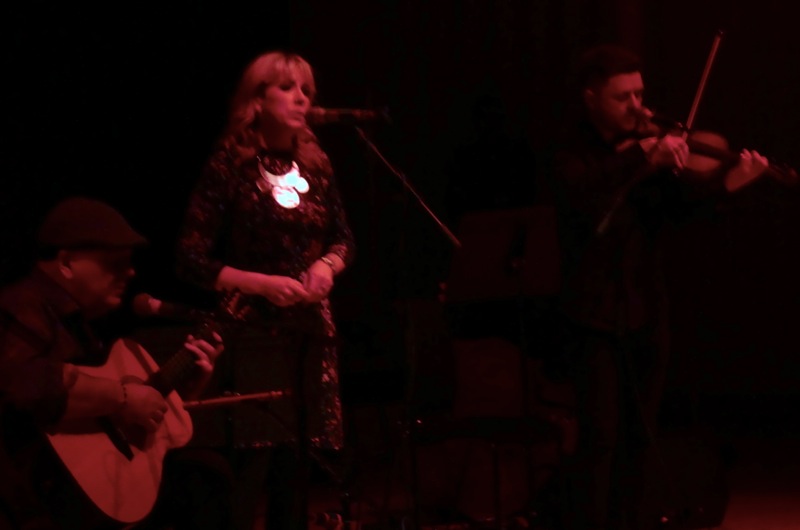
Photographs of Muireann Nic Amhlaoibh and friends in concert at Celtic Connections in Glasgow, Scotland, by Kerry Dexter, made by permission of the artists, the festival, and the venue. Thank you for respecting copyright

You may also wish to see
Muireann Nic Amhlaoibh & Julie Fowlis: Dual
Musireann Nic Amhlaoibh: The Small Hours
Muireann Nic Amhlaoibh’s web site
Cathie Ryan: Through Wind & Rain

-->Your support for the work,here at Music Road is welcome and needed.
Here is one way to offer that, through PayPal. Note that you do not have to have a PayPal account to do this. Thank you.

Another way to support: you could Buy Me a Coffee at ko-fi.com

Labels: , , , , , , , , , , , , , ,

Bookmark and Share
posted by Kerry Dexter at 0 Comments

Friday, February 22, 2013

Ireland's Music: The Small Hours: Muireann Nic Amhlaoibh

Dun Chaoin, in the Dingle peninsula in West Kerry, is a place where sea meets land and light and mountainside. It is a place where legend meets story meets present day. It is an area known for its rugged beauty, deep connection with history, a place where Irish is spoken as much, if not more, than English, and music in both languages is part of the conversation. Muireann Nic Amhlaoibh grew up there. Whether she is offering music from close to home or far way, West Kerry is a landscape you hear in her music.

Most often you hear her music in collaboration with other artists, particularly with her band mates in the top traditional band Danu, where Nic Amhlaoibh is the singer and has played flutes and whistles as well for going on a decade now. The members of Danu come from different parts of Ireland. One of the things that strengthens their sound as a band is that they take time to work in individual projects. Nic Amhlaoibh’s second solo recording, Ar Uair Bhig An Lae - The Small Hours, finds her exploring songs from nearby along with several which have caught her ear during her travels.

“Upon my return home to west Kerry at the stat of summer 2012, it was clear that I was returning to the wellspring, as songs started to come at me from all sides!” she writes in the album’s notes. One such is An Chiurach Bhleinfhionn, a song which may, it turns out, have been written about the location where she now lives. There are songs in Irish from West Kerry, from Cork, from the words of one of Ireland’s most famous female poets, songs which Nic Amhlaoibh learned from friends and neighbors along the way. There are songs in English as well. On tour in New Zealand Nic Amhlaoibh met Australian songwriter Kate Burke and has included her song Gold Hills, which fits in well in both word and idea with the songs in Irish. “I’m not really thinking about switching between languages, I’m thinking about the song when I’m working out what to sing,” she says. “But now that I’ve been at this for a while, and have had a few years to think about it, I see I’m almost a representative of the language, and in that sense I’m very proud to be able to sing in Irish, and if it gets people more interested in it, I’m very happy about that. There’s a great musicality to it, and I think people respond to that, whether they’re understanding the words or not.”

Nic Amhlaoibh herself has long been drawn to American bluegrass, so she has included a song from folk and bluegrass musician Tim O’Brien, which is called Another Day. It speaks of life and generations going on and the song living on after the singer, an idea which resonates through traditional music and fits well with the stories told in the other songs on the recording.

Nic Amhlaoibh’s own music began as a young child. She was drawn to music, but her father, a fiddler, could not get her interested in his instrument. She liked flutes and whistles, though, and followed her interest in singing, learning from tradition bearers around her in West Kerry. “You don’t really study sean nos singing,” she says of the bedrock style of Irish traditional singing. “You’re given the song, the words and the melody, and you’re expected to listen really well.”

From that beginning, too, you are expected to find your own way and your own place with a song. That is an approach which allows Nic Amhlaoibh to serve the spirit of these songs as she brings her own ideas to them. This is nowhere more clear -- or more beautifully done -- than in Cois na Abhann na Sead, which is known as River of Gems in English, and with The Bold Fenian Men, a story drawn from the history of Ireland which many have recorded, but none better than that which you’ll find on Ar Uair Bhig An Lae - The Small Hours.

The album was recorded in West Kerry with engineering by Ivan O'Shea and Donogh Hennessy. Among those backing Nic Amhlaoibh on the recording are Oisin McAuley on fiddle and Billy Mag Fhloinn on bodhran.

you may also wish to see
music, history, and Heisgeir
Dual: Julie Fowlis & Muireann Nic Amhlaoibh
learning about Irish music: a bouquet of albums for spring

my apologies to the Irish speakers here: I am writing on a computer which doesn’t allow for fadas -- and if you are wondering what those may be, they are diacritical marks, accent marks, used in Irish

-->If you'd like to support my creative work,
here is a way to do that, through PayPal. Note that you do not have to have a PayPal account to do this.Thank you.

Labels: , , , , , , , ,

Bookmark and Share
posted by Kerry Dexter at 7 Comments