Wednesday, March 28, 2018

Ireland's Music: Murieann Nic Amhlaoibh: Foxglove & Fuschia

As she was planning the project which would become her album Foxglove & Fuschia, Muireann Nic Amhlaoibh decided she wanted the music to be a bit like what she might do if she were planning for a gig in a pub near her home in Corca Duibhne, the Dingle peninsula, in the west of Ireland. It’s a situation she knows well, as she grew up in Dingle, surrounded by music and going to sessions from a young age.

As ancient stones and worn paths through mountain and along coast attest, people have been calling the Dingle peninsula in the west of Ireland home for thousands upon thousands of years. Rain and mist and wind, mountain and sea meet in a landscapes that suggests and evokes history and story.

Those stories are often told, shared, and forged through music.

Muireann Nic Amhlaoibh has studied in Dublin, taught in LImerick, and traveled the world with her music. For thirteen years she was lead singer and flute player with the top Irish band Danu. I came time, though, to return to to her native west Kerry, to live again in the Irish speaking region of the far west of Dingle where she herself had grown up and begun her life in music,

She also thought at the time that stepping away from Danu might be the end of her public career as a musician. It wasn’t.

/>

A sure and steady vision of where she is and what she wishes to create as an artist is at the heart of Foxglove & Fuschia, which is Nic Amhlaoibh’s third solo album. There are songs in English and in Irish, and a few well chosen tune sets too.

Some of the music has its origin in west Kerry. Other songs and stories make their way in from father afield. They all, though, relate in some way to that life of water and mist, music and mountain and story found in Dingle.

There is the gentle joy of word and lyric in Muirisin Deas is Nora, a song from The Great Blasket Island, which lies just to the west of the tip of Dingle. It is about a couple who have been married a long time and are still very much in love. The words in Irish are from a traditional poem, set to a new melody by guitarist Gerry O’ Beirne. O’Beirne, who often plays with Nic Amhloaibh when she goes on the road with her music, supports her on the song for the recording.He also wrote the image filled song Where Foxglove, from which Nic Amhlaoibh drew the title for the recording.

For most pieces on Foxglove & Fuschia, there are just one two musicians joining Nic Amhlaoibh. That still leaves good scope for family and friends to sit in, though: there’s a set of reels with Nic Amhlaoibh’s husband Billy Mag Fhlionn on bouzouki and a friend from her days with Danu, Donnchadh Gough, on bodhran, and on a set of polkas with her father, Feargal MacAmhlaoibh, as the fiddler, and with longtime friends, Padraig O se on accordion and Donough Hennessey on guitars. Donal O’Connor, Seamus Begley, Pauline Sclanlon. Eilis Kennedy and John McSherry are among those who sit in on various tracks, too.
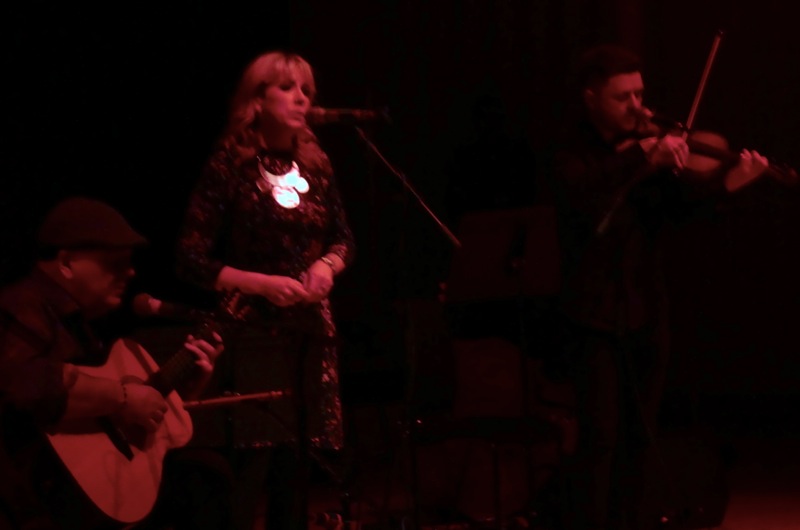
It is Nic Amhlaoibh’s voice and vision which define what’s happening on the album, though. Nowhere is that more evident than on The Final Trawl, a song of the sea by Scotland’s Archie Fisher. As part of her working co presenting the television programme Port for BBC Alba with Scottish singer Julie Fowlis, Nic Amhlaoibh had the chance to meet and sing with Fisher, who wrote the song with ideas and images drawn from his experience of seafaring.

Another song that weaves together the album’s ideas is Bean Dubh an Ghleanna. It is Nic Amhlaoibh says, one of the big songs which to her mind make up the classical tradition of Ireland’s folk music. Nic Amhlaoibh grew up in Dingle, in the Gaeltacht, where, she points out, you don’t actually study the traditional style of sean nos, you’re given the words and the melody and expected to find your own way into them.

Indeed, so she has, through each of the tracks on the recording. There are eleven of them, and each invites repeated listening. Tune, song, and story shared in ways which honor tradition and create it anew in one of Ireland’s most interesting and creative voices: this is what you will find on Foxglove & Fuschia.

Photographs of Muireann Nic Amhlaoibh and friends in concert at Celtic Connections in Glasgow, Scotland, by Kerry Dexter, made by permission of the artists, the festival, and the venue. Thank you for respecting copyright

You may also wish to see
Muireann Nic Amhlaoibh & Julie Fowlis: Dual
Musireann Nic Amhlaoibh: The Small Hours
Muireann Nic Amhlaoibh’s web site
Cathie Ryan: Through Wind & Rain

-->Your support for the work,here at Music Road is welcome and needed.
Here is one way to offer that, through PayPal. Note that you do not have to have a PayPal account to do this. Thank you.

Another way to support: you could Buy Me a Coffee at ko-fi.com

Labels: , , , , , , , , , , , , , ,

Bookmark and Share
posted by Kerry Dexter at 0 Comments

Sunday, March 06, 2016

Ireland's Music: four albums to explore

The island of Ireland is a small place, really. For all that, it has landscape both dramatic -- think the Slieve League, Bloody Foreland, the Cliffs of Moher -- and quiet, such as the countryside near Saul where Saint Patrick walked, the green fields of Monaghan, and the backroads of County Louth. There are lively cities and quiet towns, winding roads and mountains wrapped in mist. Condensed into two countries and one small island, these are aspects of landscape that call forth dreaming, connecting, and creating. This is part of the reason Ireland is known as the land of saints of scholars -- and of musicians.

As you might be thinking about, dreaming of, or making your own way across the landscapes of Ireland, here is music you will want to include in your soundtrack for such a visit, whether you travel through geography, memory, or imagination:

The members of the band Danu take in quite a few places in Ireland in their own geography: musicians come from east and west and north and south of the country. So do the songs they have chosen for the album Buan. The word means lasting in Irish, an right enough title for a recording that among other things is meant to celebrate twenty years since Danu began. There are waltzes, marches, hornpipes, and reels, and songs aplenty too, with words in both English and Irish. There is music from the tradition and music newly composed, some of that from Danu’s own folk. Listen out especially for Donal Clancy singing the outlaw ballad Willie Crotty that tells a story of times past that resonates with today’s events, Muireann Nic Amhlaoibh with John Spillane’s powerful emigration song passage West, and the whole of the band on the slides and reels that make up the Kerry to Donegal set.

The musicians of Altan are well grounded in the music and landscape of their home place of Donegal in Ireland’s far northwest. They have delighted audiences from Asia to Austraila with it, and for their album The Widening Gyre they decided to explore the connections of their music with the the music of the mountain south in the United States. That’s an interesting journey, with song and tune that draw on both of those traditions and on what connects them. There’s a set beginning with Buffalo Girls from the bluegrass side of things and taking a fast paced path to the fiery fiddle style of Donegal, a set which the the musicians say evolved from them sitting around swapping tunes in the studio. Plenty of American folk musician guests on the album, which was recorded at Compass Records studio in Nashville, among them Mary Chapin Carpenter, Bruce Molsky and Alison Brown. It is Altan’s sound which anchors the vision, though. For a fine example of that check out Altan founder, fiddle player and singer Mairéad Ní Mhaonaigh’s duet with bluegrass master time O’Brien on Gypsy Davey/The House Carpenter.

Speaking of vision, the one singer and flute player Nuala Kennedy had for her album Behave the Bravest was to include quite a bit of music sourced from areas near where she grew up, Dundalk in County Louth in the east of Ireland. The ten tracks on the recording offer that, with a fine balance of song and tune, and Kennedy also lets in hints of her travels with her music and longtime residence in Scotland along the way. Listen out especially for the Fair Hill of Killen, a love song in Irish with lyrics by Ulster poet Peadar O’Doirnin, the emigration song Lovely Armoy, and the set of reels which begins with The Glen Where the Deer Is.

Cathie Ryan sources the songs she writes and the songs she chooses from contemporary and traditional sources in light of her heritage as the first generation daughter of parents who came from Ireland to America, and in light of her own path as an adult which has seen her live for years in the United States and equally years in Ireland. That dual respect is evident in the music on her album Through Wind and Rain. The Wishing Well is a song with an Irish melody framing words Ryan wrote herself, while Fare Thee Well finds Ryan adding and changing verses to an Appalachian tune to reflect her own take on the story the song tells. The title comes from a thoughful song about friendship from Kate Rusby. Mo Nion O, written by Mairéad Ní Mhaonaigh is a song about sharing hopes and wishes with a child, so it seems only right that Ryan kept some of the verses in Irish and with Ní Mhaonaigh’s blessing, translated some into English. Speaking of blessing. Ryan’s take on May the Road Rise to Meet You may give tou a whole new thought about the song, and the Irish blessing which inspired Roger and Camilla McGuinn to write it.

Photograph of Altan courtesy of the artists; all other photographs by Kerry Dexter. Thank you for respecting copyright.

Several ways to explore Irish music further:
Cara Dillon: A Thousand Hearts
The Clancy Legacy
Matt and Shannon Heaton: Tell You In Earnest

-->Your support for Music Road is welcome and needed. If you are able to chip in, here is a way to do that, through PayPal. Note that you do not have to have a PayPal account to do this. Thank you.

Labels: , , , , , , , , , , , , ,

Bookmark and Share
posted by Kerry Dexter at 0 Comments

Sunday, November 29, 2015

First Week in Advent: music and quiet

As the month of November advances and as December comes in, news reports and essays start to appear about braving the holidays, overcoming the burdens, getting away from it all. In private conversations as well you begin to hear these ideas going around. But still...

Still. That’s a good word for it. In the Christian calendar, this begins the season of Advent, of preparation for Christmas. Certainly that sort of preparation can at times be as busy and as bothered and as burdensome as the sort things that seem to be expected in other areas of life.

Still...

In the midst of rush and hurry, burden and change and loneliness and misunderstanding that can seem to be magnified by this season that is meant to be wrapped around with goodness and light and joy, the goodness and the joy are there. Deep in the memory of carols played once to often, deep in the longings not yet met from the past, deep in the smiles of strangers, in in the snap of winter air, in the quiet of snowfall, in the turning and falling of leaves heavy with that snow, in stars flung across indigo sky, they are there. As advent begins, look for the stillness and the joy. Listen for the quiet, and the music.

It may seem a paradox to say listen for the quiet in the music. Silence, though, is the canvas on which music is painted. Music is often a doorway to two other things that are especially part of this season and which may at first seem at odds with each other: solitude and community.

Music to go along with these ideas:

Community is one of the highlights of life along Ireland’s Wild Atlantic Way. The communities where people, the work they create, the roads that run along the west of Ireland coast, the remnants if those who lived there in the recent past and in time long gone, have been around themselves from time long before the idea of the Wild Atlantic Way came to be. It’s a designation that frames the place in all its diversity and commonalities, and one that draws people to it and helps them remember and explore things they might not have come to otherwise. You could say the same of the recording The Wild Atlantic Way. It is, as its subtitle promises, a journey in Irish music. In spare yet vivid language and instrument, Francie and Rory Conway’s title track tells a bit of of life along Ireland’s wild western edge and on its western waters. In the thirteen tracks which follow, some of Ireland’s best musicians call forth the fun and the dance and the humor, the wry wit, the sadness, the fellowship and the mystery of the Atlantic edge of Ireland.

There are tunes from the tradition, for instance John McSherry’s Atlantic Drive and The Rolling Wave from Dervish, tradition and contemporary song and melody in Samhradh from Lumiere, top class singers including John Spillane, who brings his own song Along the Wild Atlantic Way, and Mairead Ni Mhaonaigh and her bandmates in Altan, who offer the haunting song Far Beyond Carrickfin. From Donegal to Cork, in song in English and Irish, with tunes and melodies of the tradition and newly created, these artists bring to mind the friendship and the mystery that are also hallmarks of the way. It is a thoughtfully chosen and well sequenced collection (that part was done by Colm O’Siochain, whose work you have met before here along the music road) that will bear return listenings in any season.

Donald Shaw writes of a landscape no less wild and challenging in his series of instrumental pieces which make up Hebrides: Islands on the Edge. This music was composed originally as soundtrack for a BBC nature series of the same name. Individually and taken together they stand beautifully on their own, calling to mind wilderness and sea, history, and a Celtic sense of place. BBC nature shows aren’t always that peaceful, as nature itself isn’t. There is however a certain peace in the turn of day to night and spring to winter. These things, along with contemplation of the landscape itself and the fact that he comes fro Scotland’s west in Argyll perhaps help inform the sense of reflection, peace, and yes, quiet, in the music Shaw creates. He has many fine musicians along for the journey, too. In addition to his own top class accordion and piano skills, Michael McGoldrick adds flute and uillean pipes, Aidan O’Rourke and Patsy Reid are on fiddle, James Mackintosh and Signy Jacobsdottir are on percussion Catriona MacKay is on clarsach, and there a a number of other musicians as well. The music they have created is good for listening at any season. Its contemplative aspects make it an especially good companion as Advent begins.

You may also wish to see
Ireland's Music: Altan: The Widening Gyre
Music for the first week in Advent: candle in the window
Voices of the Wild Atlantic Way: Donegal and Derry at Wandering Educators
Ireland in Winter at Perceptive Travel
Cathie Ryan: Through Wind and Rain

Photographs by Kerry Dexter and by and courtesy of Joseph Mischyshyn and DJ McPherson

-->Your support for Music Road is welcome and needed. If you are able to chip in, here is a way to do that, through PayPal. Note that you do not have to have a PayPal account to do this. Thank you.

Labels: , , , , , , , , , , , , ,

Bookmark and Share
posted by Kerry Dexter at 0 Comments

Wednesday, May 20, 2015

Ireland's music: Danu: Buan

One of the hallmarks of the music of Ireland is connection, and another is conversation. Between musicians, with listeners, with the strands of irish tradition, with contemporary music which draws on tradition -- connection and conversation happen in al these ways. For twenty years, the musicians who join together as the band Danu have been working on this. Their album Buan clearly shows that they just keep getting better at these connections and conversations.

Across the years and through a few changes in membership, the band has retained the bright fire with which it began in Waterford those years ago and added the seasoning and maturity that twenty more years of living and playing music will bring. With musicians coming from Waterford, Dublin, Donegal, and Kerry they choose music which draws the range of Irish landscape into the conversation.

They invite listeners into the musical conversation of Buan with an opening set of slides and reels in which the traditions of Donegal meet those of Kerry. Bouzouki joins with flute, accordion takes its place as the tunes unfold and fiddle leads a lyrical dance on the closing tune as all the while bodhran speaks of the beat. Musical conversation continues with Nic Amhloaibh singing a song from Dingle in Irish. A lively set of jigs including two from McAuley’s pen flows into Nic Amlaoibh’s thoughtful rendition of Lord Gregory, a story of star crossed lovers which shows well not only Nic Amhloaibh’s fine voice but also the players’ ability and skill in supporting and illuminating a story told in song.

That skill is also evident in another and very different song. Donal Clancy’s choices in singing and phrasing work brilliantly to tell the story of Willie Crotty, an eighteenth century outlaw from the Waterford area whose colorful life is told in a song written by Clancy’s cousin Robbie O’Connell. The fast paced melody and upbeat playing only enhance Clancy’s storytelling flair.

The musical conversation in Buan continues in equally interesting fashion through a set of reels and a set of two lighthearted songs in Irish that the band dedicates to their children. The men of Ireland’s east and north were inspired by the west as well as a lovely set of a waltz composed by McAuley leads into a march composed by Clancy, both written after the band spent a week of rehearsal in West Kerry last spring.

The enigmatic, poetic, and image filled song Passage West by John Spillane of Cork provides a gorgeous showcase not only for Nic Amhlaioibh’s voice but for all the band members working together to create a vibrant story told as much through melody as through word -- and the words and singing themselves are powerful enough that they could stand alone.

Reels and hornpipes taken over from pipes music make up a set following Passage West, which makes a graceful bridge to The Willow Tree, a quiet song which weaves modern day love song with myth, legend, and landscape and which Nic Amhlaoibh learned from the singing of its composer, Padragian Ni Uallachain. That makes a fitting close to this conversation in music -- rather than a close an invitation to a quiet pause to reflect on the journey the conversation has taken, really -- a pause which will very likely lead to repeated listening.

Danu are: Éamon Doorley, guitar and bouzouki, Oisín McAuley, fiddle, Benny McCarthy, Accordion, Dónal Clancy, guitar, voice, Muireann Nic Amhlaoibh, voice, flute, and whistles.

Joining them on Buan are producer Donal Lunny on buzouki, zook, harmonium and bass bodhran as well as former band members Tom Doorley on flute and whistle and Donnachadh Gough on pipes and bodhran. For the concert at which the photographs were made, Oisin McAuley was delayed by weather from arriving in Glasgow, so former member Darragh Doyle stepped in. Phil Cunningham on accordion and Julie Fowlis on voice and whistles were also guests at the concert in Glasgow.

Photographs were made by Kerry Dexter at the Celtic Connections Festival in Glasgow, with permission of the artists, venue, and festival. Thank you for respecting copyright.

You may also wish to see
Ireland's Music: The Small Hours: Muireann Nic Amhlaoibh
Robbie, Aoife, and Donal: The Clancy Legacy
Julie Fowlis: Every Story

-->Your support for Music Road is welcome and needed. If you are able to chip in, here is a way to do that, through PayPal. Note that you do not have to have a PayPal account to do this. Thank you.

Another way to support: you could Buy Me a Coffee at ko-fi.com

Labels: , , , , , , , , , , ,

Bookmark and Share
posted by Kerry Dexter at 0 Comments

Friday, February 22, 2013

Ireland's Music: The Small Hours: Muireann Nic Amhlaoibh

Dun Chaoin, in the Dingle peninsula in West Kerry, is a place where sea meets land and light and mountainside. It is a place where legend meets story meets present day. It is an area known for its rugged beauty, deep connection with history, a place where Irish is spoken as much, if not more, than English, and music in both languages is part of the conversation. Muireann Nic Amhlaoibh grew up there. Whether she is offering music from close to home or far way, West Kerry is a landscape you hear in her music.

Most often you hear her music in collaboration with other artists, particularly with her band mates in the top traditional band Danu, where Nic Amhlaoibh is the singer and has played flutes and whistles as well for going on a decade now. The members of Danu come from different parts of Ireland. One of the things that strengthens their sound as a band is that they take time to work in individual projects. Nic Amhlaoibh’s second solo recording, Ar Uair Bhig An Lae - The Small Hours, finds her exploring songs from nearby along with several which have caught her ear during her travels.

“Upon my return home to west Kerry at the stat of summer 2012, it was clear that I was returning to the wellspring, as songs started to come at me from all sides!” she writes in the album’s notes. One such is An Chiurach Bhleinfhionn, a song which may, it turns out, have been written about the location where she now lives. There are songs in Irish from West Kerry, from Cork, from the words of one of Ireland’s most famous female poets, songs which Nic Amhlaoibh learned from friends and neighbors along the way. There are songs in English as well. On tour in New Zealand Nic Amhlaoibh met Australian songwriter Kate Burke and has included her song Gold Hills, which fits in well in both word and idea with the songs in Irish. “I’m not really thinking about switching between languages, I’m thinking about the song when I’m working out what to sing,” she says. “But now that I’ve been at this for a while, and have had a few years to think about it, I see I’m almost a representative of the language, and in that sense I’m very proud to be able to sing in Irish, and if it gets people more interested in it, I’m very happy about that. There’s a great musicality to it, and I think people respond to that, whether they’re understanding the words or not.”

Nic Amhlaoibh herself has long been drawn to American bluegrass, so she has included a song from folk and bluegrass musician Tim O’Brien, which is called Another Day. It speaks of life and generations going on and the song living on after the singer, an idea which resonates through traditional music and fits well with the stories told in the other songs on the recording.

Nic Amhlaoibh’s own music began as a young child. She was drawn to music, but her father, a fiddler, could not get her interested in his instrument. She liked flutes and whistles, though, and followed her interest in singing, learning from tradition bearers around her in West Kerry. “You don’t really study sean nos singing,” she says of the bedrock style of Irish traditional singing. “You’re given the song, the words and the melody, and you’re expected to listen really well.”

From that beginning, too, you are expected to find your own way and your own place with a song. That is an approach which allows Nic Amhlaoibh to serve the spirit of these songs as she brings her own ideas to them. This is nowhere more clear -- or more beautifully done -- than in Cois na Abhann na Sead, which is known as River of Gems in English, and with The Bold Fenian Men, a story drawn from the history of Ireland which many have recorded, but none better than that which you’ll find on Ar Uair Bhig An Lae - The Small Hours.

The album was recorded in West Kerry with engineering by Ivan O'Shea and Donogh Hennessy. Among those backing Nic Amhlaoibh on the recording are Oisin McAuley on fiddle and Billy Mag Fhloinn on bodhran.

you may also wish to see
music, history, and Heisgeir
Dual: Julie Fowlis & Muireann Nic Amhlaoibh
learning about Irish music: a bouquet of albums for spring

my apologies to the Irish speakers here: I am writing on a computer which doesn’t allow for fadas -- and if you are wondering what those may be, they are diacritical marks, accent marks, used in Irish

-->If you'd like to support my creative work,
here is a way to do that, through PayPal. Note that you do not have to have a PayPal account to do this.Thank you.

Labels: , , , , , , , ,

Bookmark and Share
posted by Kerry Dexter at 7 Comments

Friday, February 06, 2009

Favorite Love Songs: Tuning Up for Valentine's Day

As it’s coming up on Valentine’s Day, that has me thinking about love songs. My favorite ones include


from Kathy Mattea
Goin' Gone

Untold Stories
Asking Us to Dance


from Cathie Ryan
The Farthest Wave

What's Closest to the Heart

from Carrie Newcomer
Tornado Alley

Only One Shoe

Hold On

From Tish Hinojosa
Amanacer
Everything You Wish

from Eddi Reader
Wild Mountainside


from Danu
Follow On

from Emmylou Harris
Someone Like You

from Maura O’Connell
Blessing


What they have in common, I think, is recognition that deep true love includes the hard stuff as well as the joy, and that part of the gift of love is helping us live with and through the humanness of all that. I’m not sure the artists who wrote or who sing all of these necessarily thought of them as love songs, either, but for me they work that way. See what you think, and please share some of your favorites by leaving a comment if you’d like.

Labels: , , , , , , , , ,

Bookmark and Share
posted by Kerry Dexter at 7 Comments

Wednesday, July 30, 2008

Now playing: Muireann Nic Amhlaoibh: Daybreak/Fainne an Lae


Daybreak: Fáinne an Lae

Muireann Nic Amhlaoibh is perhaps best known as lead singer with the top Irish band Danu. Her solo album is a venture into music she wanted to explore a bit differently than work within a seven piece trad based band would allow.


The dozen tracks she offers, ten songs and two instrumentals, comprise an interesting and lovely journey. Her opener, Gerry O'Beirne's Western Highway, is an evocation of travels, leaving loved ones behind, risks in such changes, and life beyond the city lights, among other things, and Nic Amhlaoibh leaves room for all the levels of the song in her interpretation. It's also a song which evokes the quiet spaces of the west. Nic Amhlaoibh is from the far westernmost part of Kerry, which finds expression in her her singing here. There are songs from the west of Kerry, as well as ones which had their origins in other parts of the island, including the rambler's song Free and Easy, from Down. There's an emigrant's song, a lullabye in Irish, another song from O'Beirne, one from Richard Thompson, and a set of tunes [Nic Amhlaoibh's instruments are flute and whistle] with Donegal and Scottish roots. She closes with the traditional song Parting Glass. "When you're in a band, you sort of feel invincible, you know," Nic Amhlaoibh says, "making a a solo album is such a soul baring thing to do for an artist." This is her first solo project, and it's well worth your listening. Nic Amhlaoibh is currently working on a duo record with Scots singer Julie Fowlis, and will appearing in the US in the autumn as host of series of live programs about the pipes called Piperlink,


Here is a video of Nic Amhlaoibh singing "An Spealadóir," a West Kerry song which is on the record, and together with Michelle Mulcahy on accordion she plays two reels: "The Caucus" and "The Wind That Shakes The Barley" on flutes and whistles. Billy Mc Glynn is on guitar.


you may also want to see these posts

Music Road: now playing: Danu: One Night Stand

Music Road: Voices: Donal Clancy

-->Your support for Music Road is welcome and needed. If you are able to chip in, here is a way to do that, through PayPal. Note that you do not have to have a PayPal account to do this. Thank you.

Labels: , , , , , ,

Bookmark and Share
posted by Kerry Dexter at 0 Comments

Tuesday, October 23, 2007

now playing: The Best of Friends


The Best of Friends

A book, this time, rather than a recording, though we’ll get to the music in minute. Ginger Mauney is a film maker who lives in Africa; Sara James is a news correspondent who lives in New York. They met when they were twelve, in Virginia, but their paths diverged, time and time again over the more than thirty years they’ve known it each other. This book is a shared chronicle -- they alternate writing chapters of their lives and bits and pieces of how having that friendship has been vital to them both. It’s more narrative than philosophy, a story of the individual circumstances of two friends who trusted and accepted their friendship even when they couldn’t or didn’t see each other for long stretches of time. It’s a story of the grace of friendship, really.

What does this have to to with music? All of us who make, follow, and trust music end up on the road a lot, with best friends in far flung places, friends who, like James and Mauney, may not be there always for the big or small events that people generally think of as building and maintaining friendship, but who continue as friends in practical ways as well as friends of soul and spirit. This book is a fine reminder to be thankful for that grace, and to nurture it.

music for these ideas:

Carrie Newcomer has a good song with a vivid image of friends called Three Women, which was first released on her recording called Angel on My Shoulder and is also on Betty's Diner.

Tommy Sands’ song There Were Roses, recorded by both Sean Keane and Cara Dillon, sets the troubles in Ireland in the context of friendship.

Cathie Ryan’s Coaineadh na d’Tri Muire. Lament of the Three Marys, on her The Music of What Happens CD, is about mother and son -- Christ and his mother Mary, actually -- but holds good insights on connection.

Follow On, written by Paul Brady and recorded by Danu on When All Is Said and Done, is another good look at the lasting power of friendship even when faith is all that’s there to keep it going.

-->If you'd like to support my creative work at Music Road,
here is a way to do that, through PayPal. Note that you do not have to have a PayPal account to do this.Thank you.

Labels: , , , , , , , ,

Bookmark and Share
posted by Kerry Dexter at 2 Comments

Friday, September 14, 2007

Now playing: Danu: One Night Stand


One Night Stand


The lads -- and the one woman, singer Muireann nic Amhlaoibh -- of Danu do a very fine job of playing traditional music, covering contemporary tunes from the likes of Paul Brady, Tommy Sands, and Bob Dylan, and communicating something new and real about why they think tradition and contemporary music fit together, and are important. This dvd adds dimension to the work they’ve recorded on CD. There’s a full on concert at Vicar Street in Dublin, which gets at the fine and fluid interaction among Donal Clancy on guitar, Oisin McAuley on fiddle, nic Amhlaoibh, who plays tin whistle as well as sings, Tom Doorley on flutes and whistles, Eamon Doorley on fiddle, Donnchadh Gough on pipes and bodhran, and Benny McCarthy on button accordion. They do music from their CD When All is Said and Done, reels, jigs, and tunes as well as songs, and they add in some crowd favorites as well, among them A Stor Mo Chroí. There are out takes from the gig included as bonus tracks, along with an entirely forgettable road trip video. Really excellent additions though are interviews with the band members and others, including Liam Clancy and Des Dillon.

-->Your support for Music Road is welcome and needed. If you are able to chip in, here is a way to do that, through PayPal. Note that you do not have to have a PayPal account to do this. Thank you.

Labels: , , , ,

Bookmark and Share
posted by Kerry Dexter at 1 Comments