Monday, May 25, 2020

Seeing Ireland: 3 music videos

Landscape and the love of it run deep in the heart of the music of Ireland. Whether you are dreaming of, remembering, or imaging a visit to the island of Ireland, here are three music videos that will help you see aspects of the place.

“This is what I believe that we bring to our audiences” says Mairead Ni Mhaonaigh. to her long time friend Moya Brennan, “that they can sense the beauty of this place.” The two are walking in Donegal where they both spent time growing up and where Mairead lives.

They go on share a memory and a song about the lights in the windows you see a at Christmas. Perhaps you are reading this at another time. It is a fine song nonetheless, good to enjoy at any season. As Ni Mhaonaigh and Brennan remark during their conversation, you are going to want to bring a heavy coat with you when you come to Donegal anyway...

You may find the song Soilse na Nollag/The Lights of Christmas, recorded on the Windham Hill collection called The Very Best of Celtic Christmas. You may find more of NI Mhaonaigh’s work on recordings by Altan, and of Brennan’s with Clannad.They each have solo albums out as well.

The Wild Atlantic Way has become the descriptive name for the many landscapes and places you will meet along the west coast of Ireland, all the way from KInsale in Cork to Malin Head in Donegal. There are six regions and, indeed all sorts of things to aexplore and all sorts of great music to hear as well.

Aoife Scott and Enda Reilly wrote the song All Along the Wild Atlantic Way, and with her partner and fellow musician Andy Meaney along for the journey Scott brings quite a bit of the place to life through this video as well as in the lyrics and melody.

You will find the song recorded on Scott’s debut album Carry the Day, and she has a second one out now as well, called Homebird.

There is much of the landscape of Ireland which lends itself to myth and legend, and many stories to go along. The stories may be true or may not, likely some of both in most cases. The song Port na bPúcaí/The Fairy Tune is one such. It comes from the Blasket Islands, which lie off the coast of west Kerry. Muireann Nic Amhlaoibh lives in the Dingle peninsula and across from the Blasket Islands.

The song, she says, was given her by her father, who told her the story that a Blasket Islands fisherman heard the music on the wind one night and played it on his fiddle. Some say it was a whale song, others that its origin was from the otherworld. The words are a story of a woman captured by the fairies. There is an otherworldly aspect to the landscape of the west Kerry shore where this video was filmed, and to the sound of the music, as well. Billy Mag Fhloinn constructed (after a concept of Gorkhem Sen) and plays the acoustic instrument called the yaybahar to compliment Nic Amhlaoibh’s singing. You will find the song on Muireann Nic Amhlaoibh’s recording Thar Toinn/Seaborne.

You may also wish to learn more about
Altan’s album The Gap of Dreams
Muireann Nic Amhlaoibh’s Foxglove & Fuschia
Another Irish musician who draws on landscape in her work to learn about
One of the most loved stories at Music Road: Irish music, Irish landscape

From the Music from Shifting Times series at Wandering Educators
Music for Connection and Contemplation, with music from Aoife Scott, Matt and Shannon Heaton, Cathie Ryan, and others

Photographs by Kerry Dexter, Thank you for respecting copyright.

-->Your support for Music Road is welcome and needed. If you are able to chip in
here is a way to do that, through PayPal. Note that you do not have to have a PayPal account to do this. Thank you for considering.

You can also Buy Me a Coffee at ko-fi.com

Labels: , , , , , , , , , ,

Bookmark and Share
posted by Kerry Dexter at 0 Comments

Wednesday, March 28, 2018

Ireland's Music: Murieann Nic Amhlaoibh: Foxglove & Fuschia

As she was planning the project which would become her album Foxglove & Fuschia, Muireann Nic Amhlaoibh decided she wanted the music to be a bit like what she might do if she were planning for a gig in a pub near her home in Corca Duibhne, the Dingle peninsula, in the west of Ireland. It’s a situation she knows well, as she grew up in Dingle, surrounded by music and going to sessions from a young age.

As ancient stones and worn paths through mountain and along coast attest, people have been calling the Dingle peninsula in the west of Ireland home for thousands upon thousands of years. Rain and mist and wind, mountain and sea meet in a landscapes that suggests and evokes history and story.

Those stories are often told, shared, and forged through music.

Muireann Nic Amhlaoibh has studied in Dublin, taught in LImerick, and traveled the world with her music. For thirteen years she was lead singer and flute player with the top Irish band Danu. I came time, though, to return to to her native west Kerry, to live again in the Irish speaking region of the far west of Dingle where she herself had grown up and begun her life in music,

She also thought at the time that stepping away from Danu might be the end of her public career as a musician. It wasn’t.

/>

A sure and steady vision of where she is and what she wishes to create as an artist is at the heart of Foxglove & Fuschia, which is Nic Amhlaoibh’s third solo album. There are songs in English and in Irish, and a few well chosen tune sets too.

Some of the music has its origin in west Kerry. Other songs and stories make their way in from father afield. They all, though, relate in some way to that life of water and mist, music and mountain and story found in Dingle.

There is the gentle joy of word and lyric in Muirisin Deas is Nora, a song from The Great Blasket Island, which lies just to the west of the tip of Dingle. It is about a couple who have been married a long time and are still very much in love. The words in Irish are from a traditional poem, set to a new melody by guitarist Gerry O’ Beirne. O’Beirne, who often plays with Nic Amhloaibh when she goes on the road with her music, supports her on the song for the recording.He also wrote the image filled song Where Foxglove, from which Nic Amhlaoibh drew the title for the recording.

For most pieces on Foxglove & Fuschia, there are just one two musicians joining Nic Amhlaoibh. That still leaves good scope for family and friends to sit in, though: there’s a set of reels with Nic Amhlaoibh’s husband Billy Mag Fhlionn on bouzouki and a friend from her days with Danu, Donnchadh Gough, on bodhran, and on a set of polkas with her father, Feargal MacAmhlaoibh, as the fiddler, and with longtime friends, Padraig O se on accordion and Donough Hennessey on guitars. Donal O’Connor, Seamus Begley, Pauline Sclanlon. Eilis Kennedy and John McSherry are among those who sit in on various tracks, too.

It is Nic Amhlaoibh’s voice and vision which define what’s happening on the album, though. Nowhere is that more evident than on The Final Trawl, a song of the sea by Scotland’s Archie Fisher. As part of her working co presenting the television programme Port for BBC Alba with Scottish singer Julie Fowlis, Nic Amhlaoibh had the chance to meet and sing with Fisher, who wrote the song with ideas and images drawn from his experience of seafaring.

Another song that weaves together the album’s ideas is Bean Dubh an Ghleanna. It is Nic Amhlaoibh says, one of the big songs which to her mind make up the classical tradition of Ireland’s folk music. Nic Amhlaoibh grew up in Dingle, in the Gaeltacht, where, she points out, you don’t actually study the traditional style of sean nos, you’re given the words and the melody and expected to find your own way into them.

Indeed, so she has, through each of the tracks on the recording. There are eleven of them, and each invites repeated listening. Tune, song, and story shared in ways which honor tradition and create it anew in one of Ireland’s most interesting and creative voices: this is what you will find on Foxglove & Fuschia.

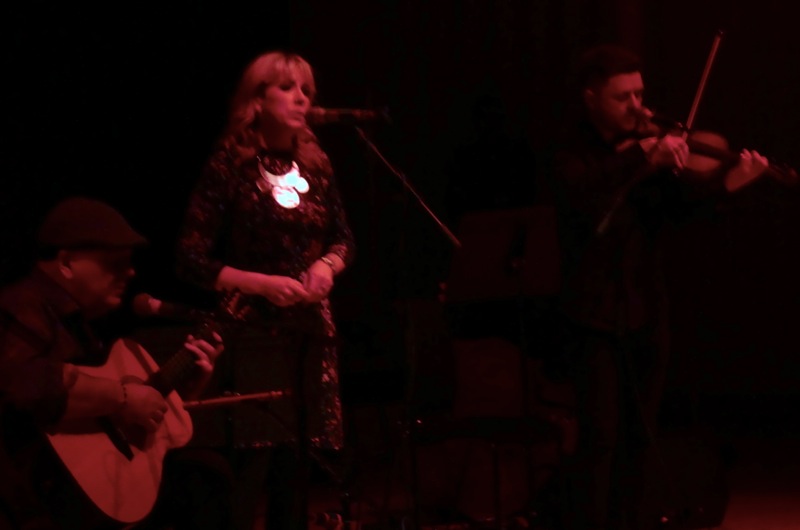
Photographs of Muireann Nic Amhlaoibh and friends in concert at Celtic Connections in Glasgow, Scotland, by Kerry Dexter, made by permission of the artists, the festival, and the venue. Thank you for respecting copyright

You may also wish to see
Muireann Nic Amhlaoibh & Julie Fowlis: Dual
Musireann Nic Amhlaoibh: The Small Hours
Muireann Nic Amhlaoibh’s web site
Cathie Ryan: Through Wind & Rain

-->Your support for the work,here at Music Road is welcome and needed.
Here is one way to offer that, through PayPal. Note that you do not have to have a PayPal account to do this. Thank you.

Another way to support: you could Buy Me a Coffee at ko-fi.com

Labels: , , , , , , , , , , , , , ,

Bookmark and Share
posted by Kerry Dexter at 0 Comments

Wednesday, May 20, 2015

Ireland's music: Danu: Buan

One of the hallmarks of the music of Ireland is connection, and another is conversation. Between musicians, with listeners, with the strands of irish tradition, with contemporary music which draws on tradition -- connection and conversation happen in al these ways. For twenty years, the musicians who join together as the band Danu have been working on this. Their album Buan clearly shows that they just keep getting better at these connections and conversations.

Across the years and through a few changes in membership, the band has retained the bright fire with which it began in Waterford those years ago and added the seasoning and maturity that twenty more years of living and playing music will bring. With musicians coming from Waterford, Dublin, Donegal, and Kerry they choose music which draws the range of Irish landscape into the conversation.

They invite listeners into the musical conversation of Buan with an opening set of slides and reels in which the traditions of Donegal meet those of Kerry. Bouzouki joins with flute, accordion takes its place as the tunes unfold and fiddle leads a lyrical dance on the closing tune as all the while bodhran speaks of the beat. Musical conversation continues with Nic Amhloaibh singing a song from Dingle in Irish. A lively set of jigs including two from McAuley’s pen flows into Nic Amlaoibh’s thoughtful rendition of Lord Gregory, a story of star crossed lovers which shows well not only Nic Amhloaibh’s fine voice but also the players’ ability and skill in supporting and illuminating a story told in song.

That skill is also evident in another and very different song. Donal Clancy’s choices in singing and phrasing work brilliantly to tell the story of Willie Crotty, an eighteenth century outlaw from the Waterford area whose colorful life is told in a song written by Clancy’s cousin Robbie O’Connell. The fast paced melody and upbeat playing only enhance Clancy’s storytelling flair.

The musical conversation in Buan continues in equally interesting fashion through a set of reels and a set of two lighthearted songs in Irish that the band dedicates to their children. The men of Ireland’s east and north were inspired by the west as well as a lovely set of a waltz composed by McAuley leads into a march composed by Clancy, both written after the band spent a week of rehearsal in West Kerry last spring.

The enigmatic, poetic, and image filled song Passage West by John Spillane of Cork provides a gorgeous showcase not only for Nic Amhlaioibh’s voice but for all the band members working together to create a vibrant story told as much through melody as through word -- and the words and singing themselves are powerful enough that they could stand alone.

Reels and hornpipes taken over from pipes music make up a set following Passage West, which makes a graceful bridge to The Willow Tree, a quiet song which weaves modern day love song with myth, legend, and landscape and which Nic Amhlaoibh learned from the singing of its composer, Padragian Ni Uallachain. That makes a fitting close to this conversation in music -- rather than a close an invitation to a quiet pause to reflect on the journey the conversation has taken, really -- a pause which will very likely lead to repeated listening.

Danu are: Éamon Doorley, guitar and bouzouki, Oisín McAuley, fiddle, Benny McCarthy, Accordion, Dónal Clancy, guitar, voice, Muireann Nic Amhlaoibh, voice, flute, and whistles.

Joining them on Buan are producer Donal Lunny on buzouki, zook, harmonium and bass bodhran as well as former band members Tom Doorley on flute and whistle and Donnachadh Gough on pipes and bodhran. For the concert at which the photographs were made, Oisin McAuley was delayed by weather from arriving in Glasgow, so former member Darragh Doyle stepped in. Phil Cunningham on accordion and Julie Fowlis on voice and whistles were also guests at the concert in Glasgow.

Photographs were made by Kerry Dexter at the Celtic Connections Festival in Glasgow, with permission of the artists, venue, and festival. Thank you for respecting copyright.

You may also wish to see
Ireland's Music: The Small Hours: Muireann Nic Amhlaoibh
Robbie, Aoife, and Donal: The Clancy Legacy
Julie Fowlis: Every Story

-->Your support for Music Road is welcome and needed. If you are able to chip in, here is a way to do that, through PayPal. Note that you do not have to have a PayPal account to do this. Thank you.

Another way to support: you could Buy Me a Coffee at ko-fi.com

Labels: , , , , , , , , , , ,

Bookmark and Share
posted by Kerry Dexter at 0 Comments

Friday, February 22, 2013

Ireland's Music: The Small Hours: Muireann Nic Amhlaoibh

Dun Chaoin, in the Dingle peninsula in West Kerry, is a place where sea meets land and light and mountainside. It is a place where legend meets story meets present day. It is an area known for its rugged beauty, deep connection with history, a place where Irish is spoken as much, if not more, than English, and music in both languages is part of the conversation. Muireann Nic Amhlaoibh grew up there. Whether she is offering music from close to home or far way, West Kerry is a landscape you hear in her music.

Most often you hear her music in collaboration with other artists, particularly with her band mates in the top traditional band Danu, where Nic Amhlaoibh is the singer and has played flutes and whistles as well for going on a decade now. The members of Danu come from different parts of Ireland. One of the things that strengthens their sound as a band is that they take time to work in individual projects. Nic Amhlaoibh’s second solo recording, Ar Uair Bhig An Lae - The Small Hours, finds her exploring songs from nearby along with several which have caught her ear during her travels.

“Upon my return home to west Kerry at the stat of summer 2012, it was clear that I was returning to the wellspring, as songs started to come at me from all sides!” she writes in the album’s notes. One such is An Chiurach Bhleinfhionn, a song which may, it turns out, have been written about the location where she now lives. There are songs in Irish from West Kerry, from Cork, from the words of one of Ireland’s most famous female poets, songs which Nic Amhlaoibh learned from friends and neighbors along the way. There are songs in English as well. On tour in New Zealand Nic Amhlaoibh met Australian songwriter Kate Burke and has included her song Gold Hills, which fits in well in both word and idea with the songs in Irish. “I’m not really thinking about switching between languages, I’m thinking about the song when I’m working out what to sing,” she says. “But now that I’ve been at this for a while, and have had a few years to think about it, I see I’m almost a representative of the language, and in that sense I’m very proud to be able to sing in Irish, and if it gets people more interested in it, I’m very happy about that. There’s a great musicality to it, and I think people respond to that, whether they’re understanding the words or not.”

Nic Amhlaoibh herself has long been drawn to American bluegrass, so she has included a song from folk and bluegrass musician Tim O’Brien, which is called Another Day. It speaks of life and generations going on and the song living on after the singer, an idea which resonates through traditional music and fits well with the stories told in the other songs on the recording.

Nic Amhlaoibh’s own music began as a young child. She was drawn to music, but her father, a fiddler, could not get her interested in his instrument. She liked flutes and whistles, though, and followed her interest in singing, learning from tradition bearers around her in West Kerry. “You don’t really study sean nos singing,” she says of the bedrock style of Irish traditional singing. “You’re given the song, the words and the melody, and you’re expected to listen really well.”

From that beginning, too, you are expected to find your own way and your own place with a song. That is an approach which allows Nic Amhlaoibh to serve the spirit of these songs as she brings her own ideas to them. This is nowhere more clear -- or more beautifully done -- than in Cois na Abhann na Sead, which is known as River of Gems in English, and with The Bold Fenian Men, a story drawn from the history of Ireland which many have recorded, but none better than that which you’ll find on Ar Uair Bhig An Lae - The Small Hours.

The album was recorded in West Kerry with engineering by Ivan O'Shea and Donogh Hennessy. Among those backing Nic Amhlaoibh on the recording are Oisin McAuley on fiddle and Billy Mag Fhloinn on bodhran.

you may also wish to see
music, history, and Heisgeir
Dual: Julie Fowlis & Muireann Nic Amhlaoibh
learning about Irish music: a bouquet of albums for spring

my apologies to the Irish speakers here: I am writing on a computer which doesn’t allow for fadas -- and if you are wondering what those may be, they are diacritical marks, accent marks, used in Irish

-->If you'd like to support my creative work,
here is a way to do that, through PayPal. Note that you do not have to have a PayPal account to do this.Thank you.

Labels: , , , , , , , ,

Bookmark and Share
posted by Kerry Dexter at 7 Comments

Friday, December 09, 2011

Song for an Advent weekend: Oíche Chiúin

In the midst holiday preparations, take a bit of time for quiet reflection on the season. Whether Irish is your language or not, I think you will recognize the song. Mairéad Ní Mhaonaigh, Muireann Nic Amhlaoibh, and Eleanor Shanley sing Oíche Chiúin from Geantraí na Nollag, broadcast in Ireland on TG4 at Christmas 2010 you may also wish to see Music Road: music, autumn, and a cup of tea Music Road: listening to Christmas: Heidi Talbot, Muireann Nic Amhlaoibh, Patty Larkin Music Road: holiday gift ideas: Irish music

-->Your support for Music Road is welcome and needed. If you are able to chip in, here is a way to do that, through PayPal. Note that you do not have to have a PayPal account to do this. Thank you.

Labels: , , , , , , , , , ,

Bookmark and Share
posted by Kerry Dexter at 8 Comments

Tuesday, December 07, 2010

Llistening to Christmas: Heidi Talbot, Muireann Nic Amhlaoibh, Patty Larkin

fire at js copyright kerry dexter
Those who make music for a living enjoy listening to and making music at the holidays as well. It is a very musical season. Their listening choices are not always what you might expect, however.


Muireann Nic Amhlaoibh grew up in Ireland, in Dun Chaoin in the Dingle Peninsula. Though she’s taken her music to far flung places as lead singer with Danu and investigated musical connections with Scotland in a project with Scottish Gaelic singer Julie Fowlis. it’s to those times in west Kerry she returns when thinking of music for the holidays.

“To sing, I love our local Christmas songs like Oíche Nollaig, Coinnle an Linbh Íosa and the music of the "wren" that we play around that time of year, which is a fantastic custom.”

St. Stephen’s Day, also known as wren day from a custom called hunting the wren when people go from house to house with music at the holidays, is a big day for socializing in Ireland. The nature of things varies across the island, from all the eligible men in the town dressing up in funny hats and going door to door with tunes and songs, to harking back to customs of ancient days with musicians taking on costumes of legendary figures of all sorts as they go through the town. Nic Amhlaoibh points to this information on the wren in Dingle.

Nic Amhlaoibh's listening tastes range wide at the holidays. “I like to listen to The Monks of Glenstal who sing Gregorian Chant very beautifully, ” she says, “and last Christmas I really enjoyed Sting's album If On A Winter's Night.

Patty Larkin, who comes from an Irish American family in Wisconsin, likes to fill her Cape Cod home with the sounds of Windham Hill’s Celtic Christmas albums at this time of year. “ That sound creates such a beautiful holiday atmosphere. It’s great in the background for parties, and to listen to on your own.”


Heidi Talbot grew up listening to Christmas songs in County Kildare, in Ireland. She spent a number of years in the United States, many of those as singer with the world renown band Cherish the Ladies. She lives now in Scotland, and a difference to her holidays this year has her thinking about holiday seasons this year and in future, as well. She says

“Every year Phil Cunningham plays shows in Edinburgh called Phil Cunningham's Christmas Songbook featuring Phil, Eddi Reader, John McCusker, and Karen Matheson. It's the perfect way to get yourself in the mood for Christmas. Last year I joined them and sang O Holy Night - one of my favourite Christmas songs to sing.

This year I'm really looking forward to being part of Brian O'Donovan's Christmas Celtic Sojourn along with Seamus Egan, Catriona MacKay, Chris Stout and lots of other fantastic musicians.

I love to sing all the traditional Christmas carols but if I had to pick a favourite Christmas track to listen to it would be Otis Redding singing White Christmas, his voice breaks my heart.

This Christmas will be our first with our daughter Molly Mae, and while she's only seven months old, I'm really looking forward to teaching her all the Christmas carols I know for many Christmases to come.”

you may also wish to
read what Aoife Clancy, Tommy Sands, and Matt Heaton have to say about choices for Christmas listening

hear Heidi Talbot sing O Holy Night and other Christmas songs with Cherish the Ladies on their album On Christmas Night

and you may also wish to see

Music Road: trilogy: 2000 Years of Christmas
Music Road: Dual: Julie Fowlis & Muireann Nic Amhlaoibh

-->Your support for Music Road is welcome and needed. If you’d like are able to chip in, here is a way to do that, through PayPal. Note that you do not have to have a PayPal account to do this. Thank you.

Labels: , , , , , , , ,

Bookmark and Share
posted by Kerry Dexter at 12 Comments

Thursday, February 11, 2010

A bouquet of Celtic love songs & tunes

A meditative guitar piece from Donal Clancy, a tune for a friend's wedding and a lively jig from Hanneke Cassel, and a set of reels meant for dancing from Matt and Shannon Heaton are the instrumentals in this set. Then there’s a song about transitions in loving in Western Highway from Muireann Nic Amhlaoibh, a happy song that holds several meanings in Carrick a Rede from Cathie Ryan, and a swirl of emotion and music with words in Irish and English, in What’s Closest to the Heart also from Ryan, and an affirmation of love and hope in a song which blends Irish and African American tradition in Fisherman’s Lullaby from Matt and Shannon Heaton. For your Valentine themed listening, and beyond.


you may also wish to see
Voices: Donal Clancy

Lovers' Well: Matt & Shannon Heaton

Hanneke Cassel and Christopher Lewis: Calm the Raging Sea

Cathie Ryan: Songwriter

-->Your support for Music Road is welcome and needed. If you are able to chip in, here is a way to do that, through PayPal. Note that you do not have to have a PayPal account to do this. Thank you.

Labels: , , , , , , , , ,

Bookmark and Share
posted by Kerry Dexter at 3 Comments

Sunday, May 17, 2009

Dual: Julie Fowlis & Muireann Nic Amhlaoibh: video

The recording Dual, in which Julie Fowlis, Muireann Nic Amhlaoibh, Ross Martin, and Eamon Doorley join up to explore connections and differences in Irish and Scots Gaelic music, made our best of the year list here at Music Road.

They have just announced a run of new tour dates beginning later this month in Ireland.
Whether you can make one of the dates noted below or not, look in on them performinga song from the record at the launch of the Scottish language television network, MG Alba. Doesn't that look like an amazing space in which to play?


more about the recording
Dual: Julie Fowlis & Muireann Nic Amhlaoibh

new tour dates:

28th May. 8pm. Regional Cultural Centre, Port Road, Letterkenny, Co. Donegal

29th May 8pm. The Glens Centre, Manorhamilton, Co. Leitrim

30th May, 8pm. An Droichead, Cook St, Belfast.

1st June, 8pm. The Crane, 2 Sea Road, Galway.

3rd June, 8pm. Linnenhall Arts Centre, Castlebar, Co. Mayo

4th June, 8pm. Celbridge Library, Celbridge, Co. Kildare.

5th June, 8pm. Racket Hall Country House Hotel, Roscrea, Co. Tipperary

6th June, 8pm. Ionad an Bhlacaoid Mhóir, Dún Chaoin, Co. Chiarraí


you may also want to see

Music Road: best music, 2008

Muireann Nic Amhlaoibh: Daybreak/Fainne an Lae

a short film about julie fowlis

-->Your support for Music Road is welcome and needed. If you are able to chip in, here is a way to do that, through PayPal. Note that you do not have to have a PayPal account to do this. Thank you.

Labels: , , , , , ,

Bookmark and Share
posted by Kerry Dexter at 1 Comments

Friday, November 14, 2008

Dual: Julie Fowlis & Muireann Nic Amhlaoibh

Julie Fowlis, Muireann Nic Amhlaoibh, Eamon Doorley, and Ross Martin

Dual

In English, the word dual means two sides of the same thing, be they alike or different. In Irish and in Scots Gaelic, dual means to twine, braid, interlace, or coil. It also means one’s own inheritance. So it is the right title for this collaboration among four musicians who explore the connections and divergences of Scots Gaelic and Irish music.

If you’re thinking but wait, I don’t know either of these languages, have no worries. You can hear the stories, the rhythms, the sea, the laughter, the history, and the conversation quite clearly through the music as the four play and sing. And if you’d like to, you may check out their comments and English translations of the lyrics in the liner notes. But listen a few times through first.

Fowlis is from North Uist in the Outer Hebrides off the northwest coast of Scotland. Nic Amhlaoibh is from Dun Chaoin, in Kerry about as far west as you can go on coast of Ireland. The two singers met several years ago, and as a one off thing a at festival decided to try doing a couple of songs together. “Only we found we had no songs in common -- or so we thought then,” Fowlis recalled. Each taught the other a song, “and we just had a blast. It was so much fun,” Nic Amhlaoibh says.

As it turned out, they did have a good bit of music in common, or at least in similarity. They found they had quite a few personal parallels as well. Each was in a band and doing solo work too, each had grown up in the far western parts of their homelands, learning songs in the old languages from tradition bearers themselves, and speaking Irish and Scotttish Gaelic as naturally as English. “When I’m doing a song, I don’t think of what language the song is in, I just think of the story,” Nic Amhlaoibh says. “Scots Gaelic is a very ancient language,” Fowlis points out. “Some of these songs go back centuries. But they are about real places and real emotions, and it’s what I know and love.”

Fowlis is in the band Dochas, has two solo albums out, often guests on other musicians’ projects, and was recently named Scotland’s first ambassador for Scottish Gaelic in recognition of her work as a musician. Nic Amhlaoibh is the lead singer with the top Irish band Danu, hosts specials on TG4, the Irish language television network, and teaches in the traditional music course at the University of Limerick. Still, “One of us came up with the hare brained idea to do a tour, just in Gaelic speaking areas. So I booked a few gigs in Scotland she organized a few dates in Ireland, and off we went -- and the concerts were wonderful, really intimate concerts at small halls, but they went over well and we loved doing it,” Fowlis said. Each year Nic Amhlaoibh, who also plays flutes and tin whistles, Fowlis, who plays whistles and pipes in addition to her singing, Fowlis’ husband Eamon Doorley, who plays bouzouki in the band Danu with Nic Amhlaoibh, and Scottish guitarist Ross Martin made time for a short run of gigs. Their audiences kept asking for an album, even when they ventured into booking gigs outside the Gaeltacht. “After we’d booked those we wondered, is this going to work at all?” Fowlis recalled, laughing. It did, and provided the push to get them gathering up grant support, booking studio time, and creating what stands to be one of the best records of the year, in any language.

As the concerts were, it’s an intimate collection. Fowlis’ sister Michelle adds vocals on one cut, and Nic Amhlaoibh’s husband, Billy Mag Fhloinn, joins in on bodhran, but aside from their contributions it’s just the original four. They offer songs about work, about a boat race, about the sea, about singing and dancing, love songs and pipe tunes and songs about battles. The languages and musics of Ireland and Scotland diverged about four centuries ago, and the music the artists have chosen here highlights both divergence and connection in story and in melody. You might hear a melody line that reminds you of the song My Own Dear Galway Bay in the song An Eala Bhan, which is from North Uist, or one that calls to mind the Irish love song Mo Ghille Mear in A Riogain Uasall, which is thought to be a metaphor for the battle of Culloden.

What you will mainly hear, whether you understand the languages or not, is conversation on the love of the land, the people and their stories, their work their lives, and their histories. It is a conversation in words you may or may not know, played and sung with grace and emotion which make language not a barrier, but a connection.

Julie Fowlis

Muireann Nic Amhlaoibh

You may also wisht to see
Muireann Nic Amhlaoibh: Daybreak/Fainne an Lae
a short film about julie fowlis
Danu: One Night Stand
Dochas: An Darna Umhail/ A Second Glance

Labels: , , , , , , ,

Bookmark and Share
posted by Kerry Dexter at 0 Comments